
Choose The Cedars if you want private residential addiction treatment with a 12-step approach, detox, relapse prevention and family support. Choose Changes Rehab if its confirmed assessment and treatment plan suit your needs better, particularly if a 12-step approach is not right for you. The Cedars is the clearer choice for someone specifically seeking 12-step residential addiction treatment; Changes Rehab earns the decision only when its own programme details make it the better personal fit.
- The Cedars vs Changes Rehab: choose The Cedars for private residential treatment built around a 12-step approach.
- Choose Changes Rehab if its confirmed treatment plan better matches your clinical needs or recovery preferences.
- Ask both centres how they assess detox needs, address mental health, involve family and plan for relapse prevention.
- Do not choose a rehab centre by its name alone; compare the proposed care plan before committing.
Why this matters
When you or someone you love needs help, a comparison page can make the choice look simpler than it is. A list of facilities cannot tell you whether a centre can safely manage withdrawal, respond to a mental health concern or support the person who will return home after treatment. Those questions belong in an assessment, not a ranking.
The distinction in The Cedars vs Changes Rehab is what can be established about each option. The Cedars describes private residential care across multiple facilities, including drug and alcohol detox, 12-step based treatment, relapse prevention, family support and treatment for addictive behaviours. Changes Rehab's equivalent programme details are not established in the information available for this comparison. That does not count against its care. It means you should ask Changes Rehab directly rather than assume it offers, or does not offer, a particular service.
At a glance: The Cedars vs Changes Rehab
| Dimension | The Cedars | Changes Rehab |
|---|---|---|
| Best for | Someone seeking private residential addiction treatment with a 12-step approach | Someone whose assessment confirms a better fit with its treatment plan |
| Treatment setting | Multiple residential facilities | Confirm the proposed setting directly |
| Detox | Drug and alcohol detox is among its stated services | Ask how withdrawal needs are assessed and managed |
| Treatment approach | 12-step based treatment | Request the treatment approach in writing |
| Mental health and addictive behaviours | Addresses mental health and addictive behaviours, including pornography addiction | Ask which needs the proposed programme treats |
| Family support | Family support programmes are stated | Ask what family involvement is available |
| Relapse prevention | Part of its stated offering | Ask for the plan after residential treatment |
| Pricing model | Private treatment; request a written explanation of charges | Request a written explanation of charges |
| Standout feature | A stated combination of residential care, 12-step treatment and family support | The individual treatment plan must establish its advantage |
The table separates confirmed information from questions that need answers. An unanswered cell is not a verdict on Changes Rehab. It is a reason to pause before making a decision that affects someone's health.
The Cedars is the documented choice for residential care
The Cedars offers care across multiple residential facilities. That makes its treatment setting a known part of this comparison. If you want to step away from your usual environment while working on recovery, ask which facility and programme the assessment recommends for you, rather than assuming every location works in the same way.
Changes Rehab might propose a setting that suits you better. The information here does not establish what that setting is, so it cannot support a residential-care win for either centre on quality or suitability. Ask whether the proposed programme is residential, what a typical day involves and how staff respond when someone struggles to settle in.
Verdict: The Cedars wins on clearly stated residential availability. The better personal setting depends on the actual programme each centre proposes.
The Cedars has a stated detox offering; safety decides the fit
The Cedars lists drug and alcohol detox among its services. If you are physically dependent on alcohol or another substance, tell the admissions team what you use and when you last used it. Do not stop alcohol or benzodiazepines abruptly without medical advice; withdrawal can be dangerous.
A detox service is not, by itself, proof that every withdrawal situation can be managed in every facility. Ask how the centre assesses withdrawal risk, who makes clinical decisions and what happens if your needs exceed the care available there. Ask Changes Rehab the same questions before comparing the answers.
Verdict: The Cedars wins on having detox explicitly identified in its stated offering. Neither centre wins on suitability for a particular withdrawal risk until a clinician has assessed that person.
The Cedars is the better fit if you want 12-step treatment
A 12-step approach is part of The Cedars' stated treatment model. For someone who wants a recovery structure built around that approach, this is a meaningful difference you can identify before making an enquiry. Ask how 12-step work fits alongside individual care and how the programme responds if you find parts of the approach difficult.
Not everyone wants 12-step treatment. If that describes you, Changes Rehab becomes the better choice only if it confirms an approach you prefer and can explain how that approach addresses your needs. Its treatment model is not specified here, so calling it a non-12-step alternative would be misleading. You can also ask The Cedars how it works with people who are uncertain about 12-step participation.
Verdict: Choose The Cedars for a stated 12-step based programme. Choose Changes Rehab when its confirmed approach is a better match for your recovery preferences.
Mental health needs require an individual plan at either centre
The Cedars describes addiction and mental health rehabilitation, as well as help for addictive behaviours including pornography addiction. Those are relevant reasons to make an enquiry, not a guarantee that one programme suits every diagnosis or combination of needs. Describe the full picture during assessment, including any current mental health treatment, medication and concerns about safety.
Ask each centre who assesses mental health needs, how those needs are addressed alongside addiction treatment and whether outside clinical support is required. If either centre cannot explain a plan for your circumstances, do not treat a broad mental health description as an answer.
Verdict: Neither centre wins for every person with both addiction and mental health concerns. The winner is the one that confirms it can provide an appropriate, coordinated plan for your situation.
The Cedars makes family support part of the conversation
The Cedars states that it offers family support programmes. That matters when relatives need help understanding boundaries, communicating without blame or preparing for a loved one's return. Family support should not mean placing responsibility for recovery on the family; it should give everyone a clearer role and a place to ask difficult questions.
Ask what family participation looks like in the programme proposed to you. Check who can attend, how privacy is handled and what support remains available when residential treatment ends. Put the same questions to Changes Rehab. A family programme that works for one household will not automatically suit another.
Verdict: The Cedars wins on explicitly stated family support. Choose between the proposed programmes after both centres explain what your family can actually expect.
Relapse prevention matters more than a reassuring promise
Relapse prevention is part of The Cedars' stated offering. Before choosing either centre, ask how the person will identify triggers, respond to cravings and seek help if recovery becomes difficult after leaving residential care. A useful plan should make sense to the person who has to follow it, not just to the team presenting it.
Ask Changes Rehab to describe its own relapse-prevention plan. Then ask both centres how family members fit into that plan, if the person in treatment wants them involved. Avoid treating a promise of lasting recovery as evidence that a programme will suit you; recovery needs continuing attention and support.
Verdict: The Cedars has a stated relapse-prevention offering. Neither centre can be declared the stronger aftercare choice without the details of the plan each would propose for you.
Pricing: get the scope of private care in writing
The Cedars is a private treatment provider. The information available here does not establish either centre's charges, how either centre structures billing or what a particular treatment plan includes. Ask both for a written explanation tailored to the recommended programme before comparing cost.
Check what the explanation covers: the assessment, residential stay, detox where appropriate, mental health care, family involvement and support after leaving. Ask how the centre handles a change in clinical needs during treatment. A shorter list of inclusions can look simpler until you discover that the care you need sits outside it.
Verdict: There is no defensible pricing winner without like-for-like written details from both centres. Compare the proposed care first, then the charges attached to that care.
How to make the choice without guessing
Take the same questions to both admissions teams. You do not need to have every answer ready yourself; a careful assessment should help identify what you need.
- Residential care: Which setting is proposed, and why does it fit your circumstances?
- Detox assessment: What happens if withdrawal needs medical oversight or more intensive care?
- Treatment approach: How does the programme work if you do, or do not, want 12-step treatment?
- Mental health care: Who addresses mental health concerns alongside substance use or another addictive behaviour?
- Family support: What can relatives take part in, and what remains private?
- Aftercare plan: What support is discussed before the residential stay ends?
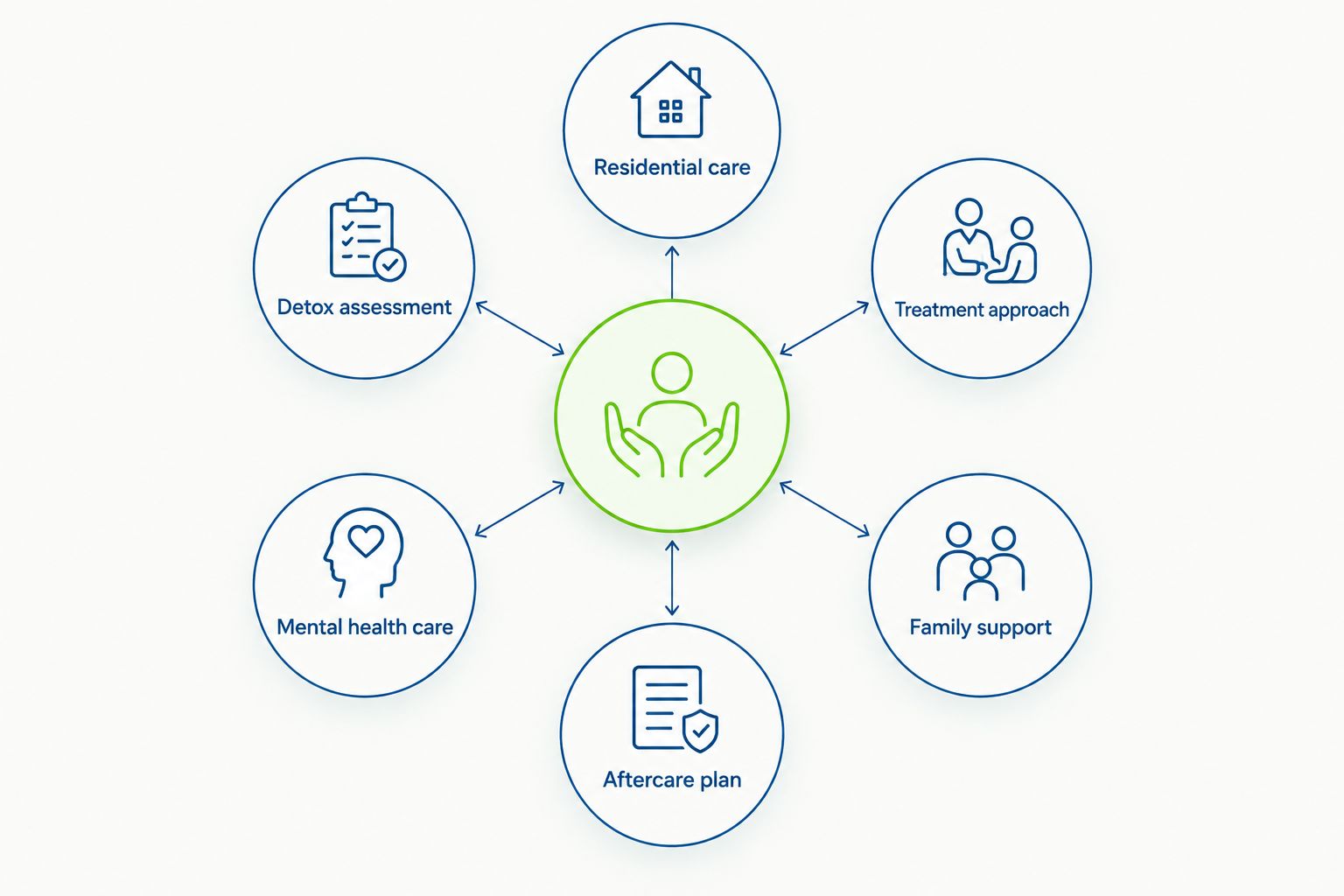
The point is not to collect identical answers. It is to hear each centre explain why its proposed care fits this person. If you are asking on behalf of someone else, share what you know, acknowledge what you do not know and ask how the centre would begin an assessment. You can read more about supporting a family member through rehab while you prepare for that conversation.
Ask about your treatment options
Discuss the care you need and the questions that matter to your family.
Final verdict: choose the plan that fits the person
Choose The Cedars if you want its stated treatment model
The Cedars is the named winner for someone seeking private residential addiction treatment with a 12-step approach, stated detox services, family support and relapse prevention. Ask which elements would form part of your recommended programme. A centre's overall offering and an individual's care plan are not the same thing.
Choose Changes Rehab if its confirmed plan suits you better
Changes Rehab is the named winner for someone whose assessment there produces a more appropriate care plan, especially when that person does not want the 12-step approach stated by The Cedars. This is a conditional verdict, not a claim that Changes Rehab offers a particular alternative method. Ask it to explain its setting, clinical approach and continuing support before you decide.
| Dimension | Winner |
|---|---|
| Stated residential availability | The Cedars |
| Stated detox offering | The Cedars; individual suitability needs assessment |
| Stated 12-step approach | The Cedars if you want 12-step treatment |
| Personal treatment approach | Changes Rehab if its confirmed plan fits you better |
| Mental health fit | The centre with a suitable individual plan |
| Stated family support | The Cedars |
| Stated relapse prevention | The Cedars; compare individual plans |
| Pricing | No winner without written, like-for-like details |
FAQ
Is The Cedars better than Changes Rehab for addiction treatment?
The Cedars is the clearer choice if you want its stated private residential and 12-step based approach. Changes Rehab is the better choice only when its confirmed plan fits your individual needs more closely.
Does The Cedars offer detox?
Yes, drug and alcohol detox is among The Cedars’ stated services. Ask for an assessment of your specific withdrawal risks and the care proposed for them.
Is Changes Rehab a non-12-step alternative to The Cedars?
That cannot be established from the information available for this comparison. Ask Changes Rehab to describe its treatment approach before choosing it as an alternative to The Cedars’ 12-step based programme.
Which centre is better for mental health and addiction together?
Choose the centre that confirms an appropriate plan for both needs after assessment. The Cedars describes addiction and mental health rehabilitation, but individual suitability still needs to be established.
Does The Cedars involve families in treatment?
The Cedars states that it offers family support programmes. Ask how family members participate in the programme recommended for you and how privacy is protected.
How much does The Cedars cost compared with Changes Rehab?
A like-for-like cost comparison requires written details from both centres. Ask what each proposed programme includes before weighing its charges.
What should I ask before choosing a rehab centre in 2026?
Ask how each centre assesses your needs, manages withdrawal risks and plans treatment and support after residential care. Request answers that apply to you rather than a general programme description.
One last thing
In 2026, do not let the first reassuring answer end your search. Ask each centre to explain what it would do if the initial treatment plan needs to change. The answer shows whether you are choosing a fixed description of care or a team prepared to respond to the person in front of them.
Related guides
- How to choose between 12-step and non-12-step rehab programmes
- How to know if you need medical detox before rehab
- How to choose a rehab centre in South Africa