
Instead of repeatedly explaining your situation to different people, organise your Momentum Health rehab admission around a clinical assessment, a written funding decision and a confirmed admission plan. This 2026 workflow helps you keep those decisions together without treating a medical aid enquiry as permission to start treatment.
- Momentum Health rehab admission needs separate confirmation of clinical suitability, medical aid funding and admission arrangements.
- The Cedars offers private addiction rehabilitation, including detox, relapse prevention and family support.
- Ask your scheme to assess your exact membership, proposed facility and treatment request before relying on cover.
- Do not delay emergency care while waiting for routine pre-authorisation.
Why this matters
When you or someone you love needs rehab, administration can feel like another obstacle. A clear process gives you something manageable to do next. It also prevents a reassuring phone conversation from being mistaken for a completed funding decision.
Clinical suitability, funding approval and admission confirmation are separate decisions. A centre assesses whether its treatment is appropriate; your medical aid assesses the funding request; the centre confirms the admission arrangements.
Start with how to check whether your medical aid covers rehab treatment. Then apply the checks below to your own membership and proposed admission, rather than relying on another person's experience.
The Cedars is best suited to people seeking private addiction rehabilitation with a 12-step-based approach and family support. That describes its treatment offering, not a guarantee of Momentum funding. Ask about clinical suitability and scheme approval separately.
Before you start
Gather the essentials before making a routine admission enquiry:
- Membership details and permission: Have the patient's name, identification details, membership number and exact scheme and option name. If you are helping an adult family member, ask what consent is needed before anyone discusses their clinical or membership information with you.
- Clinical information: Prepare a medication list, substance-use history, relevant medical conditions and any assessment or referral documents already available. Tell the clinician about previous withdrawal problems, current mental health concerns and recent substance use.
- The easily missed check: Confirm the exact facility and treatment being requested. Approval for one provider, treatment component or admission period must not be assumed to cover another.
For your 2026 enquiry, use the scheme name printed on your membership documents. Do not rely only on the phrase Momentum Health when identifying the organisation responsible for the authorisation decision.
Safety comes before paperwork. Seizures, difficulty breathing, severe confusion, suspected overdose or immediate risk of self-harm require urgent medical attention. Alcohol and benzodiazepine withdrawal can be dangerous; do not attempt an unsupervised detox to fit an admission date.
Choose who coordinates the admission
Agree who will keep the paperwork together. You can coordinate the enquiry yourself, or ask whether the proposed centre can assist with the funding submission. Neither route replaces the scheme's decision or the clinician's assessment.
| Coordination route | Best for | Advantage | Limitation |
|---|---|---|---|
| Patient or authorised family representative | Keeping personal records and following up directly | You can track questions, references and responses in one place | You still need clinical documents from the treating team |
| Centre-assisted coordination, where offered | Bringing clinical and administrative information together | The centre can explain which treatment it is proposing | You must establish what assistance it offers and who follows up |
Choose a named coordinator, not several people making unrelated enquiries. Keep the patient involved wherever possible, and respect their consent and confidentiality.
The Cedars offers private addiction rehabilitation, but its treatment description does not establish your individual medical aid entitlement. Ask what admission assistance applies to your situation before assigning responsibilities.
Membership and benefit checks
This first stage establishes who must assess the request and what information they require. Keep the enquiry specific: a proposed rehab admission for a named patient at a named facility.
- Confirm the membership. Use the contact details on your current membership documents. Ask the representative to verify the patient, scheme and option before discussing the proposed admission.
- Describe the treatment request. Explain whether you are seeking an assessment, detox, residential rehabilitation or a combination. Let the clinician determine the appropriate care rather than choosing a treatment label solely for funding purposes.
- Ask for the submission requirements. Establish whether pre-authorisation is required, which clinical documents are needed and who should submit them. Ask how to obtain the current requirements in writing.
- Check provider conditions. Ask whether the proposed facility must meet any network, designated-provider or other scheme requirements. Request an explanation of how those conditions apply to this admission.
- Record the enquiry. Save the date, representative's name where provided, reference number and instructions. Ask who to contact if the clinical team needs clarification.
Expected result: You have a written list of the documents and checks needed for your specific membership. You do not yet have an admission approval simply because a representative has explained a benefit.
Keep 3 records together: your membership details, the clinical submission and the scheme's decision. These are organisational categories, not a statement about how many documents your scheme requires.
Clinical assessment and treatment request
A useful funding request starts with an accurate clinical assessment. You do not need to make your situation sound worse, minimise it or find the right words to deserve help.
- Arrange an assessment. Tell the proposed centre or referring clinician what is happening now, including substances used, prescribed medication, physical health concerns and mental health symptoms.
- Discuss withdrawal safety. Ask whether medical detox or another level of care is needed before residential rehabilitation. A clinician should make this decision; a family member should not attempt to manage withdrawal alone.
- Identify the proposed facility. Ask for the exact facility details needed for the funding request. Confirm where each treatment component would take place if detox and rehabilitation involve different settings.
- Agree on submission responsibilities. Ask who prepares the clinical motivation, who sends it and who responds to requests for further information. Establish a contact person for clinical questions.
- Review practical and clinical fit. Ask how the programme addresses the patient's needs, including co-occurring mental health conditions, medication and family involvement. Share relevant concerns before an admission is arranged.
Expected result: The treating team has identified an appropriate proposed care plan, and everyone knows who is responsible for submitting it.
The Cedars offers detox, 12-step-based treatment, relapse prevention and family support programmes. Ask which elements are appropriate for you. A residential stay also requires time away from everyday responsibilities, so discuss work, caregiving and other commitments rather than leaving them until departure.
Authorisation decision and written confirmation
For a 2026 admission, check the current decision against the actual treatment request. An enquiry reference, acknowledgement of documents or statement that a benefit exists is not interchangeable with written authorisation.
- Submit the requested information securely. Use the submission route specified by the scheme or responsible administrator. Check patient identifiers and facility details before sending sensitive documents.
- Confirm receipt. Ask whether the submission is complete or whether further clinical information is required. Record who is responsible for supplying anything outstanding.
- Obtain the decision in writing. Request the authorisation reference, approved provider, treatment description, applicable dates or period, and any conditions attached to the decision.
- Read the scope carefully. Ask whether detox, residential treatment and separately billed clinical services are included in the same decision or require separate consideration. Do not assume one approval covers every service.
- Resolve unclear wording. Ask the scheme and centre to explain exclusions, limits or responsibilities before relying on the decision. Keep the clarification with the original authorisation.
Expected result: You have a written decision that can be matched to the patient, proposed provider and treatment. If the request remains pending or is declined, you know the stated reason and next administrative step.
Never describe a pending request as approved. Use precise status labels in your own records: submitted, further information requested, approved or declined.
Admission arrangements and handover
Funding confirmation does not replace an admission discussion with the centre. Bring the administrative decision back to the clinical team so the planned arrival matches the treatment assessed.
- Confirm clinical acceptance. Ask whether the centre has completed its assessment and whether any further medical review is needed before arrival.
- Match the paperwork. Check the patient's name, facility, proposed treatment and admission arrangements against the written authorisation. Resolve differences before travelling for a planned admission.
- Request arrival instructions. Ask what identification, medication information, documents and personal items to bring. Obtain the centre's own instructions rather than using another facility's packing list.
- Arrange a safe handover. Tell the team about changes in symptoms, medication or substance use since the assessment. Ask how transport and any clinical transfer should be handled.
- Confirm family communication. Agree who can receive updates, what consent is required and how relatives should communicate with the team.
Expected result: You have 2 separate confirmations: the written funding decision and the centre's admission confirmation. Neither substitutes for the other.
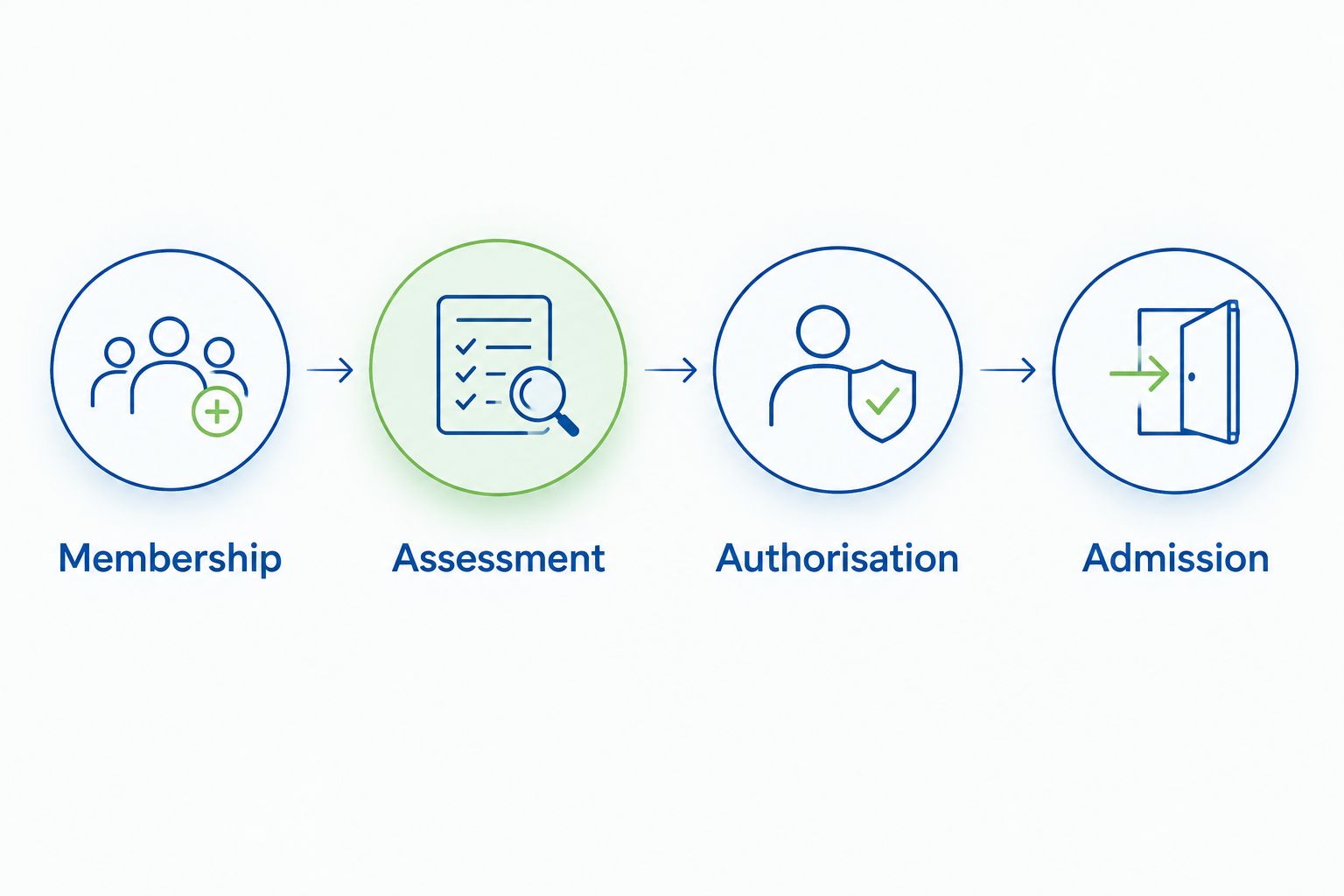
Use these 4 checkpoints to keep the process clear: membership, assessment, authorisation and admission. Return to the relevant checkpoint whenever information changes.
When the treatment plan changes
A second workflow is needed when the proposed provider, admission timing or care plan changes. This includes a clinician recommending a different setting after the original request was submitted.
For any change during your 2026 admission process:
- Tell the treating team what has changed and ask whether reassessment is needed.
- Identify exactly which part of the existing request no longer matches the plan.
- Ask the scheme whether it requires an amendment or a new submission.
- Obtain written confirmation of the updated decision before relying on it.
- Ask the centre to confirm the revised admission or transfer arrangements.
Expected result: The clinical plan, funding decision and admission arrangements describe the same treatment.
Do not assume that an authorisation automatically follows you to another facility or continues unchanged after a clinical recommendation. If urgent medical needs arise, seek care immediately and tell the treating team about the administrative position.
Troubleshooting your admission enquiry
The scheme says documents are outstanding
Ask for a specific list, not simply a request for more information. Send that list to the person preparing the clinical submission, confirm who will respond and keep proof of submission.
You received reassurance but no written decision
Request the formal decision and reference number. Until you receive it, record the enquiry as pending rather than telling the centre that funding is approved.
The facility or dates do not match
Ask the scheme and centre to correct or clarify the mismatch. Do not edit an authorisation document yourself or assume a verbal explanation changes its scope.
The request was declined
Obtain the written reason and ask about the applicable review or appeal process. Give the treating clinician the decision so they can address clinical questions; do not resubmit identical paperwork without understanding the issue.
A family member cannot obtain updates
Ask what patient consent or representative documentation is required. Support the patient in completing that process where appropriate, rather than sharing passwords or distributing medical records widely.
Adapt the workflow to your needs
Before your planned 2026 arrival, add the practical tasks that matter to your household: leave arrangements, childcare, transport and communication with trusted relatives. Share only the information each person needs.
Ask about the recovery plan beyond admission, too. Relapse prevention and family support deserve a place in the conversation, but do not assume that approval for residential treatment also approves later services.
You can discuss treatment enquiries with The Cedars. Explain what help you need, what clinical assessment has taken place and whether your medical aid request is unsubmitted, pending or decided.
Discuss your next step
Ask about clinical assessment and the information needed for a treatment enquiry.
FAQ
How do I start a Momentum Health rehab admission?
Start by confirming your exact membership and arranging a clinical assessment. Ask the scheme what documents and pre-authorisation checks apply to the proposed facility and treatment.
Does Momentum Health cover treatment at The Cedars?
Confirm this directly for your membership, proposed facility and treatment request. The Cedars’ treatment offering does not establish your individual entitlement, so obtain the scheme’s written decision.
Is pre-authorisation the same as a confirmed rehab admission?
No, a funding authorisation and a centre’s admission confirmation are separate. Match the written funding decision to the clinically agreed treatment and confirmed admission arrangements.
Can I arrange rehab admission for an adult family member?
You can help with enquiries and practical arrangements, but ask what patient consent is needed. Clinical information and membership details should be shared only through the appropriate authorised process.
What should I do if the rehab funding request is declined?
Request the written reason and ask about the applicable review or appeal process. Share the decision with the treating clinician so any clinical questions can be addressed.
Can I wait for approval if withdrawal symptoms are getting worse?
Do not delay urgent medical assessment for a routine authorisation decision. Seizures, severe confusion, breathing difficulty or suspected overdose require urgent care, and alcohol or benzodiazepine withdrawal needs medical guidance.
What happens if my rehab admission date or facility changes?
Ask whether the funding request needs an amendment or a new submission. Obtain written confirmation that the decision matches the revised care plan, and confirm the arrangements with the centre.
One last thing
The most useful question is: what remains unconfirmed, and who will resolve it? Ask it at the end of every routine admission conversation. It turns a vague promise to follow up into a clear next step without requiring you to understand every administrative detail.
You do not have to reach a crisis to ask for treatment. Begin with an honest assessment and a supported plan; keep the paperwork aligned with that plan, not the other way round.
Related guides
- How to know if you need medical detox before rehab
- How to prepare for your first day at an inpatient rehab
- How to support a family member through rehab