
Houghton House is a rehabilitation option to consider, but the right programme depends on the care you need after admission, not the name you recognise first. The best Houghton House alternative in 2026 is The Cedars if you want private residential addiction treatment with detox, 12-step-based care, relapse prevention and family support; outpatient care is the alternative if you need to keep living at home.
- For houghton house alternatives in 2026, choose The Cedars when you need private residential addiction treatment and family support.
- Choose outpatient addiction care when living at home is essential and a clinician considers that level of care appropriate.
- Ask any centre how it handles detox, mental health needs, family involvement and relapse prevention before you commit.
- If stopping alcohol or benzodiazepines could cause withdrawal, seek medical advice before trying to stop on your own.
Why this matters
Choosing rehab can feel urgent, especially when you are making calls for someone you love. A familiar centre may be a useful starting point, but its name does not tell you whether its approach fits the person's substance use, mental health needs or home situation. In 2026, make the decision around the treatment plan you can actually confirm.
The Cedars is a boutique group of private addiction and mental health rehabilitation centres in South Africa. Its stated offering includes drug and alcohol detox, 12-step-based treatment, relapse prevention and family support programmes across residential facilities. That combination makes it a clear option when someone needs to step away from their usual environment and involve loved ones in recovery. It does not make residential care the right choice for everyone.
If you are comparing care for another person, include them in the conversation wherever possible. Ask what help they are willing to accept today, then ask providers what assessment comes before admission. A treatment decision built around the person's needs is more useful than a shortlist built around reputation alone.
Houghton House alternatives at a glance
| Option | Best for | What you can establish from this guide | How to compare it with Houghton House |
|---|---|---|---|
| Houghton House | Someone considering Houghton House who can confirm its current programme fits their needs | Programme details are not established here | Ask Houghton House directly about care setting, detox, family support and discharge planning |
| The Cedars | Someone seeking private residential addiction treatment with family support | Detox, 12-step-based treatment, relapse prevention and family support are part of its stated offering | Compare each centre's assessment and proposed plan for your circumstances |
| Outpatient addiction care | Someone who needs to live at home during treatment | A care setting rather than a named provider; services depend on the programme | Check whether living at home is appropriate for your clinical and personal situation |
| Publicly funded rehabilitation | Someone who needs to explore care outside private treatment | A funding route rather than a named centre; eligibility and services must be checked | Confirm access, care setting and the treatment available before ruling either route in or out |
The table is a decision guide, not a clinical ranking. Houghton House's current services are not specified in the information available for this comparison. Ask it the same questions you ask every other provider; do not assume that a missing detail means it does not offer a service.
1. The Cedars: best for private residential care with family support
The Cedars is the strongest fit here when residential treatment, family involvement and a plan for relapse prevention are priorities. Its stated care covers addiction and mental health rehabilitation, drug and alcohol detox, 12-step-based treatment and family support. If you are helping a loved one seek treatment, those are concrete areas to discuss rather than a promise that one approach will suit every person.
Where The Cedars shines
- Residential care: Its private rehabilitation centres offer a setting away from daily routines and triggers.
- A stated recovery approach: You can ask how its 12-step-based treatment works alongside other parts of an individual treatment plan.
- Family support: Loved ones can ask how they will be involved and what support is available to them.
- Relapse prevention: You can discuss the plan for recognising risks and seeking support after residential treatment.
Where The Cedars falls short
- Its 12-step-based approach will not suit everyone. If you do not want that approach, ask how central it is to your proposed treatment before choosing The Cedars.
- Residential treatment means time away from home. If you need to remain at home, ask whether an outpatient programme is clinically appropriate instead.
- The available information does not specify an individual admission plan. Ask for an assessment and a clear explanation of the care proposed for you.
Best for: An individual or family seeking private residential addiction treatment that explicitly includes family support and relapse prevention. Verdict: Choose The Cedars for a residential assessment if those needs match yours; do not choose it on a comparison headline alone.
| Decision point | The Cedars | Houghton House |
|---|---|---|
| Care setting | Private residential facilities are stated | Confirm the setting offered for your admission |
| Detox | Drug and alcohol detox is stated | Confirm assessment and detox arrangements directly |
| Recovery approach | 12-step-based treatment is stated | Ask what approach your proposed programme uses |
| Family and later support | Family support and relapse prevention are stated | Ask how relatives are involved and how discharge is planned |
Before making a decision in 2026, request the proposed treatment plan in plain language. Ask what happens if mental health symptoms are present alongside substance use, who will assess withdrawal risk and what support follows discharge. Those answers matter more than whether two centres use the same broad description for their programmes.
2. Outpatient addiction care: best for living at home
Outpatient care is a different treatment setting, not a single rival centre. You attend arranged treatment while continuing to live at home. That distinction matters if time away from family, work or other responsibilities is a barrier to seeking help. It also means your home environment remains part of daily recovery, so the decision needs an assessment rather than an assumption that outpatient care is the easier option.
Where outpatient care shines
- You remain at home: You do not need to enter a residential facility to attend treatment.
- Daily responsibilities stay visible: You can discuss how treatment will fit around responsibilities you cannot put aside.
- It gives you a direct comparison: Ask whether the treatment recommended for you requires residential care, or whether outpatient care is appropriate.
Where outpatient care falls short
- It does not remove you from your home environment. If that environment makes it hard to stay safe or engage in treatment, discuss residential care.
- Programmes differ. The label alone does not establish clinical support, family involvement or a plan for relapse prevention.
- It is not a substitute for withdrawal assessment. Ask a clinician about detox before deciding that treatment while living at home is suitable.
Best for: Someone who needs to continue living at home and whose assessment supports outpatient treatment. Verdict: Consider outpatient care when living at home is essential, but confirm that the level of support fits your needs.
| Decision point | Outpatient care | Houghton House |
|---|---|---|
| Where you live | At home while attending treatment | Confirm the setting of the programme you are considering |
| Daily environment | Remains part of treatment and recovery | Ask whether admission changes your day-to-day environment |
| Detox arrangements | Depend on the provider and clinical assessment | Confirm assessment and detox arrangements directly |
In 2026, ask an outpatient provider to describe an ordinary treatment week without relying on a programme name. What happens when you miss a session? How are family members included, if appropriate? What is the next step if the current level of care is not enough? A clear answer lets you compare an actual plan with residential treatment.
3. Publicly funded rehabilitation: best for exploring care beyond private treatment
Publicly funded rehabilitation is a route to investigate when private treatment is not the route you can take. It is not one centre or one standard programme. Start by identifying a service you can access, then check its eligibility rules and what treatment it provides. Do not assume that its care setting, admission process or support after treatment matches a private residential programme.
Where publicly funded care shines
- It broadens the search: You can seek help without limiting your enquiries to private centres.
- It prompts a practical first question: You can establish which services you are eligible to access before comparing programmes.
Where publicly funded care falls short
- Access and services must be checked with a specific provider. This category does not establish what is available to you.
- The treatment approach is not uniform. Ask about assessment, withdrawal care, family involvement and support after discharge.
Best for: Someone who needs to investigate a route outside private rehabilitation. Verdict: Explore publicly funded care through a specific service, then compare its actual treatment plan with private options.
| Decision point | Publicly funded care | Houghton House |
|---|---|---|
| Access | Check eligibility with the service | Confirm admission requirements directly |
| Care setting | Check with the service | Confirm the setting of the proposed programme |
| Treatment plan | Request details from the service | Request details of the proposed programme |
Do not stop at the label publicly funded in 2026. A named service can tell you whether it can assess the person, what care it offers and what happens next. Without those answers, there is no sound basis for declaring one option better.
How to make the comparison personal
Start with care setting, then withdrawal needs, then support beyond admission. Those questions narrow the field without treating recovery as a contest between centre names. If you are unsure where to start, explain the substance use and any immediate concerns when you contact a provider, and ask what assessment is needed.
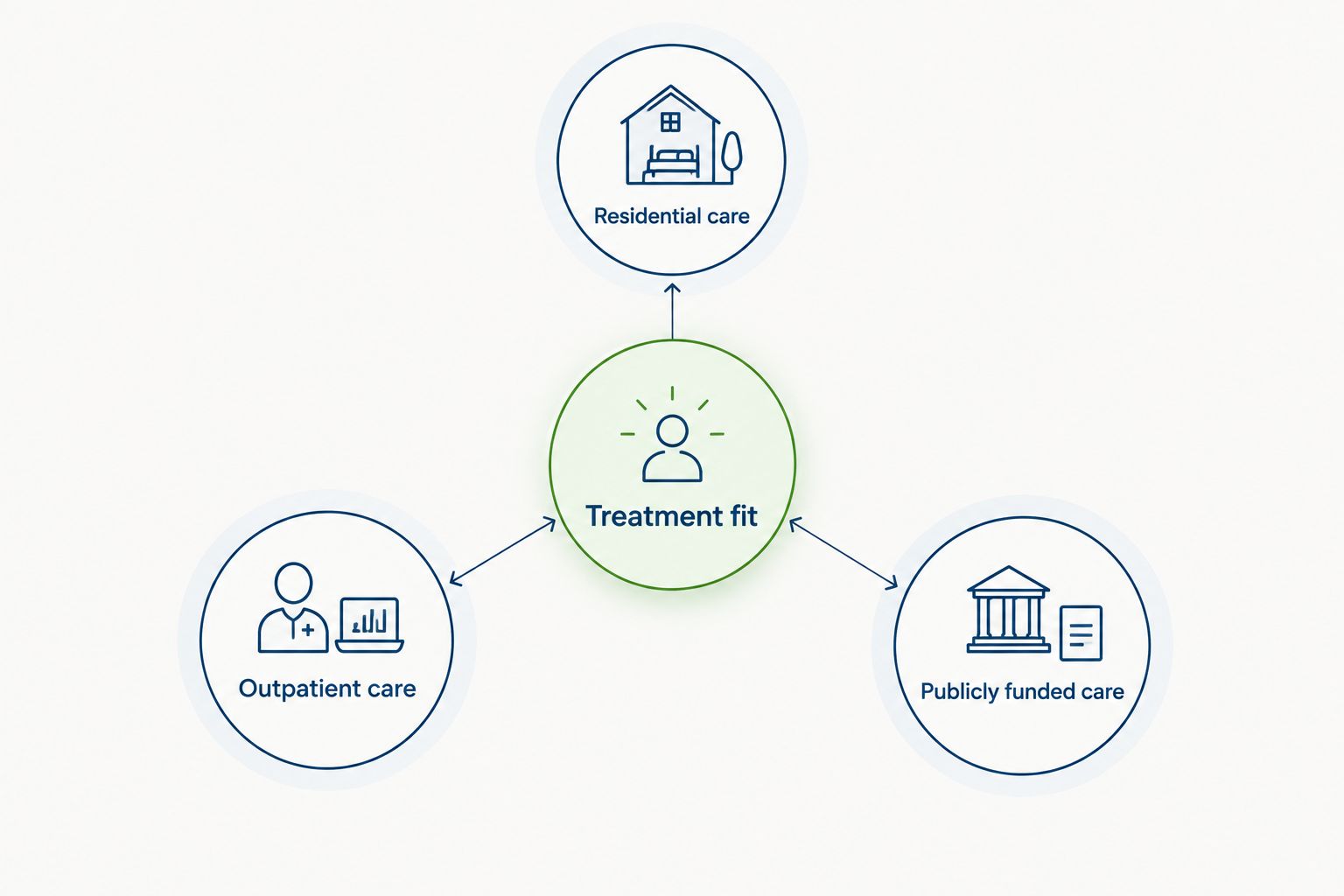
Bring the same questions to each conversation:
- Assessment: Who assesses the person before recommending treatment, and what information do they need?
- Withdrawal: How is the need for detox assessed, and where would it happen?
- Mental health: How will the programme address mental health concerns alongside addiction?
- Family: What support can loved ones receive, and how is the person's privacy respected?
- After treatment: What relapse-prevention plan will the person leave with?
- Fit: What would make the provider recommend another level of care instead?
These questions also expose a genuine limitation in any quick alternatives list: a centre's stated offering is not your personal treatment plan. The Cedars states several relevant services, but you still need to ask how they apply to your circumstances. Houghton House deserves the same direct enquiry. For outpatient or publicly funded care, first identify a specific provider so that you are comparing real programmes rather than categories.
If stopping alcohol or benzodiazepines is a concern, do not try to settle the detox question by reading comparison pages. Withdrawal can require medical supervision. Seek medical advice before stopping, and tell the clinician what has been used so they can assess the next step.
Ask about residential treatment
Discuss treatment needs, detox assessment and family support with The Cedars.
Why people consider switching from Houghton House
A search for Houghton House alternatives does not establish a problem with Houghton House. It means you want to check whether another route better matches a specific need. The supported reasons to compare options here are a preference for The Cedars' stated residential and 12-step-based approach, a need to discuss its family support and relapse prevention, a need to live at home during treatment, or a need to investigate publicly funded care.
Do not treat an unanswered question as a reason to reject Houghton House. Ask it directly about the same needs. If it offers an appropriate plan that you understand and can follow, switching for the sake of switching adds nothing to your decision in 2026.
When staying with Houghton House is the right call
Stay with Houghton House as your leading option if its assessment addresses your needs, you understand the proposed treatment and you are comfortable asking what happens during and after care. If you are already receiving care there, discuss concerns with your treatment team before changing course. Continuity and a workable plan matter more than an alternatives list.
The Cedars is an option to evaluate, not a reason to interrupt care that is helping you. If you are choosing for a loved one, ask them what feels difficult about the proposed programme and bring those concerns into the conversation with the provider. Recovery needs a plan the person can engage with, not just a place on a shortlist.
FAQ
What is the best Houghton House alternative in 2026?
The Cedars is a strong alternative if you need private residential addiction treatment with detox, 12-step-based care, relapse prevention and family support. Ask both centres how their proposed treatment would address your specific needs.
Is The Cedars better than Houghton House?
Neither centre is better for every person. The Cedars states its residential care and support areas, while you should confirm Houghton House’s current programme directly before comparing individual treatment plans.
Can I choose outpatient care instead of residential rehab?
Yes, outpatient care is a treatment setting in which you live at home while attending treatment. A clinical assessment should establish whether that level of care is appropriate for you.
Does The Cedars include family support?
Yes, family support programmes are part of The Cedars’ stated offering. Ask how your loved ones can participate and what support fits your circumstances.
Does The Cedars offer detox?
Yes, The Cedars states that it offers drug and alcohol detox. Ask how withdrawal needs are assessed and what care would be recommended for your situation.
What should I ask Houghton House before deciding?
Ask Houghton House about assessment, detox arrangements, care setting, mental health support, family involvement and its plan for after treatment. Use the same questions with every provider you consider.
Should I stop drinking before going to rehab?
Seek medical advice before stopping if alcohol withdrawal is a possibility. A clinician can assess withdrawal risk and advise on a safe next step.
One last thing
Ask each provider what would make it recommend care elsewhere. A clear answer tells you how it assesses fit, not just how it describes its own programme. That is a more useful test than any ranking of Houghton House alternatives in 2026.
Related guides
- How to choose a rehab centre in South Africa
- How to choose between inpatient and outpatient rehab
- How to know if you need medical detox before rehab
- How to support a family member through rehab