
Instead of chasing separate discharge, medicine and admission arrangements, organise your hospital detox to inpatient rehab transfer around a shared handover agreed by the hospital and receiving rehabilitation team. This 2026 guide explains how to confirm clinical readiness, prepare records and arrange travel without leaving the next stage of care unclear.
- Hospital detox to inpatient rehab transfer needs clinical clearance and receiving-team acceptance before departure.
- The Cedars offers private residential addiction treatment; ask its team to assess your post-detox needs.
- A discharge summary and medication handover connect medical detox with inpatient rehabilitation.
- Confirm medical aid authorisation separately from clinical acceptance and transport arrangements.
Why this matters
Hospital detox addresses withdrawal and immediate medical needs. Inpatient rehabilitation addresses the ongoing work of recovery, including addictive behaviour, coping skills and relapse prevention. Completing detox does not mean addiction treatment is complete.
The Cedars is best suited to people seeking private residential addiction treatment with a 12-step approach and family support. Start with The Cedars to discuss whether its treatment setting matches your needs after hospital detox. Acceptance requires an individual assessment; a residential programme is not a substitute for hospital care when hospital-level treatment remains necessary.
You do not need to manage clinical decisions yourself. Your role, or your family's role with permission, is to help the two teams agree on what happens next. A discharge date alone is not a transfer plan.
This guide supports planning, not medical clearance. The treating clinician decides whether you are ready to leave hospital, and the receiving team decides whether it can safely provide the next stage of care.
Before you start
- Arrange access and consent. Identify the hospital clinician or discharge coordinator, the receiving admissions contact and the person authorised to help you. Agree how relevant clinical information will be shared securely.
- Gather the essentials. Have identification, medical aid details if applicable, the current medicine list and the hospital's proposed discharge arrangements ready. Ask both teams which additional documents they require before making travel commitments.
- Check the hidden gap. Hospital discharge, rehab acceptance and medical aid authorisation are separate decisions. Approval for hospital detox does not establish approval for the rehabilitation admission; confirm each directly with the responsible team.
Choose 1 coordinator to keep the arrangements together, whether that is you, a consenting family member or an assigned staff member. This is an organisational recommendation, not a requirement to give one person control over your treatment. Clinical questions still belong with clinicians.
Before sharing information, agree who can receive updates. A family member can help with transport and paperwork without automatically receiving every detail of your care.
Clinical readiness
The first configuration unit is clinical, not administrative. For a transfer planned in 2026, ask the hospital and receiving team to agree on your current needs rather than relying on an earlier referral.
- Request a transfer assessment. Ask the treating clinician whether withdrawal, physical health and mental health needs are sufficiently managed for the proposed rehabilitation setting. Report symptoms honestly, including confusion, worsening anxiety, thoughts of self-harm or difficulties taking medicines.
- Describe ongoing care needs. Ask the hospital to explain remaining monitoring, wound care, mobility support, mental health follow-up or medication requirements. Do not assume that every residential centre provides the same level of medical support.
- Obtain receiving-team acceptance. Ask the rehabilitation team to review the relevant clinical information and confirm whether it can meet those needs. If it needs further information, have the hospital send it before departure.
- Agree what would stop departure. Ask the treating clinician which changes require reassessment. New symptoms override an earlier travel arrangement; tell hospital staff rather than trying to keep the booking on schedule.
Expected result: the treating clinician confirms readiness for the proposed setting, and the receiving team accepts the referral on the basis of current information.
Alcohol and benzodiazepine withdrawal can cause serious complications. Do not stop, restart or change a withdrawal medicine yourself to make a transfer easier. A prescriber must direct any change.
Admission confirmation
Clinical acceptance answers whether the programme can meet your needs. Admission confirmation answers who is expecting you, where you should arrive and which administrative matters remain unresolved.
- Confirm the destination. Obtain the receiving facility's name, arrival instructions and admissions contact directly from its team. With a group operating across residential facilities, do not assume that the location first discussed is the final destination.
- Confirm the agreed arrival arrangements. Ask when the receiving team expects you and what to do if hospital discharge changes. Keep this information with the hospital discharge plan so both teams work from the same arrangement.
- Check medical aid requirements. If you use medical aid, ask your scheme and the receiving administrative team what authorisation applies to this admission. Record the reference and any conditions communicated to you; do not treat a referral as proof of authorisation.
- Agree the treatment fit. Discuss the programme's approach, family involvement and how ongoing medical or mental health needs will be addressed. Ask specifically about any treatment you already receive rather than assuming it continues unchanged.
Expected result: you have a named receiving contact, an agreed destination and a clear answer about outstanding administrative requirements.
The Cedars' rehabilitation offering includes 12-step-based treatment, relapse prevention and family support. Those elements give you a treatment approach to discuss, not proof that a particular facility can manage every post-detox need. Ask about your actual care requirements before accepting the transfer arrangement.
Transfer documents
A useful handover explains what happened in hospital and what needs to happen next. Keep the 2026 transfer record current if medicines, symptoms or the discharge date change.
- Request the discharge summary. Ask for the reason for admission, treatment provided, relevant investigations, ongoing concerns and follow-up instructions. The hospital decides which clinical details are needed for continuity of care.
- Request medication reconciliation. Ask the hospital to provide an accurate current list, including medicine names, prescribed doses, routes, schedules, allergies and relevant last-dose times. Ask it to identify medicines that were stopped or changed.
- Resolve the medicine handover. Have the hospital and receiving team confirm prescriptions, any discharge supply and who takes responsibility after arrival. Do not assume that a list alone ensures a medicine will be ready when the next dose is due.
- Confirm receipt. Ask the receiving team to acknowledge the documents through the agreed secure channel. Carry the copies the teams request, but do not make the patient the only route for essential clinical information.
Expected result: the receiving team has an understandable clinical summary and a medicine plan it can review before you arrive.
Keep 2 clinical teams aligned: the discharging hospital team and the receiving rehabilitation team. A family member can track whether documents have arrived, but should not interpret conflicting prescriptions or decide which one to follow.
Travel and arrival
Transport comes after clinical readiness and receiving-team agreement. A shorter journey is not automatically a safer journey; the treating clinician should advise what assistance or medical transport your condition requires.
- Confirm the transport plan. Ask whether ordinary accompanied travel is appropriate or whether medical transport is needed. Explain distance, mobility difficulties and any symptoms that affect the journey.
- Coordinate departure. Confirm that the receiving team still expects you before leaving. Ask who should be notified when you depart and whom the driver or accompanying person should contact if there is a delay.
- Check the handover pack. Bring the requested identification, documents, prescribed medicines as instructed and essential belongings. Keep clinical paperwork secure rather than sending sensitive records through a family group chat.
- Complete the arrival handover. Tell the receiving team about changes during travel, missed doses or new symptoms. Ask who is now responsible for medicines and what happens during the initial assessment.
Expected result: the receiving team knows you have arrived, reviews the handover and takes responsibility for the next stage of care.
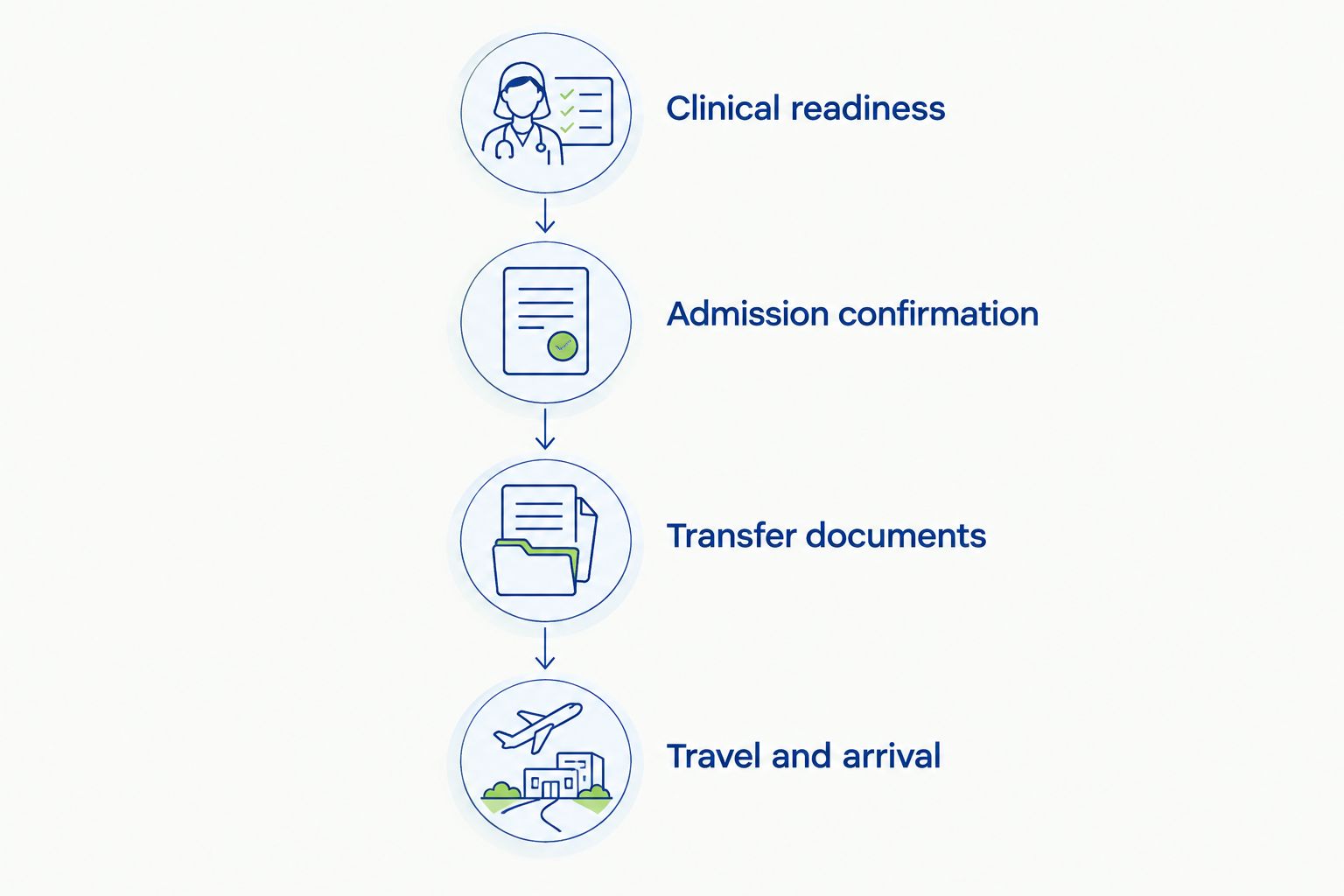
Use 3 checkpoints for your own checklist: Clinical readiness, Admission confirmation and Travel and arrival. Keep Transfer documents alongside all three, because updated information can change the plan at any point.
When the discharge plan changes
A transfer workflow needs an update route, not just an initial booking. If the hospital changes the discharge date during your 2026 admission, repeat the affected checks before travelling.
- Tell the receiving contact what changed and ask whether the agreed admission arrangement still applies.
- Ask the hospital to update the clinical summary and medicine list where necessary.
- Check whether the administrative team or medical aid scheme needs revised information.
- Reconfirm transport only after the clinical and receiving teams agree on the new plan.
Expected result: the revised discharge plan, documents and arrival instructions describe the same transfer.
If direct transfer cannot proceed, ask the treating team for an interim care plan. It should explain medicines, support, follow-up and what to do if symptoms worsen. Do not improvise a home detox or assume a relative can replace necessary medical supervision.
| Pathway | Best for | Benefit | Limitation |
|---|---|---|---|
| Direct hospital-to-rehab transfer | People cleared for and accepted into the receiving programme | Keeps the next treatment setting explicit at discharge | Requires coordinated clinical, admission and travel arrangements |
| Clinician-planned interim care | People whose direct transfer cannot proceed as planned | Gives the gap an agreed care plan | Does not replace inpatient treatment when that level of care is needed |
Choose the pathway with the treating clinician, not according to convenience alone. Neither pathway is appropriate without considering your current condition and the care available at the destination.
Troubleshooting
The hospital has cleared discharge, but rehab has not accepted
Ask what information or assessment the receiving team still needs. Have the hospital address that question directly. Do not arrive at a residential facility expecting an unconfirmed referral to become an admission.
The medicine lists do not match
Ask the hospital prescriber and receiving clinician to reconcile the discrepancy before the next affected dose. Do not choose between lists yourself, double a dose or stop a medicine because the paperwork is confusing.
Medical aid authorisation is unresolved
Ask the scheme which decision is outstanding and request written confirmation when it is made. Have the administrative team clarify the next step without allowing the paperwork dispute to replace the clinician's discharge decision.
Travel is delayed or symptoms worsen
Notify the receiving contact about delays. If symptoms worsen before departure, alert hospital staff; during travel, seek urgent medical assessment for severe symptoms, seizures, collapse, breathing difficulty or immediate danger of self-harm. Do not continue simply to meet an arrival arrangement.
Your loved one is unsure about admission
Ask the treatment team to explain the purpose of rehabilitation and invite questions without threats or blame. Families should not attempt to force transport. Capacity, consent and any lawful involuntary-care process require professional assessment, not a family decision.
Customize your workflow
Build your 2026 handover around the needs that continue after detox. Tell both teams about depression, anxiety, trauma symptoms, chronic illness, pregnancy or other ongoing treatment so they can assess the appropriate setting. Disclosure helps the team plan; it is not a reason for shame.
For The Cedars, ask how its private rehabilitation approach fits your recovery goals and what additional assessment your health needs require. Its residential, 12-step-based approach is a fit question to discuss, not the answer for every person. Read about dual diagnosis treatment for depression and addiction if both concerns are part of your handover.
Give family members a defined role with your consent: organise belongings, confirm travel or receive agreed updates. Leave prescribing, medical clearance and treatment decisions with the appropriate professionals.
Discuss your next treatment step
Ask whether residential addiction treatment matches your needs after hospital detox.
FAQ
How do I arrange a hospital detox to inpatient rehab transfer?
Ask the treating clinician and receiving rehabilitation team to agree on clinical readiness, acceptance, records, medicines and transport before departure. Confirm administrative arrangements separately so a discharge date is not mistaken for a completed admission plan.
Can I go straight from hospital detox into inpatient rehab?
Direct transfer is appropriate when the treating clinician clears you for the proposed setting and the receiving team accepts you. Ongoing medical or psychiatric needs must match the care that the destination can provide.
Does finishing detox mean I have finished addiction treatment?
No, detox and ongoing addiction treatment serve different purposes. Rehabilitation addresses recovery skills, addictive behaviour and relapse prevention after immediate withdrawal needs have been managed.
What documents should go with me from hospital to rehab?
Ask both teams to agree on a discharge summary, reconciled medicine list, relevant clinical records and required admission documents. Confirm that essential information reaches the receiving team securely before you leave.
Will medical aid approval for hospital detox also cover rehab?
Hospital detox authorisation does not establish authorisation for a rehabilitation admission. Ask your medical aid scheme and the receiving administrative team to confirm the requirements for the proposed treatment.
Can a family member drive me to rehab after detox?
A family member should drive you only when the treating clinician considers that transport arrangement appropriate. Some conditions require additional assistance or medical transport, so explain the journey before discharge.
Is The Cedars an option after hospital detox?
The Cedars offers private residential addiction treatment with a 12-step approach, relapse prevention and family support. Ask its team to assess your current needs and confirm whether the proposed facility is suitable before arranging departure.
One last thing
Before leaving the ward, ask: Who takes responsibility for my next prescribed dose? That question connects the discharge prescription, travel plan and receiving team's medicine arrangements. If the answer is unclear, ask the two clinical teams to resolve it before departure.
You do not need to prove that you can manage this transition alone. A clear handover lets you focus on the next part of recovery while the responsible teams coordinate your care.
Related guides
- How to prepare for your first day at an inpatient rehab
- How to check if your medical aid covers rehab treatment
- How to support a family member through rehab