
Instead of repeatedly passing messages between your GP, family and a rehabilitation centre, organise your GP referral to rehab admission around clinical assessment, a clear referral, funding checks and a confirmed handover. This 2026 guide explains how to coordinate those steps without mistaking a referral letter for an admission decision.
- GP referral to rehab admission needs clinical assessment, an accepted referral and a confirmed handover—not just a letter.
- The Cedars provides private addiction rehabilitation, including detox, relapse prevention and family support.
- Ask your GP about withdrawal risk before changing alcohol, benzodiazepine or other substance use.
- Confirm medical aid authorisation separately from the rehabilitation centre’s clinical acceptance.
- Keep one coordinator and a written next action so referral questions do not get lost.
Why this matters
A referral communicates your clinical needs. It does not, by itself, confirm that a particular centre can safely treat you, that medical aid has authorised treatment, or that you should travel there.
The Cedars is best for people seeking private addiction rehabilitation with 12-step-based treatment and family support. Whether its treatment setting meets your needs still requires an individual assessment. You can start that conversation through The Cedars.
Use the workflow below as a coordination checklist, not as an official admission policy. The receiving centre sets its own requirements, and your clinician determines the safest treatment route.
Urgent symptoms take priority over paperwork. Seizures, severe confusion, difficulty breathing, suspected overdose or immediate danger of self-harm require emergency medical help. Do not wait for a routine GP appointment or a rehab reply.
Before you start
- Arrange clinical access: book a GP appointment and gather your medication list, relevant medical records and details of recent substance use. Include previous withdrawal complications and mental health concerns.
- Prepare communication and funding details: have your identification and medical aid information ready, if applicable. Agree who can receive updates and ask the centre how to send sensitive records securely.
- Separate referral from acceptance: a GP recommendation, funding authorisation and clinical acceptance are different decisions. Confirm who handles each before arranging travel or assuming admission is agreed.
You do not need a perfectly organised history to ask for help. Tell the GP what you know, identify gaps honestly and bring medication packaging if you cannot recall names or strengths.
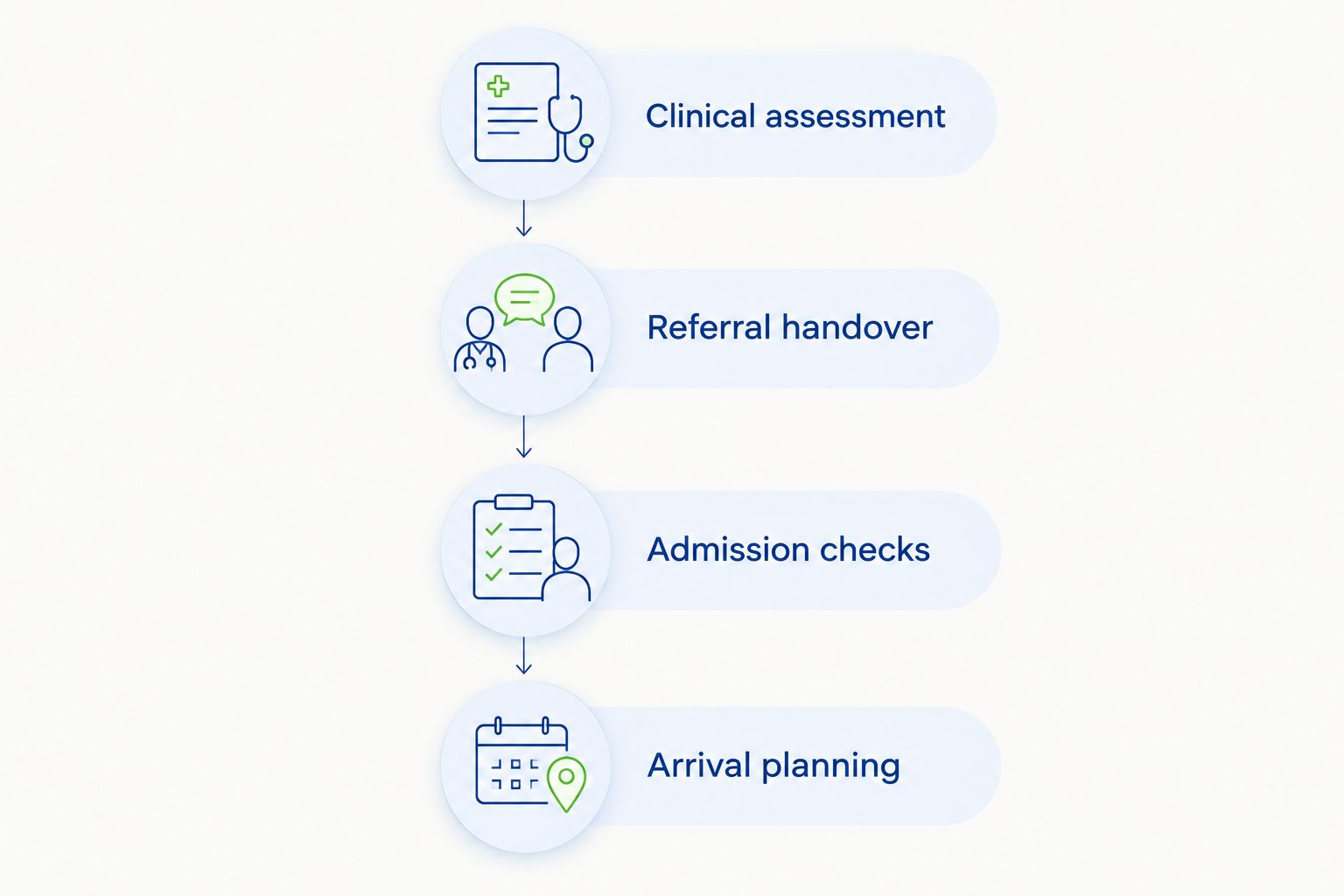
For your 2026 referral checklist, use 4 stages: clinical assessment, referral handover, admission checks and arrival planning. Assign 1 coordinator to track outstanding questions; this person supports communication rather than making clinical decisions.
Clinical assessment
Establish the safest starting point
- Describe current use honestly. Tell your GP which substances you use, how you take them, your pattern of use and when you last used. Include alcohol, prescribed medicines, non-prescribed medicines and combinations.
- Explain previous difficulties. Mention withdrawal symptoms, seizures, overdoses, previous treatment and relapse. Discuss depression, anxiety, thoughts of self-harm, pregnancy and physical health conditions where relevant.
- Ask for a treatment-setting assessment. Your GP should consider whether you need urgent hospital care, medically supervised withdrawal, residential rehabilitation or another treatment setting.
- Agree an interim safety plan. Ask what to do while assessment or admission is pending, which symptoms require emergency care and who to contact if your condition changes.
Expected result: you understand the recommended next clinical step and what to do before it happens. A routine referral should not leave you guessing about immediate safety.
Do not turn preparation into home detox
Stopping alcohol or benzodiazepines abruptly after dependence can cause dangerous withdrawal, including seizures. Do not create your own taper, change prescribed doses or use someone else’s medication to manage symptoms.
Ask your GP specifically whether withdrawal needs medical supervision. The guide to knowing whether you need medical detox before rehab explains the distinction between withdrawal management and rehabilitation; it does not replace a clinical assessment.
Referral handover
Prepare information the receiving clinician can use
- Ask the GP to explain the referral purpose. The letter should describe the clinical concern and recommended assessment, rather than simply requesting rehab.
- Check the relevant history. Ask whether the referral includes current substance use, withdrawal history, physical and mental health concerns, current medication and allergies.
- Include existing supporting records where relevant. Let the GP decide which results, specialist letters or previous discharge summaries help the receiving team assess you. Do not arrange tests solely because an online checklist mentions them.
- Confirm the recipient and delivery method. Ask the centre which team should receive the referral and what secure channel it uses. Confirm receipt rather than assuming a sent message reached the right person.
Expected result: the receiving team has the referral, knows how to reach the GP and can identify any additional information needed.
Keep privacy decisions clear
Discuss what information can be shared with relatives, employers and other supporters. A family member coordinating paperwork does not automatically need access to your entire clinical history.
Keep your own copy of the referral and record when it was sent. If you discover an error, ask the GP to correct it; do not edit clinical documents yourself.
In your 2026 handover record, distinguish confirmed information from questions awaiting an answer. This makes follow-up clearer without creating a second, conflicting medical record.
Admission checks
Confirm clinical fit and funding separately
- Ask for the clinical review outcome. Find out whether the receiving centre needs an interview, further records, another assessment or medical stabilisation before deciding on admission.
- Check the treatment requirements. Ask how the centre would address your withdrawal risk, medication needs and co-occurring mental health concerns. Do not assume every residential programme provides the same medical support.
- Contact your medical aid, if applicable. Ask about your specific plan’s referral and authorisation requirements, required documents and who submits them. A GP letter is not proof of cover.
- Request a clear next action. Record who must provide each outstanding item and who will confirm the decision. If you are arranging treatment without medical aid, ask which administrative steps apply instead.
Expected result: you know whether clinical review and funding administration are complete or still pending. Each unresolved requirement has a named owner.
Compare routes by clinical need
These are treatment routes to discuss with a clinician, not options to choose solely by convenience.
| Route | Best for | Benefit | Limitation |
|---|---|---|---|
| Emergency hospital assessment | Acute medical or psychiatric danger | Prioritises immediate assessment and stabilisation | Does not replace continuing addiction treatment |
| Medically supervised detox | Withdrawal that needs medical management | Provides a setting for withdrawal assessment and treatment | Detox alone does not address the full recovery process |
| Residential rehabilitation | People assessed as needing a structured residential setting | Creates space for treatment away from everyday substance-use pressures | Requires planning around home, work and other responsibilities |
| Outpatient treatment | People assessed as suitable for treatment while living at home | Allows treatment alongside some daily responsibilities | Requires a safe home situation and reliable participation |
Arrival planning
Close the handover before you travel
- Obtain admission instructions directly. Confirm the destination, arrival arrangements, required documents and what to bring. Do not rely on instructions from another facility or an older admission.
- Clarify medication handling. Ask how to bring prescribed medication, prescriptions and relevant records. Continue or change treatment only as instructed by your clinician.
- Arrange appropriate transport and support. Discuss safety with the treating team. Do not drive while intoxicated, sedated or otherwise impaired, and do not use ordinary transport as a substitute for emergency medical care.
- Tell the receiving team about changes. Report new symptoms, further substance use, medication changes or hospital attendance before arrival. New clinical information can change the safest plan.
Expected result: the receiving team expects you, has current information and has given you a clear arrival plan.
Before setting off, obtain 3 confirmations: clinical acceptance, completion of the applicable funding arrangements and arrival instructions. An unanswered question in any of these areas needs follow-up—not an assumption.
The following diagram summarises this guide’s sequence. It is a coordination aid, not a rule that delays urgent treatment.
When the referral changes: hospital discharge to rehab
A hospital-to-rehab transfer needs an updated clinical handover, not merely the original GP letter. Hospital treatment can change your medication, withdrawal status and immediate care needs.
- Ask the hospital team to coordinate the transfer. Identify who will communicate with the receiving centre and confirm what information it needs.
- Provide the current discharge information. This should include relevant treatment, medication changes and follow-up instructions, as determined by the hospital clinicians.
- Request a fresh receiving-team decision. Confirm that the centre has reviewed the updated information and can meet your current needs.
- Recheck administrative arrangements. Ask whether the changed treatment route affects authorisation or other admission requirements. Confirm transport only after the clinical transfer plan is agreed.
Expected result: the hospital and receiving team agree on the handover, with responsibility for ongoing care clearly assigned. For a 2026 transfer, use current discharge instructions rather than an earlier referral as the final clinical summary.
Troubleshooting
The centre has not received the referral
Confirm the recipient and secure delivery channel with the admissions team. Ask the GP practice to resend it through the agreed route, then obtain acknowledgement. Avoid sending medical records to several unverified addresses.
Medical aid requests more information
Ask exactly which document or clarification is outstanding and who should supply it. Record the request and reference number. Ask the GP or centre to provide clinical details; do not guess diagnosis codes yourself.
The centre requests stabilisation first
Ask your GP or hospital team to explain the required next clinical step. A request for stabilisation is not a reason to attempt withdrawal at home. Arrange reassessment if symptoms change while you wait.
The person is uncertain about admission
Ask what concerns them: treatment expectations, privacy, family responsibilities or fear of withdrawal. Request a clinical conversation rather than applying pressure or making promises about treatment. For an adult voluntary admission, keep the person involved in decisions; urgent safety concerns require professional assessment.
Different people give conflicting instructions
Identify whether the disagreement concerns clinical care, funding or arrival logistics. Return the question to the responsible team and request clarification in writing. Your coordinator should track the agreed instruction, not choose between competing medical advice.
Customize your workflow
Make the handover fit your circumstances. Tell the assessing clinician about chronic pain, psychiatric medication, pregnancy, accessibility needs or previous treatment difficulties so these can be considered before admission.
For The Cedars addiction rehabilitation, discuss how its stated detox, 12-step-based treatment, relapse prevention and family support relate to your assessed needs. Do not treat a programme description as confirmation of individual suitability. Ask the team what requires further assessment.
The benefit of residential care is a dedicated treatment setting; the practical trade-off is time away from home and responsibilities. Arrange childcare, essential household tasks and necessary workplace communication without sharing more health information than required.
Keep your 2026 coordination note simple: task, responsible person, current status and next action. Review unresolved items whenever clinical circumstances change. Begin discussing follow-up and relapse prevention during treatment planning, rather than treating discharge as the end of care.
FAQ
Do I need a GP referral to enter rehab in South Africa?
Ask the rehabilitation centre and your medical aid whether a GP referral is required for your circumstances. Their requirements are separate; a clinical assessment also helps identify withdrawal risk and the appropriate treatment setting.
Does a GP referral guarantee rehab admission?
No, a GP referral does not guarantee rehab admission. The receiving centre must assess whether it can meet your clinical needs, and any applicable funding arrangements need separate confirmation.
What should my GP include in a rehab referral?
A useful rehab referral explains the clinical concern, relevant substance-use and withdrawal history, health conditions and current medication. Your GP decides which supporting records and clinical details the receiving team needs.
Should I stop drinking before my rehab admission?
Do not stop abruptly without medical advice if you are dependent on alcohol. Alcohol withdrawal can cause seizures and other serious complications; ask your GP for a safe plan while admission is being arranged.
Will medical aid authorisation mean the centre has accepted me?
No, medical aid authorisation and clinical acceptance are separate decisions. Confirm both with the responsible teams, then obtain the receiving centre’s arrival instructions.
Can my family organise the referral for me?
Your family can help coordinate appointments and documents with your agreement. Keep clinical decisions with the treating professionals and agree which information relatives can receive.
How long does GP referral to rehab admission take in 2026?
There is no single timeline for GP referral to rehab admission in 2026. Ask the GP, receiving centre and medical aid about outstanding assessments and documents; urgent symptoms require emergency care rather than waiting for routine administration.
Can The Cedars help with addiction and mental health treatment?
The Cedars provides private addiction and mental health rehabilitation, including drug and alcohol detox, 12-step-based treatment, relapse prevention and family support. Discuss your referral with the team so individual treatment needs and suitability can be assessed.
One last thing
Before ending any referral conversation, ask who owns the next action. A letter can be complete while the handover remains unfinished. Knowing who will send, review or confirm the next item gives you a practical step to take without carrying the entire process alone.
Related guides
- How to check whether your medical aid covers rehab treatment
- How to prepare for your first day at inpatient rehab
- How to support a family member through rehab