
Instead of repeating your story across separate calls, organise your GEMS medical aid rehab admission around clinical assessment, benefit verification, written authorisation and admission confirmation. This 2026 workflow helps you keep those decisions together without treating scheme membership as a guarantee of payment.
- GEMS medical aid rehab admission starts with assessment and benefit verification, not an assumption that membership guarantees payment.
- The Cedars offers residential addiction treatment with 12-step-based care and family support; confirm individual funding before admission.
- Keep written authorisation and the facility’s admission confirmation together, checking the patient, provider, treatment and dates.
- Seek emergency medical care for dangerous withdrawal, overdose or immediate self-harm risk; do not wait for routine paperwork.
Why this matters
Asking for help is already a significant step. Funding administration should not leave you guessing about whether treatment can begin or what your medical aid has actually approved.
GEMS membership, clinical suitability and permission to admit are separate decisions. A clinician assesses the care you need, the scheme confirms its funding decision, and the receiving facility confirms the admission arrangements. Keep all three aligned.
For your 2026 admission, start with the exact patient, membership option and proposed facility rather than a general question about whether medical aid covers rehab. The guide to checking whether your medical aid covers rehab treatment explains the questions to take into that conversation.
The Cedars is best for people seeking residential, 12-step-based addiction treatment with family support. That treatment approach does not establish GEMS approval for a particular patient or facility; verify those details separately.
Before you start
- Prepare membership and patient details. Have the membership number, the patient’s identity details and their dependant details where applicable. Use the contact details on your current membership documents, and confirm that the person discussing the case has permission to do so.
- Arrange clinical information. Prepare a medication list, relevant health history, substances used and previous treatment details. Ask the assessing clinician which reports or referrals are needed; do not choose diagnosis codes yourself.
- Check the provider, not just the programme. Obtain the receiving facility’s exact billing identity and practice details. The non-obvious catch is that an approval for one provider, treatment episode or date range must not be assumed to cover another.
Keep sensitive records in a secure folder rather than a shared family chat. If someone is helping with administration, agree which information they can receive and who will communicate with the scheme.
This guide supports admission planning, not medical diagnosis or a funding guarantee. If the person is unconscious, has difficulty breathing, experiences seizures or faces immediate self-harm risk, seek emergency medical care now.
Clinical assessment and treatment route
The first configuration unit is the clinical plan. Establish what care is appropriate before asking the scheme to consider an undefined admission.
Assessment
- Arrange a clinical assessment. Tell the clinician what substances are involved, when they were last used, current symptoms and prescribed medicines. Include mental health concerns and previous withdrawal complications without minimising them.
- Clarify the immediate treatment setting. Ask whether the person needs emergency stabilisation, medically supervised withdrawal or a planned rehabilitation assessment. Do not stop alcohol or benzodiazepines abruptly without medical advice when dependence is suspected.
- Identify the proposed receiving provider. Ask the facility whether it can meet the assessed needs and which clinician or admissions contact will coordinate the proposed episode. Request the provider details needed for the funding enquiry.
Expected result: You have a clinical recommendation and an identified receiving provider, rather than a booking based only on family preference.
The Cedars provides drug and alcohol detox, addiction treatment, relapse prevention and family support programmes. Ask which facility and treatment pathway fit the person’s assessed needs; do not assume every location has identical arrangements.
If withdrawal safety is your main concern, read about how to know whether you need medical detox before rehab. A guide helps you prepare questions, but a clinician must make the treatment decision.
Membership verification and funding enquiry
The second configuration unit is the funding enquiry. In 2026, base it on the patient’s current membership details and the actual proposed admission.
Benefit verification
- Contact GEMS through your current membership documents. Ask the representative to verify the patient’s membership details and explain the process applicable to the proposed addiction treatment. Record the date, representative’s name and reference number where supplied.
- Ask provider-specific questions. Give the exact proposed facility and billing details. Ask about any applicable provider restrictions, clinical requirements, benefit conditions and member responsibility before confirming admission arrangements.
- Establish who submits the request. Agree whether the facility, treating clinician or member will send the authorisation material. Ask what documentation is required, where it must go and how you will receive the decision.
Expected result: You know the applicable submission route, required documents and person responsible for the next action.
Do not turn a general benefits explanation into an approval. Ask the representative to distinguish between information about your option and a decision on this particular treatment request.
Use a short question list during the call:
- Does the proposed provider meet the requirements for this treatment request?
- Which clinical records or referral documents are required?
- Does the request need to distinguish detox from rehabilitation?
- Which services need separate clarification, including treating professionals and medicines?
- How do I obtain a written decision and resolve an incomplete request?
These are questions to verify, not statements about guaranteed GEMS benefits. Record the answers in your own admission file rather than relying on memory after a stressful conversation.
Authorisation record and admission confirmation
The third configuration unit connects the scheme’s decision to the facility’s arrangements. Treat it as a handover, not an automatic booking.
Written decision
- Submit the agreed clinical and administrative material. Check that the patient identifiers, provider details and proposed admission dates match throughout. Keep a copy of the submission and ask for confirmation that it reached the correct recipient.
- Read the written funding decision. Check the patient, provider, authorised services, dates and conditions stated in the decision. If a detail is unclear or absent, ask for clarification rather than filling the gap yourself.
- Confirm admission with the facility. Share the relevant decision securely and ask the admissions contact to reconcile it with the treatment plan. Confirm arrival arrangements, required documents, medication instructions and responsibility for any services outside the approval.
Expected result: You hold 2 separate confirmations: the scheme’s written funding decision and the facility’s admission confirmation. Neither replaces the other.
Use 4 checkpoints before a planned journey: Assessment, Benefit verification, Written decision and Admission confirmation. These are administrative checkpoints, not treatment stages or a promise of approval.
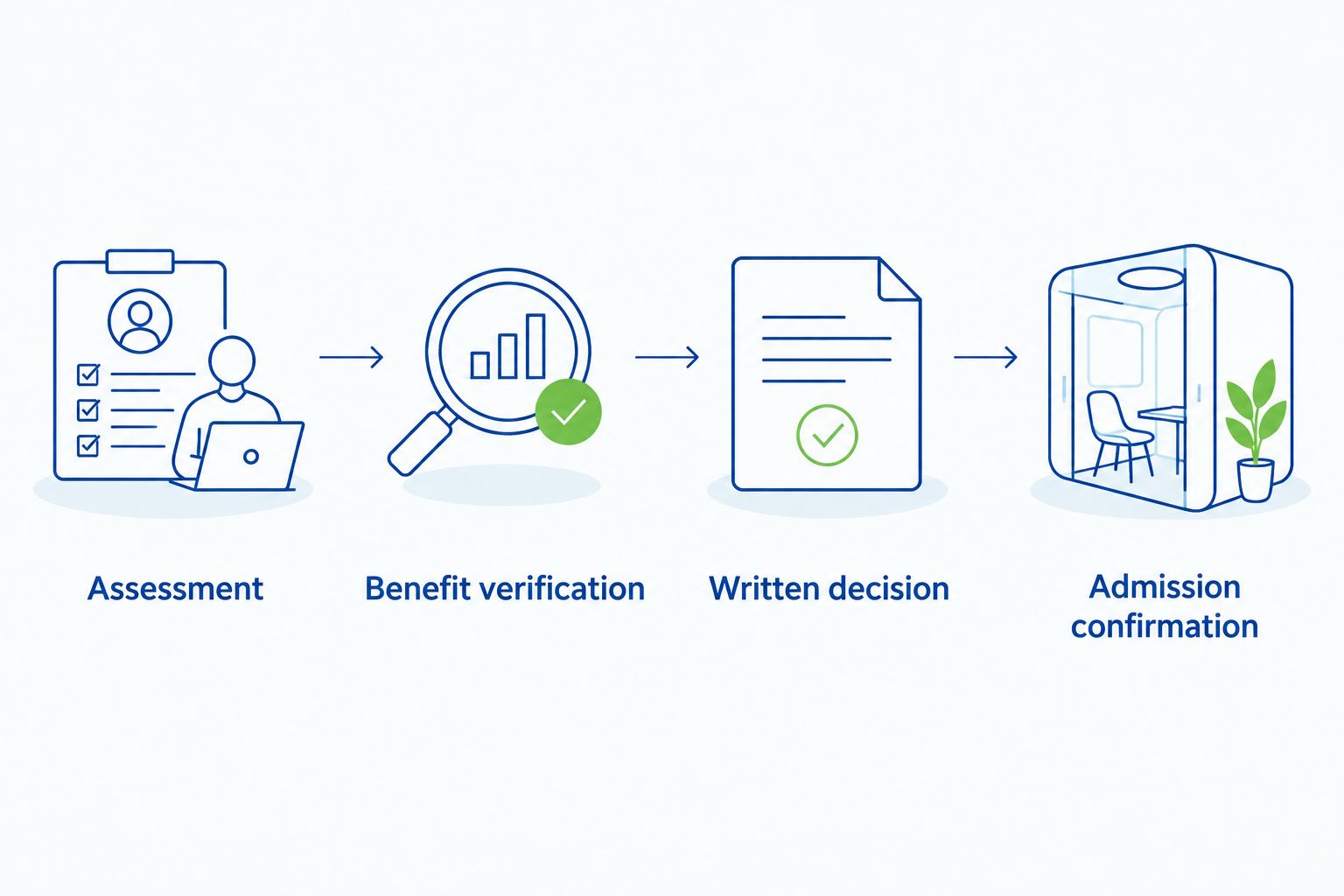
Keep the authorisation record accessible to the person travelling with you, but share only what they need. For a planned 2026 admission, confirm that the dates on the decision still match the intended arrival date before leaving home.
Admission handover and follow-up
The fourth configuration unit prepares you for arrival and protects continuity after the initial booking.
Admission confirmation
- Confirm the practical handover. Ask when and where to arrive, what identification to bring, and how prescribed medicines should be presented. Follow the facility’s actual instructions rather than a packing list from another centre.
- Agree family communication boundaries. Identify the person who can receive updates, what consent is required and how family involvement will work. Funding administration does not automatically give every relative access to clinical information.
- Ask how treatment changes are handled. Establish who will communicate with GEMS if the clinical plan, provider or intended discharge date changes. Keep a clear contact for administrative questions separate from urgent medical concerns.
Expected result: You know the arrival arrangements, authorised communication contacts and process for checking any change to the original request.
The Cedars addiction treatment includes relapse prevention and family support. Ask how these programmes fit your clinical plan and which arrangements need separate funding clarification; do not assume the initial admission decision covers every later service.
Discuss your treatment needs
Ask about assessment, residential treatment and the information needed to discuss admission.
Update the request when treatment changes
A second workflow applies when an assessed need changes after the original request. Examples include a revised admission date, a different receiving provider or a clinician recommending continued treatment.
Best for changed treatment plans: check the existing decision before relying on it. A previous approval is not evidence that the revised arrangement has also been approved.
- Ask the treating team to describe the clinical change and identify the supporting records needed.
- Ask GEMS how that change should be submitted and whether the existing decision remains applicable.
- Obtain the updated written outcome and reconcile it with the facility’s arrangements.
Keep the original decision and the update together. Label them clearly so nobody treats an earlier document as the current instruction.
| Workflow | Best for | Benefit | Limitation |
|---|---|---|---|
| Planned admission | People arranging treatment after assessment | Lets you align clinical needs, funding and arrival details | Routine administration must not delay emergency care |
| Emergency care first | Immediate danger, overdose or severe withdrawal symptoms | Prioritises urgent medical assessment | Does not establish funding for later rehabilitation |
| Revised treatment request | A changed provider, date or clinical plan | Keeps the funding enquiry aligned with current care | Requires checking rather than assuming the original decision applies |
For any 2026 change, use the current clinical recommendation. An old referral or earlier treatment history does not describe every new episode accurately.
Troubleshooting your admission workflow
The scheme and facility have different patient details
Compare 3 identifiers: membership number, patient identity details and dependant details. Ask the responsible party to correct the discrepancy, then confirm that the correction appears in the request or decision. Do not send repeated applications with inconsistent information.
You were told rehab is covered, but have no written decision
Ask whether the conversation was a benefits enquiry or an authorisation outcome. Request written confirmation for the actual provider and proposed treatment. Until those details are clear, do not describe the admission as scheme-approved.
The request is waiting for clinical information
Ask exactly which document is missing and who must supply it. Send that requirement to the assessing clinician or facility, confirm receipt, and keep the submission reference. Repeating the original enquiry without the missing material leaves the same question unresolved.
The proposed provider or date has changed
Give the updated details to both GEMS and the receiving facility. Ask whether a revised decision is required before the planned admission. Keep the change visible in your file so the transport arrangements do not follow an outdated date.
The funding request is declined or disputed
Request the written reason and ask about the applicable review or complaint process. Have the clinician address clinical questions accurately; do not ask anyone to alter a diagnosis to obtain approval. Meanwhile, discuss safe treatment alternatives with the treating team rather than abandoning care.
Customize your workflow
Choose one administrative contact if several relatives are helping. That person can maintain the document file and track unanswered questions, while the patient’s consent and clinical privacy remain central.
Add practical planning only after the treatment route is clear: transport, childcare, leave arrangements and a plan for communication during treatment. You do not need to tell every colleague or relative your diagnosis to organise support.
The Cedars offers family support alongside addiction treatment. Ask what involvement is appropriate for your circumstances, including situations where family relationships are strained. Support should help treatment, not become another source of pressure.
For your 2026 recovery plan, also ask about discharge preparation and follow-up. An admission checklist gets you through the door; continued support addresses what happens when you return home.
FAQ
How do I start a GEMS medical aid rehab admission?
Start with a clinical assessment, then ask GEMS about the process for the proposed patient, provider and treatment. Obtain the written funding decision and a separate admission confirmation from the receiving facility.
Does having GEMS mean my rehab admission is automatically approved?
No, GEMS membership alone does not establish approval for a particular rehab admission. Verify the applicable requirements and obtain a decision for the actual treatment request.
Does The Cedars accept my specific GEMS treatment request?
Confirm your individual request with The Cedars and GEMS before arranging a planned admission. The provider details, clinical plan and written funding decision need to agree; this guide does not establish approval.
What information should I prepare before asking about rehab funding?
Prepare membership details, patient identity details, relevant clinical records and the proposed provider’s billing details. Ask which additional documents are required rather than assuming a generic checklist is sufficient.
Can a family member organise the admission paperwork?
A family member can help organise paperwork with the appropriate permission. Confirm the scheme’s and facility’s consent requirements before requesting or sharing the patient’s confidential information.
Should I wait for authorisation if withdrawal symptoms are severe?
Do not delay emergency medical assessment for severe withdrawal symptoms, seizures, breathing difficulties or immediate self-harm risk. Routine rehabilitation administration is separate from urgent medical care.
What happens if my treatment dates change?
Ask GEMS and the receiving facility whether the changed dates require an updated decision. Keep the revised outcome with the original record and confirm the new arrival arrangements separately.
Does approval for admission also cover aftercare?
Do not assume admission approval includes aftercare. Ask about the specific follow-up services, providers and any separate funding requirements before discharge.
One last thing
Do not let paperwork become a test of whether you deserve help. A missing document is an administrative problem, not a judgement about your recovery.
Before a planned admission, put the written funding decision and facility confirmation together and ask one final question: do both describe the same patient, provider, treatment and dates? That check gives everyone a clearer starting point while leaving clinical decisions with the treating team.
Related guides
- How to prepare for your first day at inpatient rehab
- How to support a family member through rehab
- How to support your recovery after leaving rehab