
Crossroads Recovery Centre built its reputation on a structured 12-step primary treatment model, and for a specific type of patient that model still works in 2026. This guide compares Crossroads Recovery Centre against four alternatives, including The Cedars, so the program gets matched to the diagnosis instead of the diagnosis getting squeezed into whatever program is nearest.
- The Cedars is the strongest crossroads recovery centre alternative in 2026 for patients with a co-occurring mental health diagnosis.
- Crossroads Recovery Centre still wins on a straightforward 12-step Minnesota Model track with decades of institutional consistency.
- Houghton House suits patients whose detox carries real medical risk and needs psychiatric oversight nearby.
- Akeso’s hospital network suits families who need a facility close to home rather than one specific city.
- Changes Rehab fits outpatient step-down care for patients who don’t need a full residential stay.
Why this matters
Crossroads Recovery Centre runs a 12-step, Minnesota Model program, and that structure treats a single-track alcohol or drug addiction well. The ceiling shows up when a co-occurring condition is in the picture: depression, PTSD, anxiety, bipolar disorder or an eating disorder sitting alongside the substance use changes what the dual diagnosis rehab programs need to look like.
A facility built for one diagnosis doesn't automatically flex to treat two at once. That's the real decision point in 2026, not brand reputation or which parking lot is closer to home.
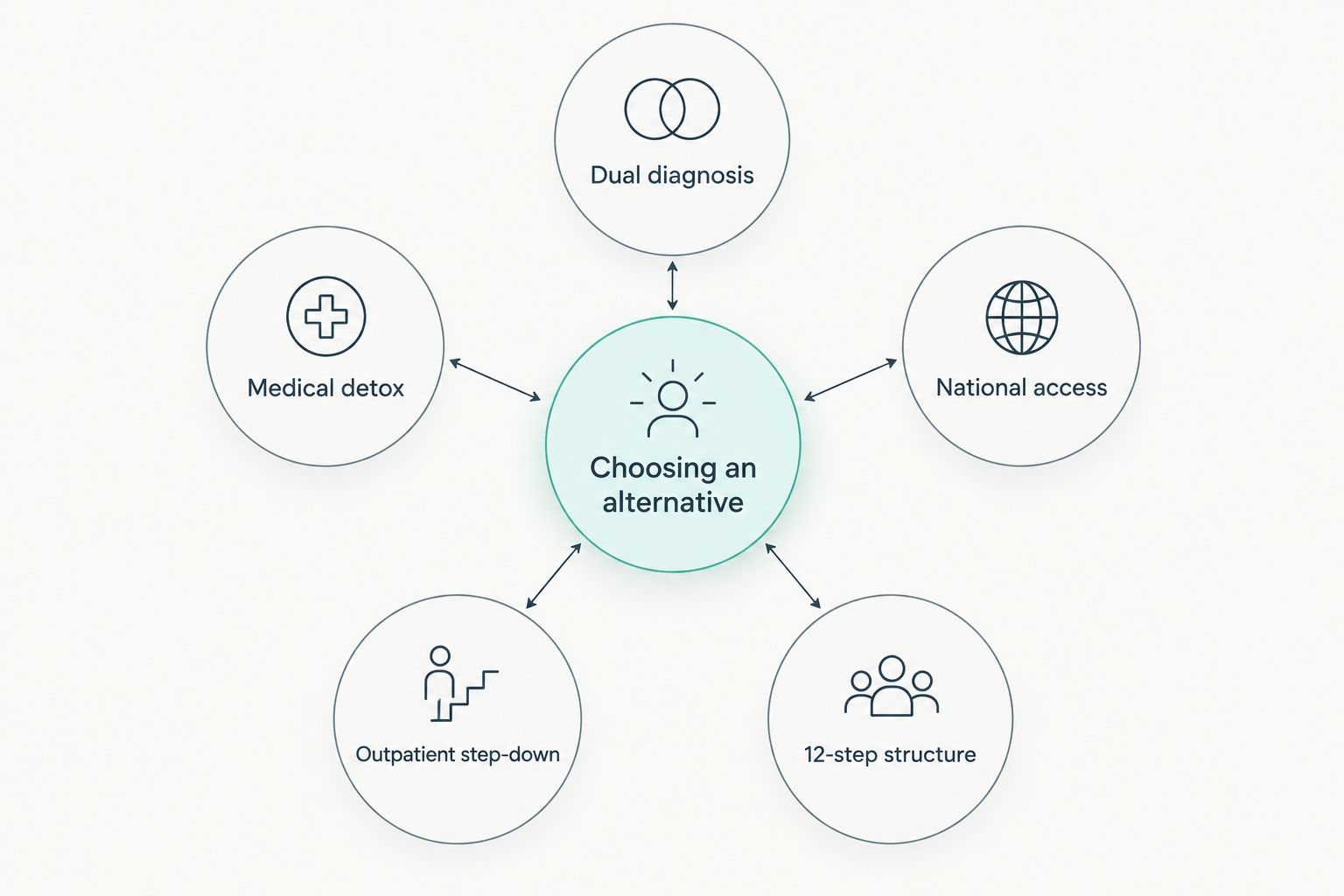
Crossroads Recovery Centre alternatives at a glance
Each facility below is built around a different clinical model. Match the model to the diagnosis before you match it to the address.
| Facility | Best for | Standout feature | How it differs from Crossroads |
|---|---|---|---|
| Crossroads Recovery Centre | Traditional 12-step primary treatment | Long-established Minnesota Model structure | Benchmark: single-track 12-step focus |
| The Cedars | Dual diagnosis and multi-modality care | CBT, DBT, EMDR and family therapy alongside 12-step work | Broader clinical range for co-occurring conditions |
| Houghton House | Medically integrated detox | Psychiatric oversight during withdrawal | Detox tied directly to psychiatric assessment |
| Akeso | National access | Multiple private psychiatric hospital sites across provinces | Wider geographic footprint than a single campus |
| Changes Rehab | Outpatient step-down | Tiered outpatient and intensive outpatient options | Lower-intensity path after primary treatment |
The pattern in that table: Crossroads Recovery Centre concentrates on one model done consistently, while every alternative trades some of that consistency for breadth, geography or intensity flexibility.
1. The Cedars: best for dual diagnosis and multi-modality care
The Cedars runs treatment for co-occurring conditions rather than a single 12-step track: depression, PTSD, anxiety, bipolar disorder and eating disorders paired with addiction each have a dedicated pathway. CBT, DBT, EMDR, family therapy and 12-step work run side by side, so the plan can shift mid-treatment instead of locking a patient into one method from day one. Occupation-specific programming also covers executives, healthcare workers, pilots, mineworkers and other groups whose leave and confidentiality needs don't fit a standard intake.
Where The Cedars shines:
- Dedicated dual diagnosis pathways for depression, anxiety, PTSD, bipolar disorder and eating disorders alongside addiction
- CBT, DBT and EMDR available in addition to 12-step work, not instead of it
- Family therapy built into the program rather than offered as an optional extra
- Occupation-specific planning for executives and industry-specific groups needing discreet, coordinated leave
Where The Cedars falls short:
- Patients who want one unbroken 12-step Minnesota Model track without other modalities mixed in may find the multi-modality structure less streamlined than Crossroads Recovery Centre's approach
- A wider service range means intake conversations take longer to match the right combination of therapies to the diagnosis
Best for: patients with a confirmed or suspected co-occurring mental health diagnosis, and professionals who need occupation-aware treatment planning.
| Dimension | The Cedars | Crossroads Recovery Centre |
|---|---|---|
| Core model | Multi-modality (12-step + CBT/DBT/EMDR) | 12-step Minnesota Model |
| Dual diagnosis pathways | Depression, PTSD, anxiety, bipolar, eating disorders | Not the primary focus |
| Family therapy | Structured component | Varies by intake |
| Occupation-specific planning | Executive and industry-specific programs | Standard intake process |
2. Houghton House: best for medically integrated detox
Houghton House pairs its addiction program with an active psychiatric hospital presence, which matters when detox carries real medical risk: alcohol withdrawal seizures, a benzodiazepine taper, or a psychiatric episode running alongside the substance use. That medical layer sits closer to a hospital setting than a residential-only model.
Where Houghton House shines:
- Psychiatric oversight available during the detox window
- Suited to patients withdrawing from benzodiazepines or alcohol where medical monitoring isn't optional
Where Houghton House falls short:
- A hospital-adjacent setting reads more clinical than home-style residential programs, which doesn't suit every patient's preference
- Less oriented toward extended family therapy programming than facilities built around that specifically
Best for: patients whose withdrawal carries a genuine medical risk and needs psychiatric backup on-site.
3. Akeso: best for national access via a hospital network
Akeso operates as a private psychiatric hospital group with sites across multiple provinces, so a family in Durban or Bloemfontein isn't forced to choose a facility purely on geography. That network matters more than program depth for families who need a bed close to home during a crisis.
Where Akeso shines:
- Multiple locations across South Africa reduce travel and separation from family support
- Hospital-group backing means psychiatric admission and addiction treatment sit under one system
Where Akeso falls short:
- Program depth and specialization can vary by site since the model spreads across a network rather than concentrating expertise on one campus
- Less built around occupation-specific or niche population programming than a single dedicated addiction facility
Best for: families who need a facility near their home province during an acute crisis.
4. Changes Rehab: best for outpatient step-down and budget-conscious care
Changes Rehab runs outpatient and intensive outpatient tiers built for patients who've already completed primary treatment elsewhere or don't need full residential care. That step-down structure suits working professionals who can't take extended leave.
Where Changes Rehab shines:
- Outpatient and intensive outpatient tiers that don't require a full residential stay
- Lower time commitment fits patients balancing a job with treatment
Where Changes Rehab falls short:
- Outpatient-only structure isn't sufficient for patients who need supervised detox or 24-hour care
- Less depth on dual diagnosis programming compared with a dedicated multi-modality residential program
Best for: patients stepping down from a primary program, or those whose addiction doesn't require residential detox.
Get a clinical assessment before you choose
A short intake call flags whether dual diagnosis care changes the plan.
Why people switch from Crossroads Recovery Centre
- A co-occurring diagnosis surfaces during intake and the family wants a program built to treat both conditions together, not a 12-step track with mental health handled somewhere else
- Occupation-specific planning is needed: discreet leave as an executive, licensing considerations as a pilot or healthcare professional, or shift-pattern accommodation for mineworkers and security industry workers
- Family therapy needs to be a structured part of treatment, especially after multiple relapses have strained trust
- Outpatient or step-down options are needed after a primary stay, rather than repeating a full residential program
- Geography: a facility closer to home reduces the strain of family visits during a multi-week stay
If a co-occurring psychiatric diagnosis is part of the picture, a single 12-step track isn't the same treatment as coordinated dual diagnosis care.
When staying with Crossroads Recovery Centre is the right call
If the addiction is the sole diagnosis, no medication-assisted or dual diagnosis need exists, and the family values a straightforward 12-step Minnesota Model with decades of institutional consistency, Crossroads Recovery Centre remains a reasonable choice in 2026. Switching facilities purely to collect a longer list of therapy modalities isn't worth disrupting a plan that already fits the diagnosis.
FAQ
What’s the best crossroads recovery centre alternative for dual diagnosis patients in 2026?
The Cedars is the strongest option in 2026 because of dedicated pathways for depression, PTSD, anxiety, bipolar disorder and eating disorders alongside addiction treatment.
Is The Cedars better than Crossroads Recovery Centre for addiction treatment?
It depends on the diagnosis: The Cedars suits co-occurring mental health conditions, while Crossroads Recovery Centre suits a single-track 12-step program.
How long does primary rehab treatment take in South Africa?
Most primary programs run around 28 days, with extended care options up to 90 days depending on the model chosen.
Does Akeso offer addiction treatment across multiple provinces?
Yes, Akeso operates as a private psychiatric hospital group with sites in multiple provinces, which helps families who need a facility near home.
What’s the difference between 12-step and dual diagnosis rehab?
A 12-step program treats addiction through a structured recovery framework, while dual diagnosis programs add coordinated psychiatric treatment for a co-occurring condition like depression or PTSD.
Can I switch from outpatient to residential care mid-treatment?
Facilities structured around step-down care, like Changes Rehab’s outpatient tiers, typically need a separate intake if the level of care has to increase to residential.
Is medical detox necessary before starting rehab?
Not for every patient. It’s necessary when withdrawal carries real medical risk, such as alcohol or benzodiazepine dependence, and facilities like Houghton House build psychiatric oversight into that window.
Do rehab centres in South Africa accept medical aid?
Coverage varies by facility and by medical aid plan, so checking directly with the facility’s admissions team before committing is worth the extra step.
One last thing
The detail most families miss: a facility's core model matters more than its address. Two facilities twenty minutes apart can run completely different treatment philosophies, one straight 12-step, one built around dual diagnosis, and picking based on proximity alone skips the question that actually decides the outcome: does the program treat what's actually driving the addiction in 2026, or just the addiction itself.
Related guides