
Instead of repeating your history and chasing separate answers, organise your Bonitas medical aid rehab admission around a clinical assessment, a written funding decision and an agreed admission plan. This 2026 workflow helps you keep those decisions together without treating a benefits enquiry as permission to begin treatment.
- Bonitas medical aid rehab admission needs individual benefit verification, clinical assessment and an agreed admission plan.
- The Cedars offers private addiction rehabilitation with detox, 12-step treatment, relapse prevention and family support.
- Confirm the exact facility, treatment scope and admission dates in writing before relying on funding approval.
- Seek urgent medical help for an immediate safety concern; do not wait for routine pre-authorisation paperwork.
Why this matters
Asking for help can feel difficult enough without having to interpret medical aid paperwork. Keep clinical suitability, funding approval and admission arrangements separate until each is confirmed. A membership number alone does not establish what treatment your medical aid will fund.
The Cedars is best for people seeking private addiction rehabilitation with 12-step-based treatment and family support. That treatment approach does not establish Bonitas funding for an individual admission. You still need a decision that matches your circumstances and the proposed facility.
You can explore The Cedars while preparing your enquiry. For a planned admission in 2026, use your current membership information and ask for the rules applying to your particular benefit option.
The practical goal is simple: arrive with a clinically appropriate plan, a clear funding decision and an agreed handover. You should not have to resolve conflicting information at reception.
Before you start
- Gather your membership information. Have the patient's name, identification details, Bonitas membership number, dependant details where relevant and current benefit option. Use the contact information on your membership documents or official scheme correspondence.
- Prepare a clinical summary and agree who can communicate. Record substances used, prescribed medicines, relevant health conditions, previous treatment and current safety concerns. If you are helping another adult, ask the patient and each organisation what consent or representative documentation they require.
- Check the exact facility, not just the group name. Ask whether the proposed facility and treatment are eligible under your option. Do not assume that a decision about one facility, treatment phase or date applies to another.
Use 1 shared checklist for documents, outstanding questions and decisions. Share sensitive information only with the people who need it, through channels the scheme and treatment provider confirm are appropriate.
If the person is unconscious, having a seizure, struggling to breathe, severely confused or at immediate risk of harming themselves, seek emergency medical help. Routine admission paperwork must not delay urgent assessment.
Membership and benefit checks
- Confirm the member details. Ask Bonitas to verify the patient and benefit option before discussing the proposed admission. Correct any mismatch in names or dependant information before the application proceeds.
- Describe the intended treatment. Explain that you are enquiring about addiction rehabilitation and ask how the scheme handles the proposed care. Identify whether medical detox, residential rehabilitation or another treatment phase is being considered; let the clinician determine what is needed.
- Ask for the applicable requirements. Request the required clinical documents, submission method, authorisation process and any provider restrictions. Ask whether separate treating professionals or treatment components need separate confirmation.
- Record the answer. Note the date, reference number, outstanding documents and who is responsible for the next action. Request written information rather than relying on a remembered telephone conversation.
Expected result: you know what Bonitas needs to assess the proposed admission, where the information must go and which questions remain unanswered. This is a requirements check, not yet a funding decision.
For more detail on the questions to ask, read how to check if your medical aid covers rehab treatment. Keep that checklist beside your own 2026 membership documents; general guidance cannot replace an individual decision.
Questions to include in your benefit enquiry
Ask whether the proposed facility is eligible, what clinical evidence is required and which treatment components the decision will address. Also ask how you will receive the outcome and what to do if the proposed treatment changes.
You do not need to interpret diagnosis codes yourself. Ask the treating professional to supply and explain the clinical information requested by the scheme.
Clinical assessment and treatment proposal
- Arrange an assessment with an appropriate clinician. Explain current substance use, physical symptoms, mental health concerns and previous withdrawal experiences. Ask the prospective centre how to arrange the assessment needed for its admission process.
- Discuss withdrawal safety before changing substance use. Alcohol and benzodiazepine withdrawal can be dangerous. Do not attempt an unsupported detox or abruptly stop prescribed medicines to fit an admission date; obtain individual medical advice.
- Clarify the proposed care. Ask the clinician to identify the appropriate treatment setting, whether detox is needed and how other health conditions will be managed. Include depression, anxiety, chronic pain or other concerns that affect safe treatment.
- Assign the submission responsibility. Agree who will send the clinical information and who will track the response. Check that the proposed facility details and intended dates match across the documents.
Expected result: you have a clinician-led treatment proposal and a named person responsible for submitting the required information. The proposal explains what care is needed rather than simply requesting a bed.
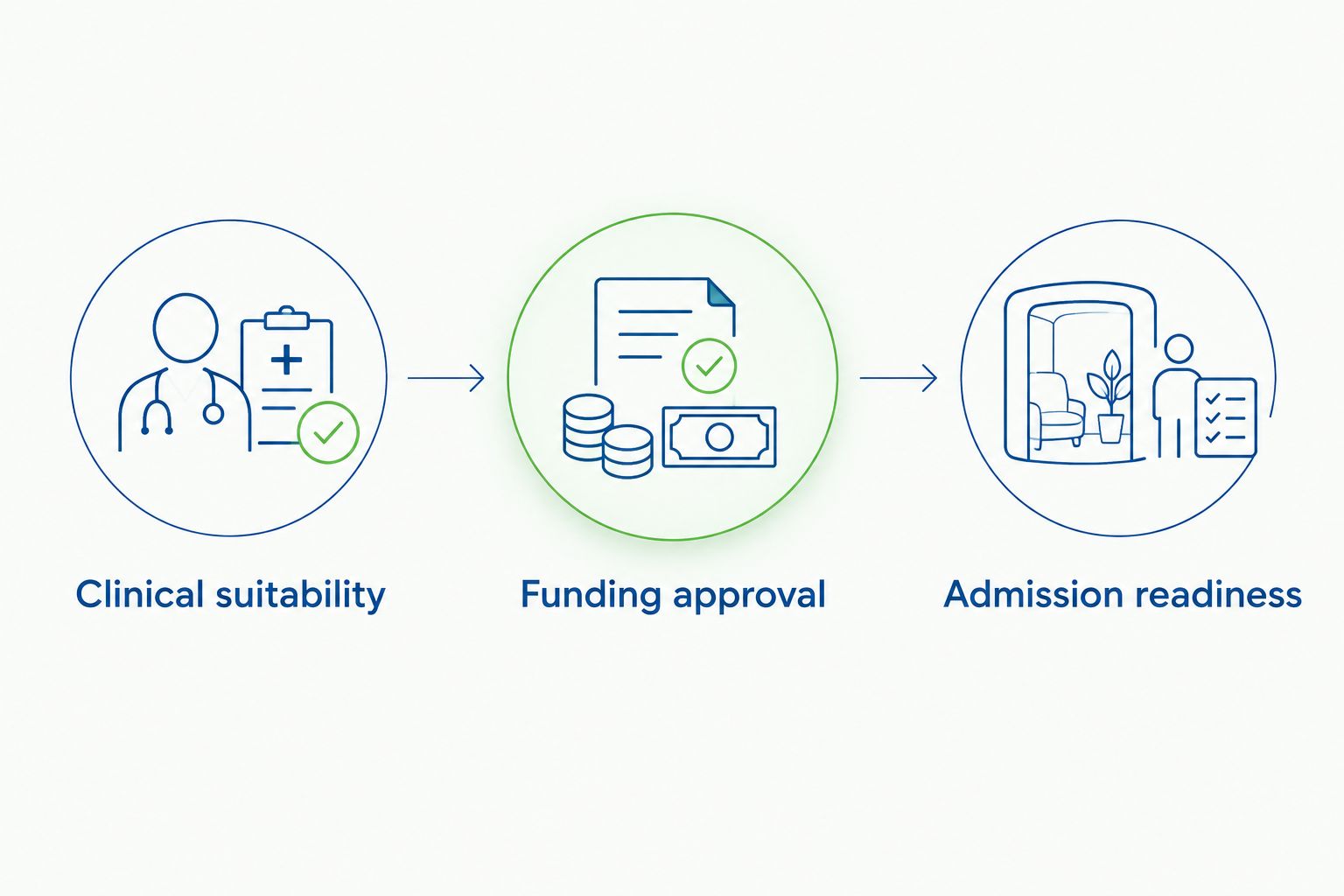
A helpful way to organise the process is to use 3 separate checkpoints: clinical suitability, funding approval and admission readiness. Completing one does not complete the others.
Give accurate information even when it feels uncomfortable. Your care team needs to understand what you have been taking and how you are feeling; the assessment is not a test of whether you deserve help.
Written funding decision
- Check that the application was received. Obtain a reference and ask whether the submission is complete. If additional information is requested, identify the missing item and the person who must provide it.
- Read the decision against the treatment proposal. Check the patient, facility, authorised treatment, dates and stated conditions. Ask for clarification wherever the wording does not match the proposed care.
- Separate approved and unresolved elements. Ask which parts of treatment the decision covers and which still need an answer. Do not assume that approval for detox also settles rehabilitation, follow-up care or every professional involved.
- Give the decision to the admitting team. Ask the facility to confirm that it can proceed on the documented terms. Resolve discrepancies with Bonitas and the provider before relying on the authorisation for a planned admission.
Expected result: both you and the facility understand the written decision and any outstanding conditions. A reference number helps track the application; it is not a substitute for understanding the outcome.
Keep 2 written confirmations together: the scheme's funding decision and the facility's admission confirmation. These documents serve different purposes, so check both rather than treating one as the other.
For a 2026 admission, check that the decision relates to the actual dates and current treatment proposal. If either changes, ask whether the existing decision needs amendment before proceeding.
Admission handover
- Agree the arrival arrangements. Confirm the destination, arrival date, receiving contact and any instructions the facility gives you. Do not arrange transport around an unconfirmed admission.
- Request the facility's preparation instructions. Ask what identification, medical documents, medicines and personal items to bring. Follow its actual instructions rather than assuming that every centre has the same rules.
- Hand over relevant health information. Give the admitting team the current medication list, assessment documents and details of any change in symptoms or substance use. Ask who should receive this information securely.
- Confirm the support arrangements. Agree who can receive updates, who will assist with transport and how family involvement will be handled with appropriate consent. Ask when the initial treatment plan will be discussed.
Expected result: the receiving team knows who is arriving, what has been agreed and what needs attention. Your practical arrangements support the clinical plan rather than replacing it.
The Cedars provides addiction rehabilitation, detox, relapse prevention and family support. Ask which parts of its treatment offering suit your assessed needs and which parts appear in your individual funding decision.
Discuss your next treatment step
Ask about treatment suitability and the information needed for an admission enquiry.
When the treatment plan changes
A second workflow applies when the clinician recommends a different facility, a revised admission date or a different treatment phase. Check the funding decision against the revised plan; do not assume that an earlier authorisation follows every change.
| Admission workflow | Best for | Advantage | Limitation |
|---|---|---|---|
| Initial planned admission | People arranging their first proposed stay | Establishes clinical, funding and arrival arrangements together | Requires all relevant information before decisions can be matched |
| Revised treatment plan | People whose dates, facility or clinical needs change | Keeps the recorded decision aligned with the current proposal | Needs clarification of whether amendments or another submission are required |
For a revised plan:
- Ask the clinician or facility to document what changed and why.
- Give Bonitas the updated information through its confirmed process.
- Ask whether the existing decision remains applicable or needs amendment.
- Obtain the outcome and agree revised arrangements with the receiving team.
The table compares administrative workflows, not levels of treatment. Your clinical needs determine the care recommendation; the paperwork records how the proposed care will proceed.
If your condition worsens while an amendment is being considered, seek medical assessment. Do not use an administrative timeline to decide whether urgent care is necessary.
Troubleshooting your admission
The application has no clear status
Ask whether the submission was received, whether it is complete and what specific action is outstanding. Record the reference and assign the next task to a named person. Repeated general enquiries do not resolve a missing clinical document.
The facility details do not match
Ask the provider to confirm its exact details, then ask Bonitas to clarify or correct the decision. A group name and a specific facility are not interchangeable for checking an individual application.
A family member cannot obtain information
Ask what consent or representative documentation is required. Being a supportive relative does not automatically establish permission to receive another adult's medical or membership information; agree communication arrangements with the patient where possible.
The funding request is declined or only partly approved
Request the written reason and ask what review or dispute process applies. Have the clinician address the stated issue with accurate supporting information. Do not assume that resubmitting the same documents will produce a different outcome.
Symptoms change before arrival
Tell the treating clinician and receiving facility promptly. A new withdrawal concern, worsening mental health or another medical problem needs clinical reassessment; it is not merely an admission-date adjustment.
Customize your workflow
Build your support plan around the treatment recommendation, not only the admission date. Ask who will help with family communication, work arrangements and the transition after residential care.
The Cedars offers relapse prevention and family support alongside its addiction rehabilitation services. Those are relevant topics to discuss, but their inclusion in your clinical plan does not establish medical aid funding for every component.
Keep the benefit enquiry specific. If follow-up care is recommended for later in 2026, ask what separate information or decisions are needed rather than assuming the initial admission decision covers it.
The strongest handover includes an agreed next step for recovery after discharge. Ask the clinical team who will coordinate that step and what information you need to keep.
FAQ
How do I start a Bonitas medical aid rehab admission?
Start by checking your current membership details and asking Bonitas what information it requires for the proposed treatment. Arrange a clinical assessment and confirm the exact facility before relying on a funding decision.
Does Bonitas cover treatment at The Cedars?
Confirm coverage for your exact benefit option, proposed facility and treatment directly with Bonitas. The Cedars offers private rehabilitation, but that does not establish approval for an individual member.
Is an authorisation reference enough to arrange admission?
An authorisation reference alone is not enough to understand the funding decision or confirm admission. Check the written outcome, its conditions and the facility’s separate admission arrangements.
Can my family arrange my rehab admission for me?
Your family can help organise an admission enquiry, but information sharing requires the appropriate consent or representative arrangements. Ask the scheme and treatment provider what documentation they need.
Should I stop drinking before I go to rehab?
Seek individual medical advice before stopping alcohol if dependence or withdrawal is a concern. Alcohol withdrawal can be dangerous, and an admission date is not a safe detox plan.
What happens if my admission date changes?
Tell the facility and ask Bonitas whether the existing decision applies to the revised dates. Obtain any required amendment before relying on the earlier decision for a planned admission.
Can I use admission approval for aftercare in 2026?
Do not assume an admission decision includes aftercare in 2026. Ask the clinician what follow-up is recommended and ask Bonitas how that proposed care must be assessed.
One last thing
The most useful final check is a match, not another general reassurance. Put the clinical proposal, written funding decision and admission confirmation beside one another, then check the patient, facility, treatment and dates.
If they disagree, resolve the difference before a planned arrival. You do not need to manage recovery alone, and you do not need to understand every administrative term before asking for help.
Related guides
- How to prepare for your first day at inpatient rehab
- How to support a family member through rehab
- How to support your recovery after leaving rehab