
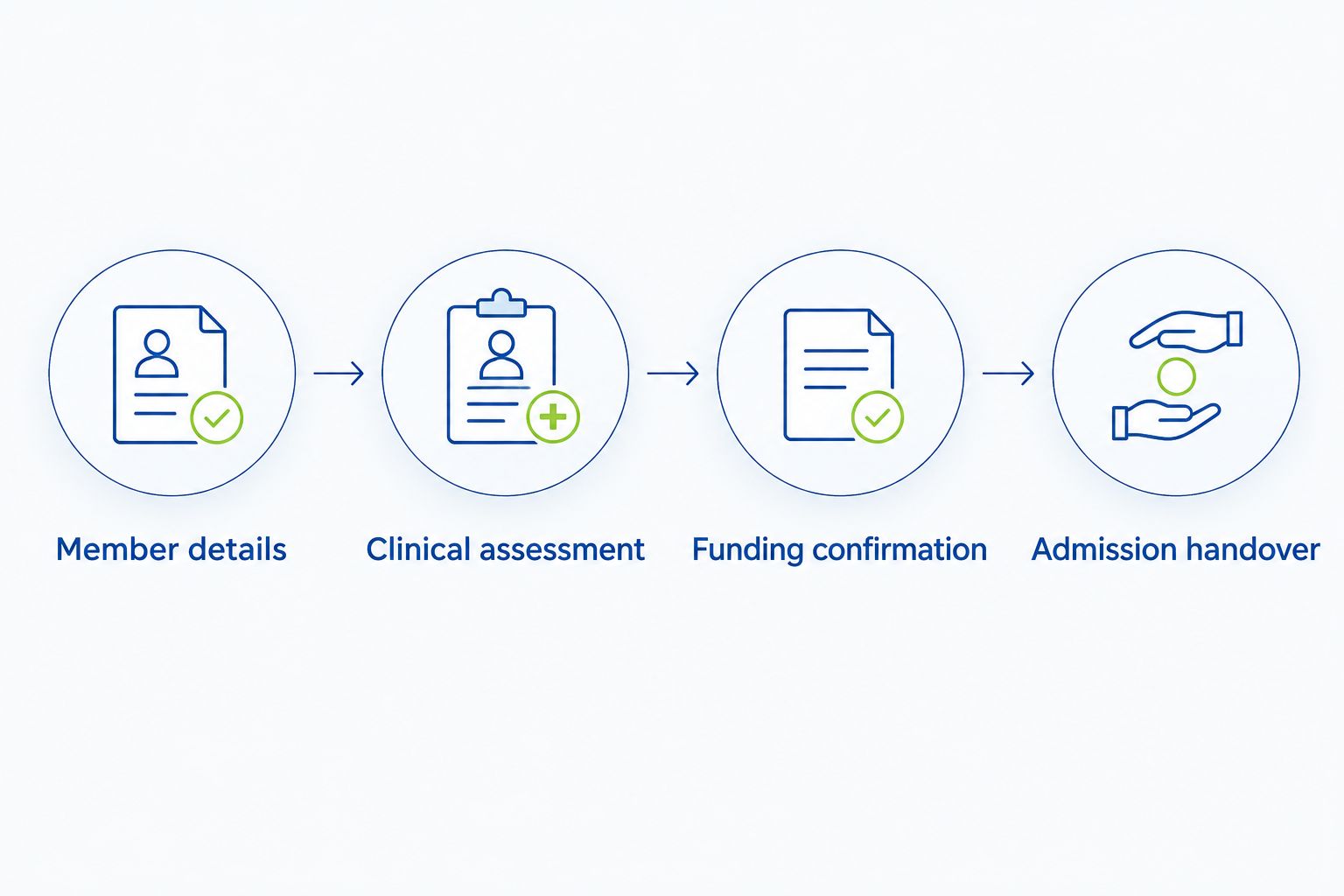
Instead of repeating your history across calls, organise your Bestmed rehab admission around a shared record: member details, clinical assessment, written funding confirmation and an admission handover. This 2026 guide explains what to ask Bestmed and your chosen rehabilitation centre, while keeping urgent medical needs separate from routine paperwork.
- Bestmed rehab admission needs member-specific funding confirmation alongside a clinical assessment; an enquiry is not an approval.
- The Cedars suits people seeking residential addiction treatment with a 12-step approach and family support.
- Confirm the named facility, treatment scope and approved dates before finalising a planned admission.
- Urgent withdrawal symptoms or immediate safety concerns require medical care, not a wait for routine authorisation.
Why this matters
Seeking help can already feel overwhelming. You should not have to reconstruct every conversation while also supporting someone through addiction. Keep clinical suitability and funding confirmation separate: a treatment recommendation does not establish what your medical aid will fund.
The Cedars provides private addiction and mental health rehabilitation, including detox, 12-step-based treatment, relapse prevention and family support. The Cedars is best suited to people seeking residential addiction treatment with a 12-step approach and family support. That treatment approach still needs to match the individual's assessed needs.
For a planned admission in 2026, your practical goal is 3 written confirmations: the clinical recommendation, Bestmed's funding decision and the centre's admission instructions. These are a coordination checklist, not a statement of Bestmed's requirements. Obtain the scheme's actual requirements directly for the member concerned.
Before you start
- Gather identification and access. Have the patient's membership details, identity information, plan name and current contact details ready. If you are helping another adult, ask what consent Bestmed and the centre require before discussing their information.
- Prepare a factual health summary. List substances used, prescribed medicines, recent use, previous withdrawal problems, existing diagnoses and current safety concerns. A clinician must assess treatment needs; relatives should not diagnose or select a detox regimen.
- Check the specific facility, not just the group name. Ask Bestmed to identify the exact facility and provider details it needs. Do not assume that a discussion about one centre establishes funding for another location, provider or stage of treatment.
Choose 1 shared record for administration, with access limited to people authorised to help. Include dates, reference numbers, outstanding requests and the person responsible for each next action. Keep sensitive clinical documents out of family group chats.
Planned admission or urgent medical care?
The first decision is about safety, not administration. If someone has a seizure, breathing difficulty, severe confusion or an immediate risk of self-harm, seek emergency medical care. Do not wait for the routine admission process or try to manage dangerous withdrawal at home.
| Route | Best for | Advantage | Limitation |
|---|---|---|---|
| Planned rehabilitation admission | Someone assessed as safe to follow a scheduled admission process | Allows clinical information, funding questions and arrival arrangements to be coordinated | Administrative progress does not make untreated withdrawal safe |
| Urgent medical assessment | Someone with serious symptoms or immediate safety concerns | Prioritises assessment and stabilisation | Does not itself establish funding or acceptance for a later rehabilitation admission |
Use the clinician's assessment to choose the route. A family preference for residential treatment cannot replace an assessment of immediate medical needs.
Member details
- Confirm the member and patient. Check the membership number, dependant details, plan name and contact information against the member's current records. Ask Bestmed to confirm the patient's membership status for the intended admission date.
- Ask for the relevant 2026 process. Explain that you are seeking an assessment for addiction rehabilitation. Ask which department handles the request, whether pre-authorisation is required and which documents must accompany it.
- Check permission to coordinate. If a relative is making enquiries, establish how the patient can authorise communication. Ask separately about consent for scheme discussions and disclosure of clinical information.
- Record the next action. Note the date, contact person's name, reference number and requested documents. Agree who will obtain each item rather than leaving the task with an unnamed person.
Use clear headings in your own record, such as Member details, Requested documents and Next action. These are organisational labels, not Bestmed portal fields or instructions to use a particular online system.
Expected result: you know whose membership applies, which process Bestmed requires and who is responsible for completing the request. You have not yet established treatment approval.
Clinical assessment
- Arrange an assessment with an appropriate clinician. Describe substance use honestly, including alcohol, prescribed medication and combinations of substances. Include previous seizures or difficult withdrawal, even if they occurred during an earlier attempt to stop.
- Ask for the recommended level of care. Clarify whether the immediate need is medical stabilisation, detox, residential rehabilitation or another treatment setting. Do not treat those terms as interchangeable.
- Ask the centre to review suitability. Share clinical information through the channel it requests, with appropriate consent. Confirm that the proposed facility can address the assessed needs before organising travel.
- Coordinate the supporting documents. Ask Bestmed what clinical documentation is required and ask the treating clinician who will prepare it. Check that the patient's details and intended provider are consistent throughout.
Read the guide to knowing whether you need medical detox before rehab if you need help understanding that distinction. It does not replace an individual assessment.
The Cedars offers detox and residential addiction treatment, but the appropriate treatment sequence is a clinical decision. Its 12-step approach is a treatment feature to discuss during assessment, not proof that every patient needs the same programme.
Expected result: a documented clinical recommendation, a suitability discussion and a clear owner for the supporting paperwork.
Funding confirmation
- Submit through Bestmed's instructed channel. Use the current process supplied by the scheme. Ask whether the member, clinician or facility should submit each component, and retain evidence of submission.
- Check the request's status. Distinguish between received, awaiting information, declined and authorised. Ask what remains outstanding rather than interpreting a reference number as approval.
- Obtain the written decision. For a planned 2026 admission, ask Bestmed to confirm the named patient, facility, treatment scope, dates and any conditions attached to its decision.
- Clarify financial responsibility. Ask Bestmed and the facility to explain any services outside the confirmed scope, billing arrangements and responsibilities the patient must understand. Read those explanations before agreeing to admission.
Do not assume that approval for detox includes the subsequent rehabilitation programme, or that approval for a facility includes every separately billed service. Ask for the scope explicitly. This is a verification step, not a claim about how a particular Bestmed plan structures its benefits.
If you receive a verbal answer, request written confirmation of the relevant details. Keep 2 copies of the final decision: one in the member's secure records and one shared securely with the facility.
Expected result: you can identify what Bestmed has confirmed, what remains unresolved and which conditions need attention before planned admission.
Admission handover
- Reconcile the documents with the centre. Check that the patient, provider, treatment description and intended dates match the funding decision. Ask the centre to flag discrepancies before arrival.
- Confirm the practical instructions. Request arrival arrangements, required identification, medication instructions, permitted belongings and the appropriate contact for questions. Follow the centre's actual instructions rather than a generic packing list.
- Plan a safe journey. Tell the clinical team about any change in symptoms or substance use before departure. Ask for advice if the person appears unwell or unable to travel safely.
- Agree the communication boundaries. Establish who the patient wants involved, what information can be shared and whom the family should approach during treatment. Respect the patient's consent and the centre's clinical responsibilities.
Expected result: the facility has the agreed documents, the patient understands the next step and the family knows its role. An administrative checklist is complete only when the receiving team confirms the handover, not when a relative has sent an email.
The planned sequence is Member details, Clinical assessment, Funding confirmation, Admission handover. Urgent medical concerns interrupt that sequence and take priority.
Repeat the checks whenever the treatment plan changes
An adjacent workflow is needed when the proposed treatment changes after the initial request. Examples include a different facility, a revised admission date or a clinician recommending a different level of care. Do not carry an earlier decision across to the new arrangement without checking its scope.
- Record the change. State what is changing and which clinician or facility has recommended it. Separate administrative changes from changes in clinical need.
- Ask Bestmed what must be updated. Establish whether the existing decision covers the change or whether a revised request is required. Ask who should submit any additional information.
- Obtain the revised position in writing. Keep the earlier decision, but clearly identify which document applies to the proposed arrangement.
- Repeat the handover. Share the confirmed position securely with the receiving facility and revisit arrival instructions where necessary.
For continuing treatment during 2026, ask the clinical team who monitors any authorised period and who communicates with Bestmed if further treatment is recommended. A recommendation to continue treatment is not the same as confirmation of funding.
Expected result: the current clinical plan and the current funding decision refer to the same proposed treatment.
Troubleshooting
You have a reference number but no decision
Ask Bestmed whether the reference records an enquiry, a submitted request or an authorisation. Request the current status and any outstanding action in writing. Do not finalise a planned admission on the assumption that the number proves approval.
Bestmed requests more clinical information
Ask for the precise information required and which clinician should provide it. Pass that request to the responsible professional without trying to write a clinical motivation yourself. Record submission and follow up through the instructed channel.
The facility details do not match
Pause the planned handover and ask the centre to confirm its correct provider details. Ask Bestmed how to correct or reconsider the request. Do not change a clinical document or an authorisation record yourself.
A family member cannot obtain information
Ask what permission or verification is required. Support the patient in completing that process where appropriate, rather than using their login or presenting yourself as them. Seek urgent clinical help separately if there is an immediate safety concern.
The patient's condition worsens while paperwork is pending
Seek prompt medical assessment; use emergency care for serious symptoms or immediate danger. Tell the treating team what has changed and update the admission coordinator afterwards. Do not let a pending funding request delay necessary emergency care.
Customize your workflow
Build the administration around the person receiving care. Someone coordinating their own admission needs a manageable checklist; a family helping an overwhelmed adult needs agreed responsibilities and clear consent. Neither arrangement requires sharing the full clinical history with everyone involved.
At The Cedars, addiction rehabilitation includes relapse prevention and family support. Those are useful subjects for the assessment conversation, alongside the fit of the 12-step approach. Residential care also involves time away from ordinary routines, and clinical suitability and Bestmed funding still require individual confirmation.
Before admission, ask how the proposed programme addresses mental health needs alongside substance use. Also ask who will discuss discharge planning, follow-up care and family involvement. Do not assume that funding for residential treatment extends to every later service.
For your 2026 recovery plan, keep treatment administration in one record and personal recovery goals in another. The authorisation paperwork helps coordinate admission; it is not the recovery plan itself.
Explore residential treatment
Learn about addiction treatment, relapse prevention and family support at The Cedars.
FAQ
How do I start a Bestmed rehab admission in 2026?
Start by contacting Bestmed about the patient’s specific membership and arranging a clinical assessment. Ask which documents and authorisation steps apply, then coordinate the request with the proposed rehabilitation centre.
Does Bestmed cover treatment at The Cedars?
Obtain a member-specific answer directly from Bestmed for the proposed facility and treatment. Do not treat a general medical-aid discussion or a clinical recommendation as confirmation of funding.
Can I arrange rehab for a family member using their Bestmed membership?
You can help coordinate enquiries, but ask what consent and identity verification Bestmed and the centre require. Supporting an adult relative does not automatically authorise access to their clinical or membership information.
Is a Bestmed reference number proof that rehab is authorised?
Do not use a reference number alone as proof of authorisation. Ask what the reference represents and obtain the written decision identifying the patient, provider, treatment scope and applicable dates.
Do I need detox before residential rehab?
A clinician must assess whether you need medical detox or stabilisation before rehabilitation. Describe your substance use, prescribed medicines and previous withdrawal problems honestly; do not attempt an unsupervised detox.
What should I do if Bestmed asks for more information?
Ask exactly what information is required and who should provide it. Send clinical requests to the responsible clinician, retain the submission record and confirm whether anything remains outstanding.
What happens if my admission date or treatment plan changes?
Ask Bestmed whether the existing decision applies to the changed arrangement. Obtain written clarification or an updated decision as instructed, then reconcile it with the facility before planned admission.
Should we wait for authorisation if someone is seriously unwell?
Seek urgent medical care for serious symptoms or immediate safety concerns rather than waiting for routine authorisation. Emergency assessment and the later rehabilitation funding process are separate matters.
One last thing
The most useful final question is not whether everything has been sent. It is who owns the next action. A submitted document can still leave the member, clinician and facility each expecting someone else to follow up.
Before ending a call, record the next task, the responsible person and how you will learn the outcome. You do not have to manage recovery alone, and you do not have to solve every administrative question at once. Start with safety, then make the next step clear.
Related guides
- How to check whether your medical aid covers rehab treatment
- How to prepare for your first day at inpatient rehab
- How to support a family member through rehab