
Medication-assisted treatment rehab centres in South Africa combine prescribed medication with counselling to treat opioid, alcohol and other substance dependence, and which facility fits you depends on funding, work schedule and whether a mental health condition is part of the picture.
- The Cedars ranks best overall among medication-assisted treatment rehab centres in South Africa for 2026.
- Government-funded MAT clinics remove the cost barrier for patients without medical aid.
- Medical aid-covered MAT programs suit patients who want private care claimed through their scheme.
- Intensive outpatient MAT keeps working professionals employed during treatment.
- Dual-diagnosis MAT programs treat mental health conditions alongside substance dependence.
Why this matters
Substance dependence rarely responds to willpower alone, and untreated opioid, alcohol or benzodiazepine withdrawal carries real medical risk. Medication-assisted treatment pairs prescribed medication with structured counselling, which lowers the chance of a medical crisis during detox and improves the odds a patient stays in treatment long enough for therapy to change behaviour.
South Africa's rehab landscape offers several paths into MAT-aligned care in 2026, and none of them is universally "best" – the right one depends on funding, whether you can step away from work, and whether a diagnosed mental health condition sits alongside the addiction. Before comparing facilities, work out whether you need medical detox before rehab starts, because that decision narrows which of the options below actually applies to your case.
Accreditation matters more than marketing here. A facility offering medication without a psychiatrist to titrate it, or without counselling running alongside the prescription, isn't offering medication-assisted treatment – it's offering a prescription with a bed attached.
Common medications used in MAT
Medication-assisted treatment relies on a small set of established medications, chosen based on the substance involved and the patient's medical history:
- Naltrexone blocks the euphoric effect of opioids and reduces alcohol cravings, taken daily or as a monthly injection.
- Buprenorphine eases opioid withdrawal and cravings without producing the same high, and is prescribed and monitored by a psychiatrist.
- Methadone is a longer-established opioid substitute, used mainly through specialised opioid treatment programmes.
- Acamprosate reduces alcohol cravings in the months after detox, once alcohol has fully cleared the system.
None of these work alone. Every one of them is meant to run alongside structured counselling, not instead of it.
“A facility that only hands out a prescription without therapy isn’t running a real MAT program – it’s running a pharmacy.”
What makes the best MAT rehab centre
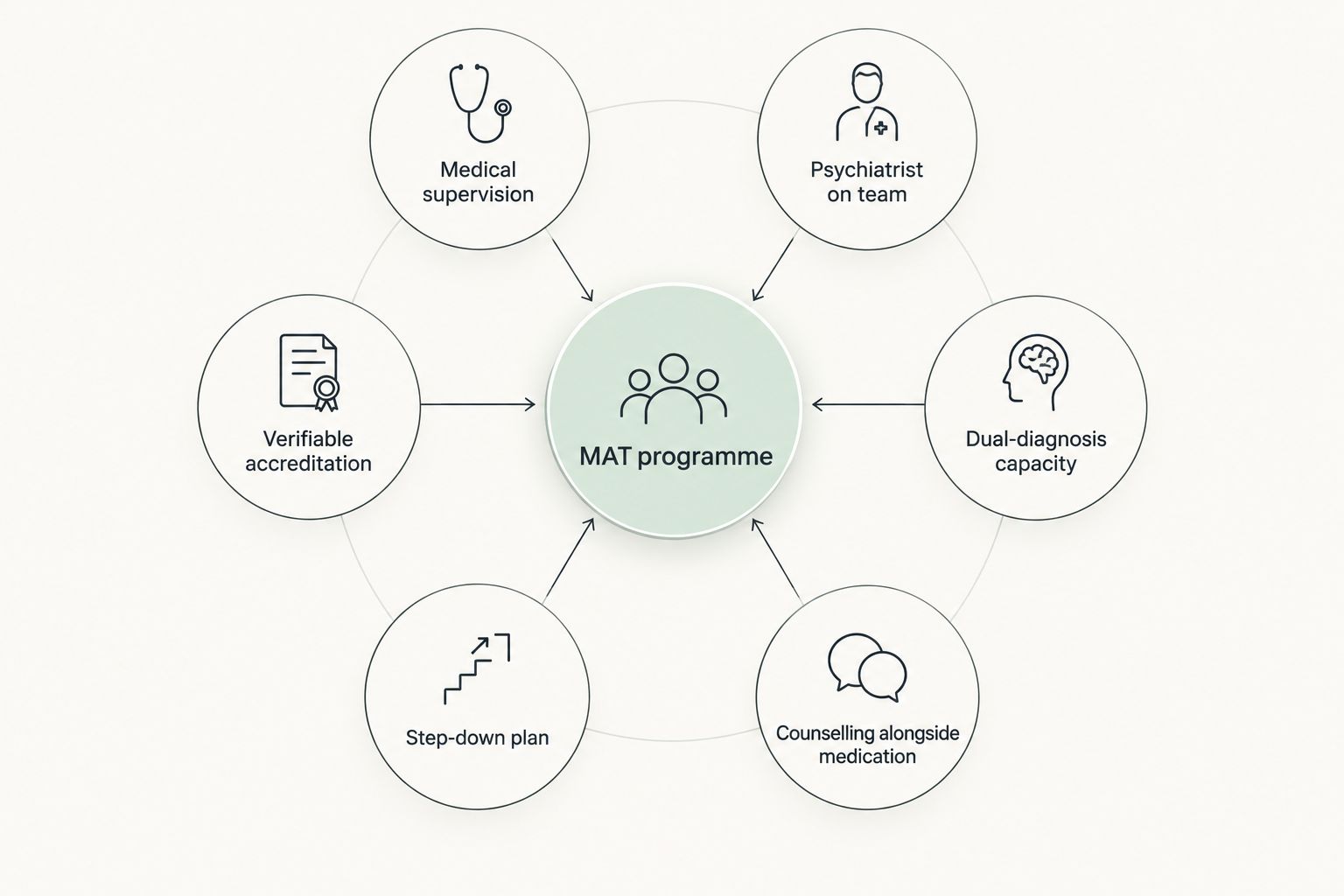
Rank any medication-assisted treatment rehab centre in South Africa against these six criteria before you trust a website's claims:
- 24-hour medical supervision during detox and medication induction
- A psychiatrist on the treatment team to manage and adjust medication over time
- Dual-diagnosis capacity for co-occurring depression, anxiety or PTSD
- Counselling running alongside medication, not instead of it
- A clear step-down plan once medication is stabilised
- Verifiable accreditation with South Africa's health authorities
Medication-assisted treatment rehab centres in South Africa: at a glance
| Care model | Best for | Standout feature | Key limitation |
|---|---|---|---|
| The Cedars | Patients needing medical detox before MAT-aligned therapy | Private inpatient stabilisation with individual treatment planning | Costs more than state-run care |
| Government-funded MAT clinics | Patients without medical aid or savings | No-cost access through public health facilities | Waiting lists in most provinces |
| Medical aid-covered MAT programs | Patients wanting private care through insurance | Private-facility standards with scheme accountability | Requires pre-authorisation and network checks |
| Intensive outpatient MAT programs | Working professionals who can't take extended leave | Treatment continues without full inpatient admission | Needs a stable, trigger-free home environment |
| Dual-diagnosis MAT programs | Patients with a diagnosed co-occurring condition | Treats mental health and substance dependence together | Typically a longer programme length |
1. The Cedars: best medication-assisted treatment rehab for medical detox before therapy
The Cedars is a private inpatient rehab centre in South Africa built around medically supervised detox before therapy begins. Stabilising a patient medically first is what makes the medication side of MAT-aligned treatment safe to introduce, and round-the-clock inpatient supervision catches withdrawal complications early rather than after the fact.

The Cedars pros:
- Medical detox on-site with round-the-clock supervision
- Private setting removed from work and family pressure during stabilisation
- Individual treatment planning instead of one fixed programme for every patient
The Cedars cons:
- Private inpatient care costs more than state-run alternatives
- Not built for a patient who needs to keep working through outpatient hours
Best for: patients who need medical stabilisation before starting MAT-aligned therapy.
Verdict: Recommended if you need supervised detox first.
2. Government-funded and free MAT-inclusive clinics: best for patients without medical aid
State and non-profit clinics extend MAT-aligned care to patients who can't afford private admission. Government-funded rehab centres exist in most provinces, though bed availability and medication access vary by region and facility.
Government-funded MAT clinics pros:
- No cost barrier for patients without medical aid or cash funds
- Available through public health facilities in most provinces
Government-funded MAT clinics cons:
- Waiting lists are common
- Less one-on-one time per patient than private inpatient care
Best for: patients without medical aid or savings who still need medically supervised care.
Verdict: Recommended if cost is the deciding factor.
3. Medical aid-covered private MAT programs: best for patients with insurance cover
Several private facilities in South Africa accept medical aid, which offsets some or all of the cost of a MAT-aligned admission depending on the scheme and plan chosen. Confirming medical aid rehab centres and their network status before admission avoids a surprise bill later.
Medical aid MAT programs pros:
- Costs partly or fully offset depending on the scheme
- Private-facility standards with insurance-backed accountability
Medical aid MAT programs cons:
- Requires pre-authorisation, and not every scheme covers the full stay
- Not every private facility sits on every scheme's network
Best for: patients who want private-facility care claimed through their medical aid.
Verdict: Recommended if your scheme covers behavioural health admissions.
4. Intensive outpatient MAT programs: best for working professionals
Intensive outpatient programmes keep medication management going without requiring a patient to step away from work entirely. These intensive outpatient programs fit patients who have already completed detox or who don't need inpatient stabilisation to start medication safely.
Intensive outpatient MAT pros:
- Patients keep working or studying during treatment
- Medication management continues without full inpatient admission
Intensive outpatient MAT cons:
- Requires a stable home environment free of triggers
- Not suitable for a patient who still needs supervision during induction
Best for: working professionals who can't take extended leave.
Verdict: Recommended once detox is already handled.
5. Dual-diagnosis MAT programs: best for co-occurring mental health conditions
Dual-diagnosis programmes treat substance dependence and a diagnosed mental health condition on the same treatment team, rather than referring one condition out to a separate provider. Untreated depression, anxiety or PTSD is a common relapse trigger once medication for the substance itself has been stabilised.
Dual-diagnosis MAT pros:
- Treats substance dependence and a mental health condition together
- Reduces relapse triggered by an untreated co-occurring condition
Dual-diagnosis MAT cons:
- Typically a longer programme than single-diagnosis treatment
- Needs a psychiatrist on the treatment team, which not every facility has
Best for: patients with a diagnosed co-occurring mental health condition.
Verdict: Recommended if a mental health diagnosis is already on record.
How we ranked these options
Each care model above is judged against the same six criteria: medical supervision during detox, a psychiatrist on the treatment team, dual-diagnosis capacity, counselling running alongside medication, a step-down plan, and verifiable accreditation. No single model wins on every criterion, and that's deliberate – a ranking that pretends one facility beats every other on every measure isn't honest about how rehab funding and readiness actually work in 2026.
The Cedars wins on medical supervision during the detox phase; government-funded clinics win on cost; medical aid-covered programs win on claimable cost with private standards; outpatient programs win on keeping a job during treatment; dual-diagnosis programs win on treating co-occurring conditions. Match your own situation to the criterion that matters most before you pick a name off a list.
Talk to The Cedars about MAT-aligned care
Ask which stage of treatment fits your situation before you commit.
Which medication-assisted treatment rehab centre should you choose?
If you haven't started detox yet and need medical supervision first, The Cedars is the default choice among medication-assisted treatment rehab centres in South Africa for 2026. If cost is the barrier, start with a government-funded clinic rather than waiting to save up for private care.
If your medical aid covers behavioural health, a private MAT program on your scheme's network gets you similar clinical standards with less waiting than the state system. If you can't step away from work, look at intensive outpatient programs once detox is behind you rather than before it. If a mental health diagnosis is already on file, pick a dual-diagnosis program over a single-focus one every time – treating one condition and ignoring the other is the most common reason MAT-aligned treatment fails to hold.
FAQ
What is medication-assisted treatment (MAT)?
Medication-assisted treatment combines prescribed medication with counselling to treat substance dependence, most often opioid or alcohol use disorder. Medications such as naltrexone, buprenorphine or acamprosate reduce cravings and withdrawal risk while therapy addresses the behaviour behind the dependence.
Is MAT rehab available in South Africa?
Yes, medication-assisted treatment rehab centres operate in South Africa across private inpatient, government-funded and outpatient settings. Availability of specific medications depends on the facility and the prescribing psychiatrist.
Does medical aid cover MAT rehab centres in South Africa?
Some medical aid schemes cover MAT-aligned rehab admissions, but coverage depends on the specific plan and requires pre-authorisation. Confirm network status and behavioural health benefits with your scheme before admission.
What medications are used in medication-assisted treatment?
Naltrexone, buprenorphine, methadone and acamprosate are common medications used in MAT, chosen based on the substance involved and the patient’s medical history. A psychiatrist on the treatment team decides which medication fits and adjusts dosage as treatment progresses.
Is MAT the same as replacing one addiction with another?
No, MAT medications are prescribed and monitored by a psychiatrist to stabilise brain chemistry, not to produce the same euphoric effect as the substance being treated. The goal is reducing cravings enough for counselling to work, not substituting a new dependence.
Can I access MAT as an outpatient in South Africa?
Yes, intensive outpatient MAT programs let patients continue medication management without full inpatient admission, provided detox is already handled and the home environment is stable. This route suits patients who need to keep working during treatment.
How long does a MAT-inclusive rehab programme last?
Programme length varies, with many South African inpatient options running 28 to 90 days before stepping down to outpatient medication management. Medication management itself often continues well beyond the inpatient stay.
Is The Cedars a MAT rehab centre?
The Cedars is a private inpatient rehab centre in South Africa that provides medically supervised detox and stabilisation, a step most MAT-aligned treatment plans build on. Confirm current medication protocols directly with the facility for your specific substance.
One last thing
Medication-assisted treatment is not a shortcut around therapy – it's a stabiliser that buys the brain enough calm to do the therapy work. A patient who stops medication the moment cravings ease, without a step-down plan already in place, is the single most common relapse pattern across MAT-aligned programmes in South Africa in 2026.
Before you ask a facility anything else, ask what their step-down plan looks like once medication is stabilised. That answer tells you more about whether a centre understands medication-assisted treatment than any brochure will.