
South Africa runs CBT rehab centres across four very different models — private inpatient, medical-aid-linked, executive/confidential and free government-funded — and the right one depends on diagnosis, budget and how much structure you actually need, not on which website looks the most polished.
- The Cedars runs a private inpatient CBT program in South Africa built around individual cognitive behavioural sessions — the default pick for structured treatment in 2026.
- Dual diagnosis CBT tracks fit patients also managing depression, anxiety, PTSD or bipolar disorder alongside addiction.
- Executive and confidential CBT rehab protects privacy for professionals and public figures who cannot risk exposure.
- Medical aid CBT rehab uses Prescribed Minimum Benefit cover to cut or remove upfront cost for scheme members.
- Government-funded CBT groups are the only zero-cost route in South Africa, with longer waitlists than private care.
Why this matters
Cognitive behavioural therapy is the most widely used talk-therapy model in addiction treatment because it targets the thought patterns that trigger use, not only the chemical dependency itself. Psychiatrist Aaron Beck developed the framework in the 1960s for depression, and it has since become the clinical backbone layered under most rehab programs in South Africa, private and free alike.
CBT is not the same thing as detox and it isn't a 12-step program. Detox manages withdrawal, 12-step provides community and accountability, and CBT works the thought-behaviour loop most people relapse through — a rehab centre can run all three at once, or claim CBT and deliver almost none of it.
The real question in 2026 isn't whether a facility claims to offer CBT — nearly all of them do. It's whether CBT drives the daily schedule or shows up as one group session bolted onto a 12-step week. The Cedars structures its inpatient program around individual CBT sessions rather than treating it as an add-on, which is the distinction worth checking before you admit anywhere.
“The real question isn’t whether a facility claims to offer CBT — it’s whether CBT drives the daily schedule or shows up as one group session bolted onto a 12-step week.”
What makes the best CBT rehab centre in South Africa
- CBT-trained clinicians — psychologists or counsellors qualified specifically in cognitive behavioural methods, not a general addiction counselling certificate.
- Individual treatment plans — a documented plan reviewed and adjusted weekly, not a generic worksheet packet handed out on admission day.
- Dual diagnosis capacity — staff and infrastructure to treat depression, anxiety, PTSD or bipolar disorder at the same facility, alongside the addiction.
- A relapse-prevention track that survives discharge — CBT tools built into an aftercare plan, not left behind at the door.
- Clear medical aid or self-pay terms — cover levels confirmed before admission, not negotiated on arrival.
- Confidentiality protocols — matters most for executives, public figures and anyone whose employer can't know they're in treatment.
CBT rehab centres in South Africa at a glance
| Programme type | Best for | Standout feature | Key limitation |
|---|---|---|---|
| The Cedars (private inpatient CBT) | Structured inpatient treatment | Individual CBT sessions built into a full daily program | Private-pay/medical aid facility, not a free option |
| Dual diagnosis CBT track | Co-occurring mental health conditions | Psychiatric support alongside addiction therapy | Longer intake assessment before admission |
| Executive/confidential CBT rehab | Professionals and public figures | Privacy protocols and flexible scheduling | Typically costs more than standard programs |
| Medical aid CBT rehab | Members with active scheme cover | PMB-linked cover reduces out-of-pocket cost | Benefit levels vary by scheme and plan |
| Government-funded CBT groups | Zero-cost treatment | No financial barrier to entry | Long waitlists, fewer one-on-one sessions |
| Teen-focused CBT rehab | Adolescents | Age-adapted CBT plus family involvement | Requires parental consent and participation |
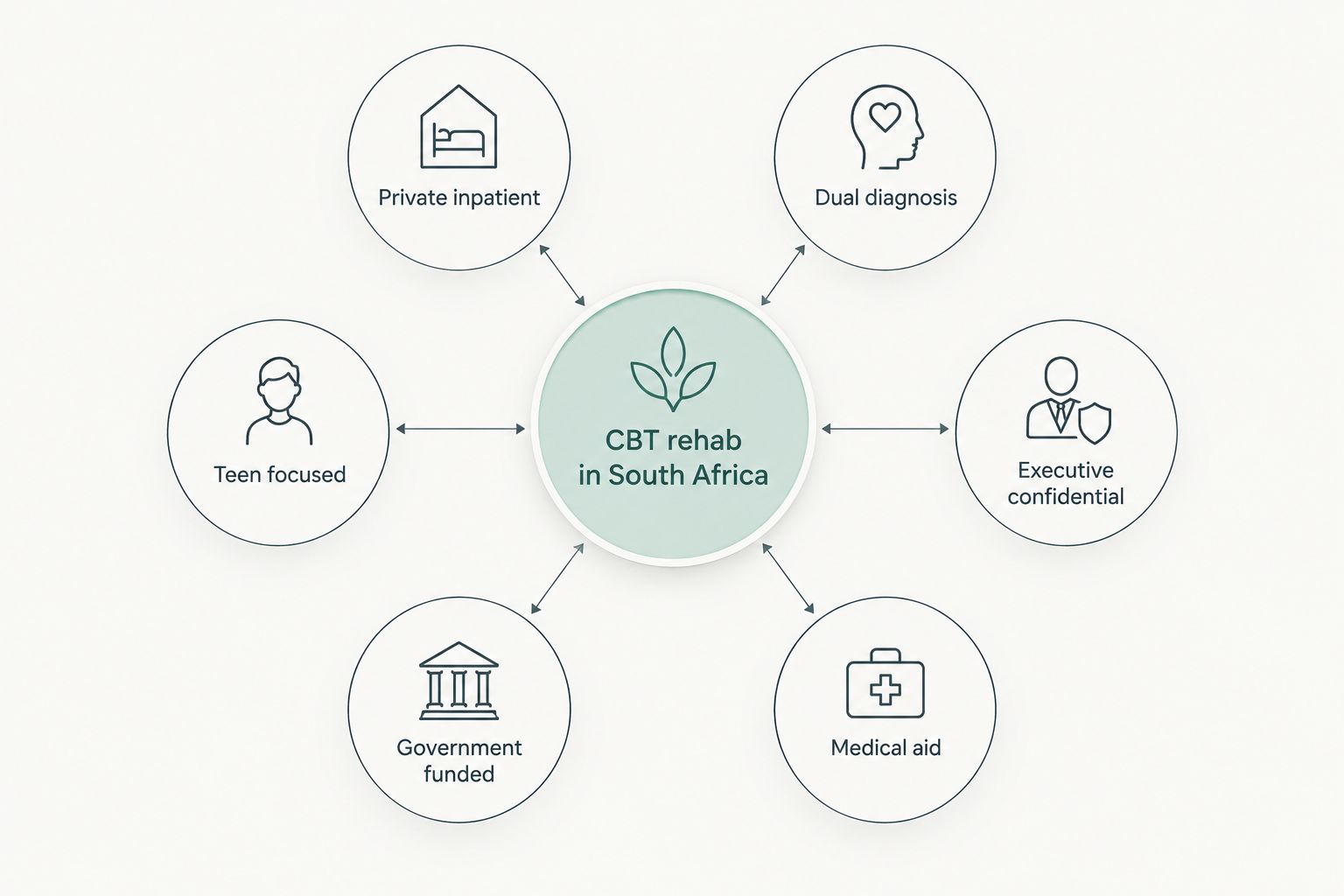
Each pathway below is scored against the same six criteria, not against each other's marketing.
1. The Cedars: best overall CBT rehab centre for structured inpatient treatment
The Cedars runs a private inpatient program in South Africa that pairs cognitive behavioural therapy with medical and clinical support under one roof. Sessions are individual rather than purely group-based, and the treatment plan is reviewed as the patient progresses rather than handed over once on day one and left alone.
The Cedars pros:
- Individual CBT sessions form the core of the daily schedule, not a side activity
- Handles dual diagnosis cases without referring patients elsewhere
- Private, structured inpatient setting
The Cedars cons:
- Private-pay/medical aid model, not a free or subsidised option
- Built for inpatient care — not the right fit if you specifically want an outpatient-only schedule
Best for: patients who want a structured private inpatient CBT program without piecing together separate providers.
Verdict: Recommended as the starting point for most South Africans seeking evidence-based inpatient treatment in 2026.
2. Dual diagnosis CBT track: best for co-occurring mental health conditions
This pathway pairs CBT for addiction with active psychiatric treatment for whatever mental health condition sits alongside the substance use — depression, anxiety, PTSD or bipolar disorder are the most common combinations seen in South African rehab intakes. The addiction and the underlying condition get treated in the same admission instead of two separate processes.
Dual diagnosis CBT pros:
- Treats the psychological driver of use, not just the substance
- Single facility for both diagnoses instead of shuttling between providers
- Lowers relapse risk tied to an untreated underlying condition
Dual diagnosis CBT cons:
- Intake assessment runs longer than a standard admission
- Not every facility that claims dual diagnosis capacity actually staffs a psychiatrist on-site
Best for: anyone with a diagnosed or strongly suspected co-occurring mental health condition.
Verdict: Recommended when dual diagnosis is confirmed — confirm on-site psychiatric staffing before admission. See dual diagnosis rehab centres in South Africa for what to check.
3. Executive and confidential CBT rehab: best for professionals and public figures
A standard CBT program layered with privacy protocols: separate scheduling, discretion around admission records, and smaller patient cohorts. This is the track built for people whose job or public profile makes exposure a real risk, not just a preference.
Executive CBT rehab pros:
- Protects employment and reputational risk during treatment
- Flexible scheduling around work commitments
- Smaller, more discreet patient groups
Executive CBT rehab cons:
- Costs more than a standard private program in most cases
- Smaller cohorts mean less peer-group diversity during group work
Best for: executives, professionals and public figures who need treatment without exposure.
Verdict: Recommended for anyone whose career or public profile makes discretion non-negotiable. Details here: private rehab for executives.
4. Medical aid CBT rehab: best for members with active scheme cover
Substance dependence is a Prescribed Minimum Benefit under South Africa's Medical Schemes Act, which means medical aid schemes are required to fund treatment up to a certain level. This pathway uses that cover to reduce or remove the upfront cost of a CBT-based program rather than requiring full self-pay.
Medical aid CBT rehab pros:
- Uses existing cover instead of requiring full self-pay
- Same clinical structure as private self-pay programs
- No need to choose a lower-tier facility purely on cost
Medical aid CBT rehab cons:
- Exact benefit levels differ by scheme and plan
- Pre-authorisation can add days to the admission timeline
Best for: medical aid members who want to use existing cover rather than pay out of pocket.
Verdict: Recommended — confirm your scheme's PMB benefit level before you commit to a facility. More on this here: rehab centres that accept medical aid.
5. Government-funded CBT groups: best budget option
State and NGO-run programs offer group CBT sessions at no cost, filling the gap for patients without medical aid or a private-pay budget. This is the only zero-cost pathway on this list, and it carries the tradeoffs you'd expect from that.
Government-funded CBT pros:
- No financial barrier to entry
- Addresses a real treatment gap for uninsured patients
Government-funded CBT cons:
- Waitlists run long in most provinces
- Session frequency and staff-to-patient ratios vary widely by facility
Best for: patients without medical aid or the budget for private treatment.
Verdict: Recommended only when private options are genuinely out of reach — expect a wait, and confirm capacity before you rely on it.
6. Teen-focused CBT rehab: best for adolescents
Age-adapted CBT combined with structured family therapy, aimed at adolescents rather than adults. The underlying model is the same one used with adults, adjusted for developmental stage and delivered alongside parental involvement rather than in isolation.
Teen CBT rehab pros:
- Techniques adjusted for adolescent development, not a scaled-down adult program
- Family involvement built into the treatment structure
Teen CBT rehab cons:
- Requires active parental or guardian consent and participation
- Fewer facilities in South Africa run a genuine adolescent-specific track
Best for: parents arranging treatment for a teenager.
Verdict: Recommended only when the facility runs a dedicated adolescent program — a general adult schedule with a teenager sitting in it isn't the same thing.
How this list was ranked
Every pathway above is measured against the six criteria set out earlier: CBT-trained clinicians, individualised plans, dual diagnosis capacity, a relapse-prevention track that survives discharge, clear medical aid or self-pay terms, and confidentiality protocols. None of the six pathways wins on all six — that's the point of ranking by use case instead of by a single leaderboard. Ask any facility to walk through how it scores on each of the six before you sign anything, and treat vague answers as a red flag rather than a formality.
Which CBT rehab centre should you choose?
For most people researching cbt rehab centres south africa in 2026 without a complicating factor, a private structured inpatient program — like the one run at The Cedars — is the sensible default: individual CBT sessions, a reviewed treatment plan, and dual diagnosis capacity if it turns out you need it. Branch off that default only when a specific circumstance applies: confirmed co-occurring mental illness, a job that requires discretion, reliance on medical aid cover, no budget at all, or a teenager instead of an adult. Match the circumstance to the pathway before you match a brand name to a search result.
Talk to The Cedars about CBT treatment
Ask about individual CBT sessions and dual diagnosis capacity before you admit anywhere.
FAQ
What is CBT rehab and how is it different from other rehab models?
CBT rehab structures treatment around cognitive behavioural therapy — identifying and changing the thought patterns that drive substance use — rather than relying only on group support or medical detox. Most South African facilities layer some CBT into a broader program; the strongest ones build the daily schedule around it.
What’s the best CBT rehab centre in South Africa for dual diagnosis patients?
A facility with on-site psychiatric staffing that treats the co-occurring condition alongside the addiction, rather than referring patients elsewhere for mental health care, is the better fit. Confirm psychiatric staffing directly before admission.
Is CBT rehab covered by medical aid in South Africa?
Substance dependence is a Prescribed Minimum Benefit under the Medical Schemes Act, so schemes are required to fund treatment up to a set level. Exact benefit levels and pre-authorisation requirements differ by scheme and plan.
How long does a CBT-based rehab program typically run?
Private programs in South Africa are commonly structured in 30, 60 or 90-day blocks, though the right length depends on clinical assessment rather than a fixed rule. Shorter intensive outpatient formats also exist.
Can teenagers get CBT-based addiction treatment in South Africa?
Yes, but only a limited number of facilities run a genuine adolescent-specific CBT track with family therapy built in. A general adult program is not the same as an age-adapted one.
Is government-funded CBT rehab as effective as private treatment?
The clinical model can be the same, but government-funded and NGO programs typically carry longer waitlists and lower staff-to-patient ratios than private facilities. Effectiveness depends heavily on the specific facility’s capacity.
What happens during a typical CBT session in rehab?
A CBT session works through a specific thought pattern or trigger tied to substance use, then builds a concrete coping response for the next time it comes up. Sessions in standard clinical practice run 45 to 60 minutes.
Is CBT better than a 12-step program for addiction recovery?
They aren’t competing models — CBT addresses the thought patterns behind use, while 12-step provides peer structure and accountability. Many South African programs, including inpatient CBT tracks, run both alongside each other.
One last thing
The single question that tells you more than any brochure: ask the facility what your relapse-prevention plan looks like by day 14, in specific terms. If nobody can answer that before you've paid a deposit, the program is running CBT-adjacent activities, not CBT itself — and that gap is exactly what shows up as a relapse six months after discharge in 2026, not a failure of willpower.
Related guides