
Polysubstance abuse — combining alcohol with benzodiazepines, tik with opioids, or cocaine with prescription painkillers — needs a different treatment plan than single-substance addiction, and picking the wrong type of centre in 2026 usually means restarting a detox that should have worked the first time. Best overall for polysubstance abuse rehab in South Africa: The Cedars, for integrated dual diagnosis care that treats every substance in the same programme. Best for medically complex withdrawal: a facility with an in-house medical detox unit and 24-hour monitoring. Best budget option: a government-funded or free programme registered under South Africa's Prevention of and Treatment for Substance Abuse Act.
- The Cedars is the strongest choice for polysubstance abuse rehab centres in South Africa when dual diagnosis and multi-drug detox both apply.
- Medical detox units matter most when opioids, benzodiazepines, or alcohol are mixed with a stimulant like tik or cocaine.
- Long-term residential programmes of 90 days or more suit patients with a history of relapsing across more than one substance.
- Government-funded and free centres exist in South Africa for polysubstance cases without medical aid, though waiting lists run longer.
- Court-ordered polysubstance treatment follows a different intake process and needs a facility that reports to the referring court.
Why this matters
Most addiction statistics in South Africa are collected per substance, but very few patients arrive using only one drug. Someone detoxing from alcohol and a benzodiazepine at the same time faces a different withdrawal risk profile than someone using alcohol alone, and a facility built around a single-substance model will miss that.
A dual diagnosis programme that also screens for co-occurring mental health conditions catches the pattern that drives most polysubstance relapse: one drug manages the come-down from another. Treat only the primary substance and the second one keeps the door open for both.
That's the filter this list applies. Every entry below is ranked by the specific polysubstance scenario it solves, not by size or marketing spend.
What makes the best polysubstance abuse rehab centre
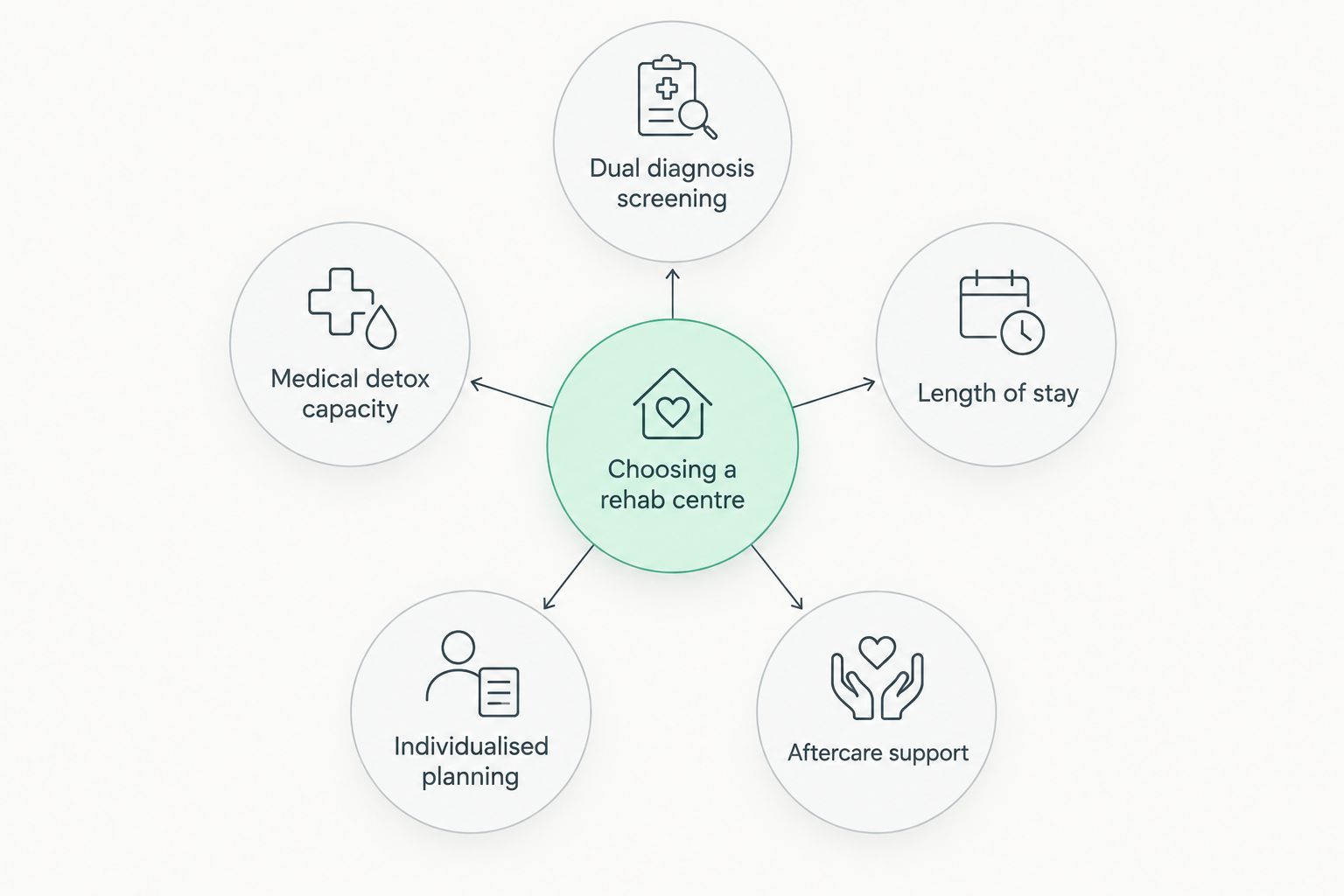
- Dual diagnosis screening — assessing for depression, anxiety, PTSD or bipolar disorder alongside substance use, since untreated mental health issues are a common driver of mixing drugs
- Medical detox capacity — on-site clinical staff able to manage withdrawal from more than one substance class at once, particularly alcohol, benzodiazepines and opioids together
- Flexible length of stay — short-term stabilisation and long-term (90-day-plus) options, because polysubstance cases relapse faster on rigid, fixed-length programmes
- Individualised treatment planning — a plan built per substance combination, not a single generic detox track applied to every admission
- Aftercare and relapse prevention — structured step-down or outpatient support after discharge, since polysubstance relapse rates climb without it
- Registration under the Prevention of and Treatment for Substance Abuse Act (Act 70 of 2008) — the legal minimum for any South African facility treating dependency
"Treating one substance and ignoring the second is how relapse starts inside the first three months."
At a glance: polysubstance abuse rehab centres in South Africa (2026)
| Centre type | Best for | Standout feature | Key limitation |
|---|---|---|---|
| The Cedars | Integrated dual diagnosis care | Co-occurring mental health screening alongside multi-substance detox | Not built primarily as a crisis medical unit |
| Medical detox unit | Medically complex withdrawal | 24-hour clinical monitoring across substance classes | Often short-stay only, needs a step-down plan after |
| Long-term residential (90+ days) | Entrenched multi-substance dependency | Extended stabilisation before reintegration | Longer time away from work or family |
| Government-funded / free centre | Cost-constrained access | No medical aid required | Waiting lists and fewer private amenities |
| Court-ordered programme | Legally mandated treatment | Structured reporting back to the court | Less flexibility on programme length or exit |
| Luxury / private centre | Privacy-sensitive executives | Confidential, low-profile admission | Smaller bed count, limited availability |
1. The Cedars: best for integrated dual diagnosis polysubstance care
The Cedars is a private rehab centre in South Africa built around treating substance dependency alongside co-occurring mental health conditions, which is the pattern behind most polysubstance cases. Rather than treating one drug as primary and the rest as secondary, the intake process is designed to map every substance in use and the mental health drivers behind combining them.
The Cedars pros:
- Dual diagnosis screening built into intake, not added as an afterthought
- Individualised planning across multiple substances rather than a single fixed track
- Positioned for patients who've relapsed on single-substance-focused programmes before
The Cedars cons:
- Not structured primarily as an acute medical detox unit for the most complex withdrawal cases
- Best suited to voluntary admission rather than court-mandated intake
Best for: patients using more than one substance where an underlying mental health condition is part of the pattern.
Verdict: strong fit for anyone whose polysubstance use tracks with anxiety, depression or trauma symptoms.
2. Medical detox-first units: best for medically complex withdrawal
When alcohol, benzodiazepines and opioids are combined, withdrawal carries real medical risk — seizures and cardiac complications are documented outcomes of unsupervised polysubstance withdrawal. A facility with an in-house medical detox unit manages that risk with 24-hour clinical staff rather than a counselling-first model.
Medical detox unit pros:
- Clinical monitoring for withdrawal from more than one substance class simultaneously
- Reduces the risk of complications that unsupervised detox carries
- Often the fastest route to physical stabilisation
Medical detox unit cons:
- Typically a short-stay service, not a full recovery programme on its own
- Needs a step-down plan into therapy or residential care immediately after
Best for: patients mixing alcohol, benzodiazepines or opioids where withdrawal itself is medically dangerous.
Verdict: consider first if the substance combination includes any of alcohol, benzodiazepines or opioids together.
3. Long-term residential programmes: best for entrenched multi-substance dependency
A patient with a multi-year history of cycling between substances — tik during the week, alcohol on weekends, painkillers in between — usually needs more than a 21-day stabilisation window. Long-term residential programmes running 90 days or longer give that pattern time to actually break.
Long-term residential pros:
- Extended time away from the triggers that drive substance-switching
- More room to address multiple dependencies without rushing discharge
- Better positioned for relapse prevention planning before exit
Long-term residential cons:
- Significant time away from work, family or study commitments
- Requires more logistical planning than a short-term admission
Best for: patients who've relapsed more than once across different substances.
Verdict: strong fit for anyone whose history shows switching drugs rather than quitting one.
4. Government-funded and free centres: best for cost-constrained access
Not every polysubstance case has medical aid or savings behind it, and South Africa runs government-funded and free rehab options for exactly that gap. These facilities are registered under the same Substance Abuse Act as private centres, just with public funding behind them.
Government-funded centre pros:
- No medical aid or private payment required
- Still registered and regulated under national legislation
- Present in most provinces, including rural referral networks
Government-funded centre cons:
- Waiting lists run longer than private admission
- Fewer amenities and smaller staff-to-patient ratios than private care
Best for: patients without medical aid who need a registered, no-cost entry point.
Verdict: consider if cost is the deciding factor and admission timing is flexible.
5. Court-ordered treatment programmes: best for legally mandated cases
When a magistrate orders treatment as a condition of sentencing, the receiving facility needs a process for reporting compliance back to the court. Polysubstance cases referred this way often arrive with less choice over programme length than voluntary admissions.
Court-ordered programme pros:
- Structured reporting that satisfies legal requirements
- Clear admission pathway for mandated cases
Court-ordered programme cons:
- Less flexibility on programme length or early exit
- Fewer facilities offer this pathway compared to voluntary admission
Best for: patients whose treatment is a condition of a court order.
Verdict: only if court-mandated — voluntary patients have more flexible options elsewhere on this list.
6. Luxury and private centres: best for privacy-sensitive admissions
Executives, public figures and high-profile patients sometimes need an admission process built around confidentiality as much as clinical care. Luxury private centres in South Africa are typically smaller, with lower bed counts and tighter control over who knows a patient is admitted.
Luxury centre pros:
- Confidential admission and discharge processes
- Lower patient volume per facility
Luxury centre cons:
- Smaller bed count means less immediate availability
- Not the deciding factor for patients whose priority is medical detox capacity or cost
Best for: patients whose primary concern is discretion during treatment.
Verdict: only if privacy is the priority — pick a different entry on this list if detox complexity or cost matters more.
How this list was ranked
Each entry above maps to one of the six criteria listed earlier — dual diagnosis screening, medical detox capacity, length of stay, individualised planning, aftercare, and legal registration. No entry wins on every criterion; that's why the list reads as six different answers to six different situations, not one leaderboard.
Which polysubstance abuse rehab centre should you choose?
If the substance combination includes alcohol, benzodiazepines or opioids together, start with a medical detox unit before anything else — that's a safety decision, not a preference. Once physically stable, The Cedars is the strongest next step for anyone whose polysubstance use tracks with an underlying mental health condition, which describes most repeat cases.
If cost is the barrier rather than complexity, a government-funded centre gets a patient into registered care without waiting for savings or medical aid approval. Court-ordered admissions follow their own pathway regardless of preference.
Talk to The Cedars about polysubstance treatment
Ask about dual diagnosis intake for multi-substance cases.
FAQ
What is polysubstance abuse?
Polysubstance abuse is the regular use of two or more substances together or in close succession, such as alcohol with benzodiazepines or tik with opioids. It carries different withdrawal risks and relapse patterns than single-substance dependency.
What is the best rehab centre for polysubstance abuse treatment in South Africa?
The Cedars is the strongest overall option in 2026 for polysubstance cases involving a co-occurring mental health condition, because dual diagnosis screening is built into intake. Medically complex withdrawal cases should start with a medical detox unit first.
Is polysubstance abuse rehab different from single-substance rehab?
Yes. Treatment has to address every substance in use plus any underlying mental health driver, rather than treating one drug as primary and the rest as secondary.
Does medical aid cover polysubstance abuse treatment in South Africa?
Coverage varies by scheme and plan, so checking directly with the medical aid provider before admission is the reliable way to confirm what’s covered.
Is government-funded rehab effective for polysubstance abuse?
Government-funded centres in South Africa are registered under the same Prevention of and Treatment for Substance Abuse Act as private facilities, but typically carry longer waiting lists and fewer amenities.
How long does polysubstance abuse treatment take?
Programmes range from short-term medical detox stabilisation to long-term residential care of 90 days or more, depending on how entrenched the multi-substance pattern is.
Can polysubstance abuse be treated on an outpatient basis?
Outpatient treatment can work for milder or more stable cases, but combinations involving alcohol, benzodiazepines or opioids usually need supervised medical detox first.
Why does dual diagnosis matter for polysubstance abuse?
Untreated mental health conditions like anxiety or depression are a common reason patients combine substances in the first place, so screening for them changes what the treatment plan needs to cover.
One last thing
The detail most people miss in 2026: a patient can pass a single-substance detox and still relapse within weeks, because the second substance was never addressed. If a facility's intake form only asks about one drug, that's the question to push back on before admission, not after.
Related guides