
Nyaope addiction rehab centres in South Africa fall into five distinct care models, and picking the wrong one wastes weeks a withdrawal-prone patient doesn't have. This guide ranks those models by what actually keeps someone in treatment past week one in 2026.
- Nyaope withdrawal carries real medical risk — centres with onsite detox rank above talk-only programs.
- Most long-term nyaope users carry co-occurring depression, anxiety or trauma that needs dual-diagnosis care.
- Government-funded and free centres are the realistic budget option in 2026, with longer waitlists.
- Court-ordered and 90-day-plus programs suit repeat relapse and legal mandates, not first-time treatment.
- The Cedars runs a dedicated nyaope treatment track with onsite medical detox and dual-diagnosis care.
Why this matters
Nyaope (also called whoonga in parts of KwaZulu-Natal) is usually a mix of low-grade heroin, cannabis and whatever cutting agents a dealer had on hand that week. That mix is the reason generic outpatient counselling fails so often — the opioid component means withdrawal can involve vomiting, tremors, and cardiovascular strain that a lounge-and-talk facility isn't equipped to manage.
The centres worth calling in 2026 are the ones that treat nyaope as a medical detox problem first and a behavioural problem second. The Cedars' nyaope addiction treatment programme is built on that order, and it's the order every family should check for before booking a bed anywhere.
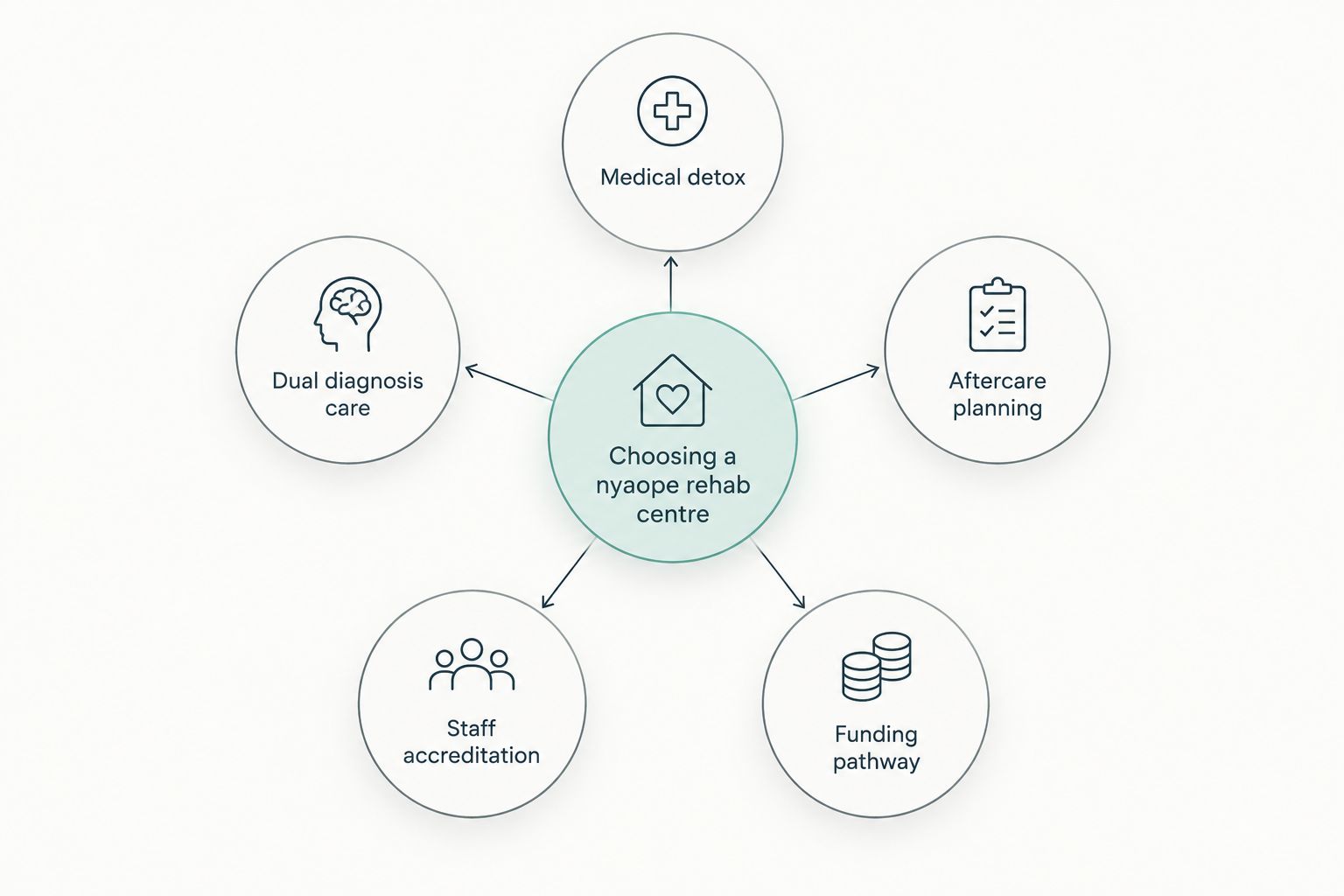
What makes the best nyaope rehab centre
- Onsite medical detox — nurses and doctors monitoring withdrawal round the clock, not a referral to a clinic down the road
- Dual-diagnosis capacity — trained staff who treat depression, anxiety or trauma alongside the addiction, not after it
- Registered status — centres operating under South Africa's Prevention of and Treatment for Substance Abuse Act framework
- Aftercare planning — a relapse-prevention plan that starts before discharge, not on the day of it
- A realistic funding pathway — private pay, medical aid, or government subsidy, matched to what the family can actually sustain
- Flexible length of stay — the option to extend past 28 days when relapse history calls for it
Nyaope rehab centres at a glance
| Care model | Best for | Standout feature | Key limitation |
|---|---|---|---|
| Medical detox & stabilisation | Physical safety during withdrawal | 24-hour clinical monitoring | Higher staffing means fewer available beds |
| Dual-diagnosis centres | Co-occurring depression, anxiety, trauma | Psychiatric care alongside detox | Longer intake assessment before admission |
| Government-funded & free centres | Families without private funds | No or low cost to the patient | Waitlists can run for weeks |
| Long-term residential (90+ days) | Repeat relapse patients | Extended structure past the 28-day norm | Requires time away from work or school |
| Court-ordered treatment programs | Legally mandated admissions | Structured reporting to courts or probation | Limited choice over facility or pace |
1. Medical detox and stabilisation centres: best overall for withdrawal safety
This is the model that matters most for nyaope specifically, because the drug's opioid content makes unsupervised withdrawal genuinely dangerous. A stabilisation unit runs bloodwork, manages symptoms with medication where needed, and holds the patient until they're physically fit for the next phase of treatment.
Medical detox pros:
- Clinical staff present around the clock during the highest-risk days
- Reduces the chance of a patient walking out mid-withdrawal
- Sets up a cleaner transition into therapy once the body has stabilised
Medical detox cons:
- Costs more than an outpatient-only program
- Not every centre advertising "detox" has a doctor on site — ask directly
The Cedars pairs this stage with its medical detox units, which is the reason it sits at the top of this list for nyaope cases rather than lower down for general substance use.
Verdict: Buy — start here if withdrawal risk is the immediate concern.
2. Dual-diagnosis centres: best for co-occurring mental health conditions
Many people who end up on nyaope were already carrying untreated depression, anxiety or trauma before the addiction started. A centre that only addresses the substance use and skips the psychiatric side sets a patient up to relapse the moment the underlying condition resurfaces.
Dual-diagnosis pros:
- Psychiatric assessment happens alongside detox, not months later
- Medication management for depression or anxiety runs in parallel with recovery work
- Lower relapse triggers because the root condition gets treated, not ignored
Dual-diagnosis cons:
- Intake assessments take longer than a standard admission
- Requires a psychiatrist on staff, which not every private centre has
Centres offering this level of care, including dual-diagnosis programs, are worth the extra intake time for anyone with a known mental health history.
Verdict: Buy — essential if depression, anxiety or trauma preceded the addiction.
3. Government-funded and free centres: best budget option
South Africa has state and NGO-run facilities that admit patients at no or low cost, and for families with no medical aid and no spare cash, this is the realistic entry point in 2026. Quality varies more than in the private sector, and demand consistently outstrips bed capacity.
Free centre pros:
- No cost barrier to starting treatment
- Some run structured, evidence-based programs despite limited resources
Free centre cons:
- Waitlists can stretch for weeks while addiction progresses
- Staff-to-patient ratios are typically lower than private facilities
- Medical detox capacity is inconsistent between locations
Verdict: Hold if a private bed is reachable; Buy if it's the only funded option available now.
4. Long-term residential programs (90+ days): best for repeat relapse
A 28-day stay works for a first admission with a stable home environment to return to. It works far less well for someone who has relapsed on nyaope multiple times, where the underlying habits and triggers need more than a month to unwind.
Long-term program pros:
- More time to rebuild routine, employment plans, and sober relationships
- Deeper relapse-prevention work than a standard 28-day model allows
Long-term program cons:
- Extended time away from work, family or study
- Fewer facilities offer stays past 90 days, so options narrow
Verdict: Buy for anyone with two or more prior relapses; Wait if this is a first attempt at treatment.
5. Court-ordered treatment programs: best for legally mandated admissions
When a nyaope-related charge results in a court-mandated treatment order, the facility needs formal reporting structures to probation officers or the court itself. This isn't a voluntary-admission model, and the patient has less say over pace or facility choice.
Court-ordered program pros:
- Satisfies legal requirements while still delivering structured treatment
- Often paired with case management that continues after discharge
Court-ordered program cons:
- Limited flexibility on which centre or program the patient attends
- Success depends heavily on the patient's own willingness, which a court order can't manufacture
Verdict: Buy when court-mandated; not the right fit for voluntary first admissions.
How this list was ranked
Each care model was weighed against the six criteria above — medical detox capability, dual-diagnosis capacity, registration status, aftercare planning, funding realism, and length-of-stay flexibility. Medical detox and dual-diagnosis care carried the most weight because nyaope's opioid content makes both genuinely load-bearing, not optional extras.
“Withdrawal risk, not willpower, decides whether nyaope treatment needs a medical detox unit first.”
Which nyaope rehab centre should you choose?
If cost isn't the deciding factor, start with a medical detox and dual-diagnosis centre — nyaope's opioid content and the high rate of co-occurring mental health conditions make that combination the safest starting point in 2026. If funding is the real constraint, a government-funded centre is the honest next step, with the understanding that waitlists are part of the tradeoff. Repeat relapse cases should look at long-term residential stays past 90 days rather than cycling through short admissions again.
Check admission options for nyaope treatment
See how medical detox and dual-diagnosis care fit into a nyaope recovery plan.
FAQ
What is the best type of rehab centre for nyaope addiction in South Africa?
A centre with onsite medical detox and dual-diagnosis care is the safest starting point in 2026, because nyaope’s opioid content makes unsupervised withdrawal risky and many users carry untreated mental health conditions.
Is nyaope addiction treated differently from other drug addictions?
Yes — nyaope typically contains low-grade heroin mixed with other substances, so withdrawal needs medical supervision similar to opioid detox rather than a standard counselling-only approach.
Are there free rehab centres for nyaope addiction in South Africa?
Government-funded and NGO-run centres admit nyaope patients at no or low cost, though waitlists are typically longer than at private facilities.
How long does nyaope rehab take?
Programs commonly run 28 days for a first admission, with long-term options past 90 days for patients with a history of repeat relapse.
Do nyaope rehab centres treat co-occurring mental health conditions?
Dual-diagnosis centres treat depression, anxiety or trauma alongside the addiction, which lowers the relapse risk that comes from leaving the underlying condition untreated.
Can someone be court-ordered into nyaope rehab in South Africa?
Yes — court-ordered treatment programs exist for legally mandated admissions and include reporting structures back to the court or a probation officer.
Is medical detox necessary for nyaope withdrawal?
It’s strongly recommended — nyaope’s opioid component can produce withdrawal symptoms serious enough to need clinical monitoring rather than an unsupervised home detox.
What should I check before choosing a nyaope rehab centre?
Confirm onsite medical detox, dual-diagnosis staffing, registration under South Africa’s substance abuse treatment framework, and a discharge aftercare plan before booking a bed.
One last thing
The detail families miss most often: nyaope's exact composition changes from batch to batch, so the same person's withdrawal experience can differ between uses. That unpredictability is precisely why a rehab centre with clinical monitoring beats a purely residential, talk-based program for nyaope specifically — the risk isn't consistent enough to guess at.
Related guides
- Best free and government-funded rehab centres in South Africa
- Rehab options for court-ordered addiction treatment in South Africa