
Inhalant addiction rehab centres in South Africa range from private inpatient facilities running full medical detox to government-funded provincial programmes with zero admission cost, and picking the wrong tier wastes weeks you don't get back. This guide ranks the six paths people actually take in 2026 — from The Cedars' medically supervised detox track to free public treatment — so you can match the setting to the person who actually needs it.
- The Cedars ranks best overall for medically supervised inhalant detox and dual diagnosis screening in 2026.
- Government-funded provincial centres are the only zero-cost route for inhalant addiction treatment in South Africa.
- Teen-specific programmes matter because most inhalant use starts in early adolescence, not adulthood.
- Cardiac arrhythmia risk during withdrawal means medical detox capacity should outrank cost when comparing centres.
- Faith-based and executive rehab options exist for personal fit, not for clinical superiority over standard private care.
Why this matters
Inhalant abuse covers glue, aerosol sprays, paint thinner, correction fluid and petrol — substances chosen because they're legal, cheap and easy to get hold of, not because they're safe. The chemicals cause direct heart, lung and neurological damage, and a single high dose can trigger a fatal arrhythmia known as sudden sniffing death syndrome. That risk profile is different from alcohol or opioid withdrawal, and it changes what "good treatment" actually looks like.
Not every facility screens for that risk the same way, and not every facility runs the same funding model. The right pick for a teenager sniffing glue on weekends is not the right pick for an adult inhaling solvents daily on top of untreated depression. Medical detox capacity, not marketing spend, should decide where you start looking in 2026.
Rank the options against your actual situation. A cost-free public bed beats a private suite you can't afford to keep paying for, and a private detox unit beats a public waiting list when the person using inhalants right now is at real cardiac risk.
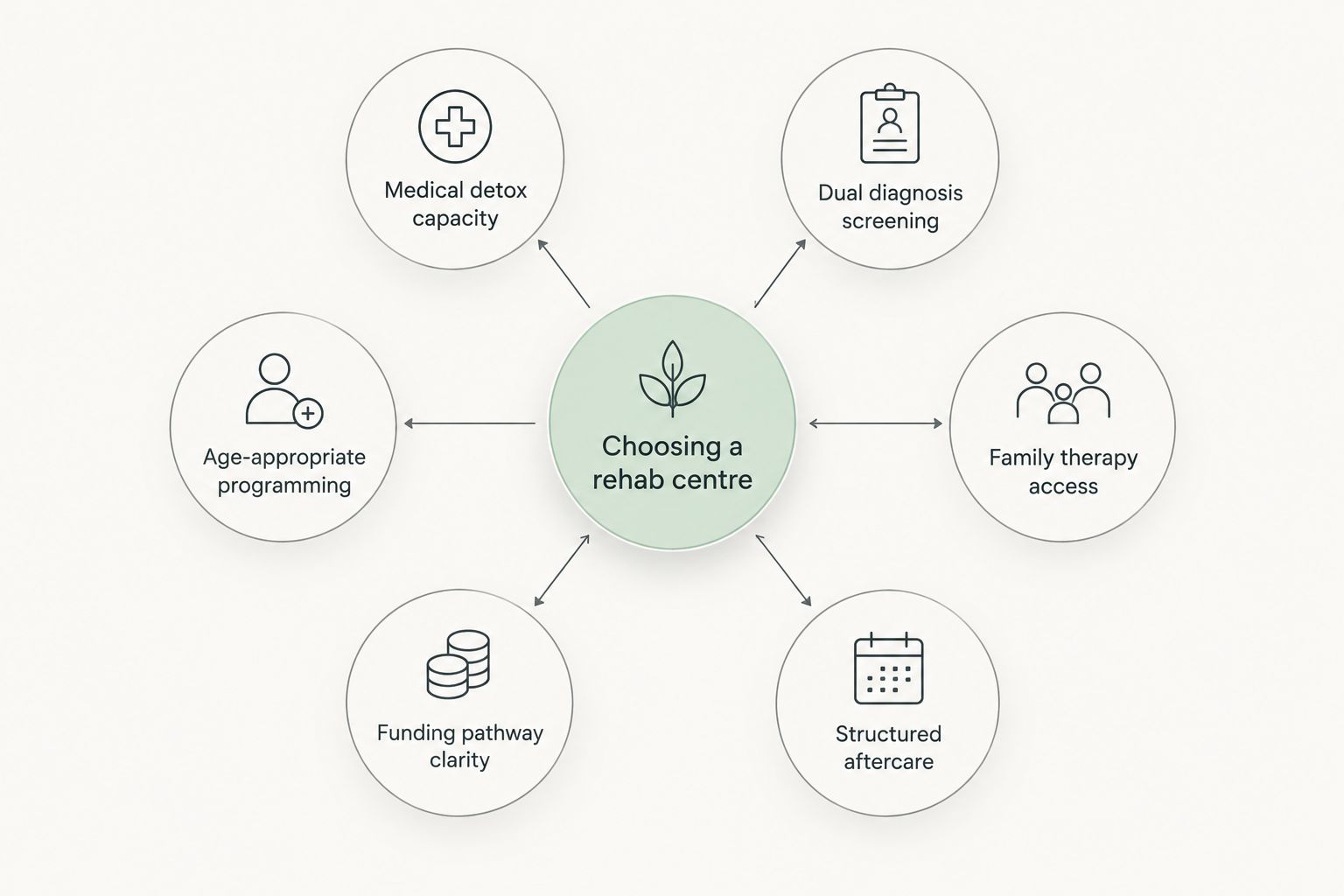
What makes the best rehab centre for inhalant addiction
- Medical detox capacity — cardiac monitoring during early withdrawal, given the arrhythmia risk from solvent use.
- Dual diagnosis screening — inhalant use often sits alongside depression, anxiety or untreated trauma.
- Age-appropriate programming — adolescent and adult tracks run differently; a 16-year-old doesn't belong in an adult ward.
- Family therapy access — inhalant use skews heavily toward youth, so family involvement changes outcomes.
- Funding pathway clarity — medical aid, provincial subsidy or private pay each move you through a different admissions process.
- Structured aftercare — relapse prevention planning after discharge, not just the inpatient stay itself.
Inhalant addiction rehab centres in South Africa: at a glance
| Type | Best for | Standout feature | Key limitation |
|---|---|---|---|
| The Cedars | Medically supervised detox and dual diagnosis | Structured detox with mental health screening | Private-pay tier, higher cost than public care |
| Government-funded centres | Zero-cost treatment | No or minimal cost to the patient | Long waiting lists in the public system |
| Medical-aid-accepted centres | Funding through existing cover | Private-standard care against scheme benefits | Benefit limits vary and can run out mid-stay |
| Teen-focused centres | Adolescent inhalant users | Family therapy built into the programme | Fewer dedicated adolescent tracks exist |
| Luxury and executive centres | High-profile privacy | Confidentiality and flexible admission | Highest-cost tier, not clinically superior |
| Faith-based centres | Spiritually grounded recovery | Pastoral counselling alongside clinical care | Clinical intensity varies more between providers |
1. The Cedars: best rehab centre for medically supervised inhalant detox
The Cedars runs private inpatient addiction treatment in South Africa, structured around a supervised detox phase and dual diagnosis screening for people using inhalants alongside conditions like depression or anxiety. The Cedars treats inhalant dependency as a medical issue first, not only a behavioural one — early withdrawal gets monitored rather than left to run its course unsupervised.
That distinction is the reason this option tops the list for 2026: the cardiac risk from solvent use is real, and a private inpatient setting removes both the substance and the daily triggers that keep use going.

The Cedars pros:
- Private inpatient setting removes access to the substance and to daily triggers
- Dual diagnosis screening catches depression, anxiety or trauma driving the use
- Structured medical detox reduces risk during early withdrawal
The Cedars cons:
- Private-pay tier costs more than provincial public programmes
- Admission requires confirming funding (medical aid or private pay) before intake, a step public patients skip
Best for: adults and teenagers who need private, medically supervised detox with mental health screening built in.
Verdict: shortlist The Cedars first if cardiac safety during detox is the main concern.
2. Government-funded rehab centres: best for zero-cost inhalant addiction treatment
Government-funded and NGO-run centres provide supervised withdrawal and group-based recovery programmes at no or minimal cost, funded through provincial health departments and non-profit partners. Coverage runs wider than the private sector, especially outside the major metros.
The trade-off is time. Public system waiting lists are long, and inpatient stays tend to run shorter than a comparable private admission.
Government-funded centre pros:
- No or minimal cost to the patient
- Wide geographic coverage, including smaller centres
- Community-based aftercare links already built in
Government-funded centre cons:
- Waiting lists can delay admission by weeks
- Dual diagnosis capacity is inconsistent across facilities
Best for: patients without medical aid or spare income who need treatment access above private comfort.
Verdict: worth the wait if cost is the deciding factor and the situation isn't acutely urgent.
3. Medical-aid-accepted rehab centres: best for funding treatment through existing cover
Medical-aid-accepted centres are private facilities registered with South African medical schemes, so admission draws against mental health and substance-treatment benefits rather than requiring full private payment upfront. Standard of care matches other private inpatient facilities.
The catch sits in the fine print: benefit limits vary by scheme, and some patients run out of authorised days mid-treatment.
Medical-aid-accepted centre pros:
- Reduces or covers a portion of treatment cost through existing cover
- Private-standard care with faster admission than public waiting lists
Medical-aid-accepted centre cons:
- Benefit limits differ sharply between schemes and plans
- Pre-authorisation paperwork can add days before admission
Best for: medical aid members who want private-standard care without full private-pay cost.
Verdict: confirm your scheme's exact benefit before you commit to a facility, not after.
4. Teen-focused rehab centres: best for adolescent inhalant users
Teen-specific programmes build treatment around adolescent development, mandatory family therapy involvement and school-reintegration planning — relevant here because most inhalant use starts in early adolescence rather than adulthood. Peer groups stay age-matched throughout the programme.
Fewer facilities in South Africa run a genuinely dedicated adolescent track, so options narrow quickly once you filter for this.
Teen-focused centre pros:
- Age-matched peer groups instead of mixed adult wards
- Family therapy built into the core programme
- School and education continuity planning
Teen-focused centre cons:
- Fewer facilities run dedicated adolescent tracks
- Parental or guardian involvement is usually mandatory, which some families find logistically hard
Best for: parents seeking treatment for a teenager rather than an adult.
Verdict: prioritise this over a general adult facility every time the patient is under 18.
5. Luxury and executive rehab centres: best for high-profile privacy
Luxury and executive centres offer enhanced privacy, single-occupancy rooms and flexible admission scheduling for professionals who need treatment to stay confidential. Lower client-to-staff ratios are the other selling point.
The premium positioning doesn't automatically translate into better clinical outcomes than a solid mid-tier private facility — you're paying for discretion and comfort, not a different treatment method.
Luxury and executive centre pros:
- Strong confidentiality protocols
- Flexible scheduling around work commitments
- Lower client-to-staff ratios
Luxury and executive centre cons:
- Highest-cost tier of private care
- Not necessarily better clinically than standard private rehab
Best for: executives, public figures or professionals who prioritise discretion above all else.
Verdict: pick this tier for privacy needs, not for a clinical upgrade.
6. Faith-based rehab centres: best for spiritually grounded recovery
Faith-based rehab centres combine standard clinical treatment with pastoral or spiritual counselling built around a specific religious tradition. Daily structure usually includes worship or reflection alongside group therapy.
Fit matters more here than in any other category on this list — a mismatch between the patient's own beliefs and the centre's tradition tends to reduce engagement fast.
Faith-based centre pros:
- Spiritual community support built into daily structure
- Some lower-cost NGO-linked options exist
- Appeals strongly to patients who want faith integrated into recovery
Faith-based centre cons:
- Personal fit is essential; mismatch reduces engagement
- Clinical intensity varies more between providers than at accredited private clinics
Best for: patients who want recovery framed around their own religious or spiritual practice.
Verdict: a strong pick only when the faith alignment is genuine, not assumed.
Talk to The Cedars about inhalant detox
Ask about medically supervised detox and dual diagnosis screening.
How this list was ranked
Each type above gets measured against the six criteria set out earlier. Medical detox capacity carries the most weight given the cardiac risk in inhalant withdrawal, followed by dual diagnosis screening and funding pathway clarity — the two factors that most often decide whether treatment actually gets finished.
Admission policies, waiting lists and funding rules shift through 2026, so confirm current details directly with any centre before booking rather than relying on last year's information.
Which rehab centre should you choose for inhalant addiction in 2026?
Start with the risk, not the budget. If cardiac safety during withdrawal is a live concern, a facility offering supervised medical detox outranks cost or convenience every time — inhalant withdrawal isn't managed with a specific reversal medication the way opioid withdrawal is, which makes monitoring the main safety net available.
“Inhalant withdrawal carries genuine cardiac risk, so medical detox capacity should outrank cost or convenience every time.”
For an adult without medical aid and no acute risk markers, a government-funded centre is the sound default despite the wait. For a teenager, skip straight to a dedicated adolescent programme — a general adult ward is the wrong environment regardless of price. For everyone else, weigh medical aid cover against private-pay comfort and pick the tier your funding actually supports in 2026.
FAQ
What is inhalant addiction and how is it treated in South Africa?
Inhalant addiction is repeated use of substances like glue, aerosol sprays, paint thinner or petrol for their intoxicating effect. Treatment in South Africa in 2026 typically starts with medically supervised withdrawal, followed by counselling and, where relevant, dual diagnosis care for co-occurring mental health conditions.
Is inhalant addiction rehab covered by medical aid in South Africa?
Some private rehab centres are registered with medical aid schemes and can draw against mental health or substance-treatment benefits. Benefit limits vary by scheme, so confirm exact cover and pre-authorisation requirements before admission.
Are there free rehab centres for inhalant addiction in South Africa?
Yes, government-funded and NGO-run provincial treatment centres offer supervised withdrawal and group recovery programmes at no or minimal cost. Waiting lists are the main trade-off compared with private admission.
How long does inhalant addiction treatment take?
Length of stay depends on the facility and the severity of use, with private inpatient programmes generally running longer than public system admissions. Aftercare and relapse prevention planning continue well beyond the inpatient phase.
Can teenagers get rehab treatment for inhalant addiction in South Africa?
Yes, some facilities run dedicated adolescent tracks with age-matched peer groups and mandatory family therapy. These programmes are fewer in number than general adult rehab, so confirm availability early.
What is sudden sniffing death syndrome?
Sudden sniffing death syndrome is a fatal cardiac arrhythmia that can occur after inhaling solvents or aerosols, even on a single occasion. It’s the primary reason medical detox and monitoring matter more for inhalant addiction than for many other substances.
Is inpatient or outpatient treatment better for inhalant addiction?
Inpatient treatment is generally preferred for inhalant addiction because of the cardiac risk during withdrawal and the need to remove access to the substance entirely. Outpatient care may suit milder, well-supported cases after an initial supervised period.
Do rehab centres in South Africa treat inhalant addiction alongside other substance use?
Yes, polysubstance use is common, and most private and public rehab centres screen for use of multiple substances during intake. Treatment plans are adjusted to address every substance involved, not just the inhalant use.
One last thing
There's no approved medication that reverses inhalant withdrawal the way methadone eases opioid withdrawal — recovery from solvent dependency is managed symptomatically. That's exactly why medical monitoring during the first days matters more here than for almost any other substance on this list, and why the medical detox column in the table above should be the first thing you check in 2026, not the last.
Related guides
- Best faith-based and Christian rehab centres in South Africa
- Best private rehab centres in South Africa for executives