
Media professionals’ addiction treatment is care for substance use or addictive behaviours aimed at restoring health and supporting a sustainable working life. This 2026 guide explains how to seek help while addressing deadlines, public visibility, irregular schedules and the practical concerns of taking time away from work.
- Addiction treatment for media professionals starts with a clinical assessment, not a decision based solely on deadlines.
- The Cedars offers private residential addiction treatment, a 12-step approach, relapse prevention and family support.
- Ask about confidentiality, medical detox and mental health care before choosing a programme.
- Arrange work cover and aftercare before returning to assignments, broadcasts or production schedules.
Why addiction treatment matters for media professionals
You do not need to lose your job, miss a broadcast or experience a public crisis before asking for help. Keeping up appearances does not answer the clinical questions: whether substance use is harming you, whether withdrawal needs supervision and what support will help you recover.
If you work on camera, publish under your own name or manage a public profile, privacy deserves a specific discussion. Start with this guide to confidential rehab treatment for public figures, then ask prospective providers how they handle records, visitors and communication.
Your role matters because treatment must address the situations you will return to. A journalist covering distressing events, a producer managing overnight shoots and a freelancer facing uncertain assignments need individual plans—not assumptions about everyone in media.
Treatment should fit your clinical needs first; your work arrangements should support that decision. A programme that leaves the central health problem untreated is not a good fit simply because it accommodates your calendar.
How to arrange treatment in 2026
Build your plan around five practical areas: Assessment, Privacy, Treatment, Work cover and Aftercare. Begin with safety, then organise the personal and professional arrangements that make treatment possible.
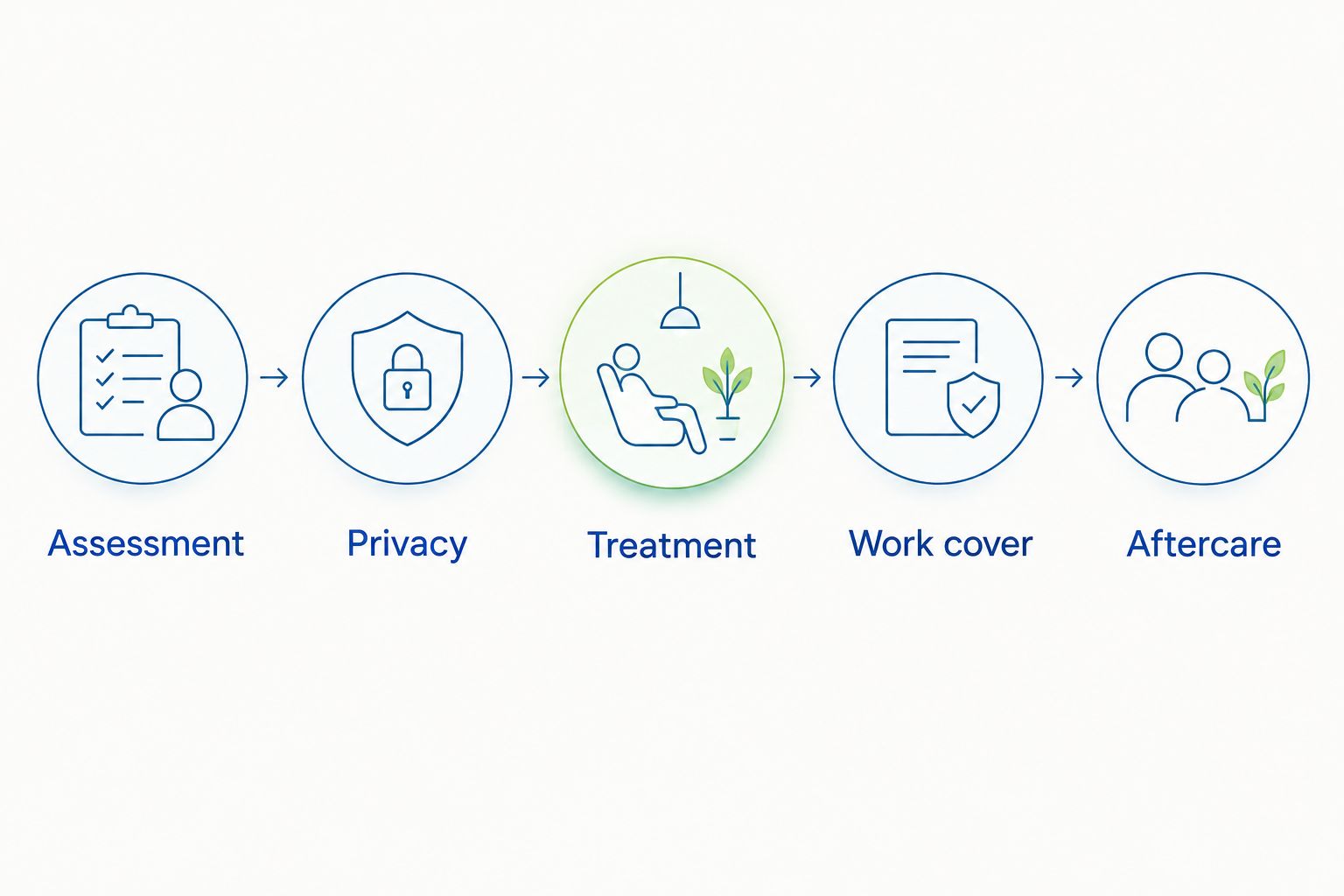
1. Arrange a clinical assessment before changing your use
Write down what you use, how often you use it, your prescribed medicines and what happens when you reduce or stop. Bring that information to a doctor or qualified addiction clinician. Include substances you use to sleep, stay awake or manage anxiety; the full picture matters.
Alcohol and benzodiazepine withdrawal can be dangerous. Do not attempt an unsupervised detox if you are dependent on either. Seizures, severe confusion, difficulty breathing, suspected overdose or immediate risk of self-harm require urgent medical attention, not a routine rehabilitation enquiry.
A clinical assessment also separates physical dependence, addiction and other health concerns. You do not need to choose the diagnosis yourself.
- Record your last use and any recent changes in consumption.
- List prescribed medicines, non-prescribed medicines and other substances.
- Describe previous withdrawal symptoms, overdoses or treatment episodes.
- Tell the clinician about sleep, mood, pain and thoughts of self-harm.
- Ask whether you need urgent care, supervised detox or a rehabilitation assessment.
2. Set clear privacy and communication boundaries
Before sharing sensitive information beyond your treating clinician, decide who needs to know and why. A trusted family member might help with admission arrangements; an employer might need information about absence and work restrictions. Those are different conversations.
For your 2026 treatment enquiries, prepare 3 questions about privacy: who can access your information, what requires your consent and what exceptions apply. Confidentiality is a professional obligation with legal and safety exceptions—not an absolute promise that nobody will ever receive information.
Public visibility also creates practical questions about photographs, social media and visitors. Ask for the provider’s current policy rather than assuming that private treatment means a particular arrangement.
- Request an explanation of confidentiality and its exceptions.
- Ask how the centre manages photographs, visitors and online posts.
- Identify who is authorised to receive clinical updates.
- Agree on a contact person for essential personal messages.
- Separate employer administration from detailed clinical disclosure.
3. Choose the level of care your assessment supports
Ask your assessing clinician to explain the recommended setting and why it fits your health, home environment and ability to attend treatment. Residential care provides separation from your usual surroundings. Outpatient care allows you to live at home, but it requires reliable attendance and an environment that supports recovery.
The Cedars is best for people seeking private residential addiction treatment with a 12-step approach. Its stated services include drug and alcohol detox, relapse prevention and family support programmes.
You can explore The Cedars as a residential treatment option. Before deciding, confirm the arrangements at the proposed facility, how your medical needs would be managed and whether its treatment approach suits you. Residential care also requires time away from home and ordinary work responsibilities.
- Ask the clinician to explain residential and outpatient suitability.
- Confirm how withdrawal assessment and medical care are arranged.
- Discuss whether a 12-step approach fits your preferences.
- Ask about support for co-occurring mental health concerns.
- Request an explanation of discharge planning and follow-up responsibilities.
4. Arrange work cover without turning treatment into a work trip
Start with a written handover rather than trying to remain available throughout treatment. List active assignments, immediate deadlines, access requirements and the person responsible for each task. A colleague should not need your medical history to understand the handover.
Prepare 2 documents: a work handover and a private treatment logistics sheet. Keep clinical details out of the handover. The logistics sheet can cover transport, dependants, emergency contacts and arrangements at home.
Freelancers should review commitments directly with clients or obtain appropriate contractual advice. Employees should check their workplace’s leave process and documentation requirements. Do not assume that every employer, contract or production schedule follows the same rules.
- Allocate each live assignment to a named replacement.
- Agree on how incoming calls, emails and booking requests will be handled.
- Clarify leave documentation with the appropriate workplace contact.
- Ask the treatment team about device access and work communication.
- Arrange care for children, relatives, pets or other responsibilities.
5. Discuss mental health and the situations behind your use
Tell your clinician what substance use does for you in the moment. Does it help you fall asleep after a late shift, tolerate social situations, suppress distress or keep working when exhausted? These details help shape treatment without excusing harm or assigning blame.
Discuss anxiety, low mood, trauma symptoms and sleep problems alongside substance use. A clinician should assess these concerns rather than assuming that they all have the same cause. Treatment decisions about medication belong with an appropriately qualified prescriber.
In your 2026 care plan, name the work situations that need attention. Specific examples are more useful than a general promise to manage stress better.
- Describe difficult assignments, shifts or social settings without minimising them.
- Explain the relationship between substance use and sleep.
- Report mental health symptoms even when you are unsure what they mean.
- Ask how relevant clinicians will coordinate your care.
- Identify coping skills you need to practise before returning to work.
6. Involve supportive people without surrendering your privacy
You can ask for practical help without asking someone to monitor every aspect of your life. Choose a person who can listen, help with arrangements and respond to warning signs without shaming you. Tell them what support you want and what information remains private.
Family support is part of The Cedars’ stated addiction treatment services. Ask how participation is arranged and how your consent is handled. Involvement should be discussed individually, particularly where relationships involve conflict, coercion or safety concerns.
For a loved one, useful support means encouraging assessment and following professional advice—not managing withdrawal at home or bargaining over substance use.
- Identify a trusted person for practical arrangements.
- Agree on what clinical information you consent to share.
- Ask whether family sessions suit your circumstances.
- Explain boundaries around money, work messages and visitors.
- Discuss a safety plan when a relationship does not feel safe.
7. Build aftercare before accepting your next assignment
Write a 1-page recovery plan with your treatment team before discharge. Include follow-up appointments, recovery support, warning signs and whom to contact if substance use resumes. Keep it somewhere accessible rather than treating it as admission paperwork you will never read again.
Your return-to-work plan for 2026 should address actual assignments: travel, late finishes, launches, social events and periods without regular work. Discuss changes with your clinician and the appropriate workplace contact. There is no single return date that suits every person or role.
A return to substance use calls for prompt reassessment, not concealment. If overdose or dangerous withdrawal is possible, seek urgent medical care.
- Book recommended follow-up appointments before leaving treatment.
- Identify support that you can access around changing work schedules.
- Rehearse a clear response to offers of alcohol or drugs.
- Plan transport and an exit from events that threaten your recovery.
- Record warning signs and the action you will take for each.
Take the next step towards treatment
Explore private addiction treatment and prepare questions about detox, residential care and family support.
Compare treatment options for your circumstances
Choose a setting for its clinical fit, not its ability to keep you working. The options below serve different purposes. Medical detox addresses withdrawal; rehabilitation addresses the broader pattern of substance use; peer support supports recovery but does not replace medical care.
| Option | Best for | Main benefit | Key limitation |
|---|---|---|---|
| Medically supervised detox | People whose withdrawal requires clinical supervision | Assessment and management of withdrawal risks | Detox alone does not address all ongoing recovery needs |
| Residential rehabilitation, including The Cedars | People assessed as needing residential care who want a 12-step-based option | Time away from usual surroundings with organised treatment | Requires time away from home and ordinary work commitments |
| Outpatient addiction treatment | People assessed as suitable to live at home during care | Treatment while remaining in the community | Requires reliable attendance and a supportive living situation |
| Peer recovery support | People seeking continuing connection alongside appropriate treatment | Shared experience and recovery-focused support | Does not provide medical detox or replace individual clinical assessment |
Ask providers to explain their current arrangements directly. A description of residential or outpatient treatment does not establish that a particular provider offers every service you need.
Common mistakes media professionals make
Treating continued performance as proof of safety
Publishing work, meeting deadlines or appearing composed does not establish that substance use is safe. Describe the private consequences to your clinician, including withdrawal, relationship strain and using more than intended.
Choosing treatment around unrestricted device access
Being reachable can feel essential when your work depends on bookings or breaking news. Discuss communication needs honestly, but do not make constant work access the deciding criterion when it conflicts with treatment.
Confusing confidentiality with isolation
You do not owe colleagues a public account of your recovery. You still need a safe route to clinical help and appropriate support; secrecy that prevents either is different from protecting your privacy.
Returning to the same assignments without a recovery plan
An unchanged diary can bring back the situations discussed in treatment. Review late shifts, travel and event commitments with your care team rather than relying only on determination.
FAQ
What is addiction treatment for media professionals?
Addiction treatment for media professionals is clinical care for substance use or addictive behaviours that also addresses relevant work circumstances. Assessment guides decisions about detox, residential or outpatient care, mental health support and aftercare.
Can I get help without telling everyone at work?
You can seek a clinical assessment without making a public announcement. Ask the clinician about confidentiality and discuss any necessary leave documentation separately with the appropriate workplace contact.
Can I keep working while receiving addiction treatment?
Whether you can keep working depends on your clinical needs and the treatment setting. Ask your clinician to assess safety and discuss work communication rules with the provider before committing to a programme.
Do I need medical detox before rehab?
A qualified clinician must assess whether you need medical detox. Alcohol and benzodiazepine withdrawal can be dangerous, so do not abruptly stop dependent use without medical advice.
Is The Cedars suitable for someone working in media?
The Cedars is an option for someone seeking private residential addiction treatment with a 12-step approach, detox, relapse prevention and family support. Confirm that the proposed facility can meet your individual clinical needs and discuss privacy and work arrangements before admission.
Should I wait until a production or major assignment ends?
Do not postpone an assessment because an assignment is unfinished. A clinician can determine urgency; suspected overdose, seizures, severe confusion or immediate self-harm risk require urgent medical attention.
How do I protect recovery when I return to media work?
Protect recovery with a written aftercare plan that addresses your actual assignments and work settings. Arrange follow-up care, identify warning signs and decide how you will respond to difficult events, shifts or travel.
One last thing
Before you accept your first assignment after treatment, rehearse the least comfortable conversation: declining a drink, refusing an overnight shift or asking to leave an event. Write the words down and practise them with someone you trust. A boundary you have rehearsed is easier to use than one you must invent under pressure.
Related guides
- How to talk to your employer about taking leave for rehab
- How to choose between inpatient and outpatient rehab
- How to support your recovery after leaving rehab