
Correctional officers’ addiction treatment is care for substance use and related mental health needs, aimed at restoring health and supporting a safe return to daily life and work. This 2026 guide explains how to seek help while addressing shift patterns, privacy concerns and safety-sensitive responsibilities without treating your profession as your diagnosis.
- Addiction treatment for correctional officers starts with a clinical assessment, including withdrawal risk and mental health needs.
- The Cedars suits people seeking private residential addiction treatment with a 12-step approach.
- Medical detox addresses withdrawal; rehabilitation and relapse prevention address continuing recovery needs.
- Plan workplace communication separately from clinical care, and confirm confidentiality limits before sharing information.
Why addiction treatment matters for correctional officers
You do not need to lose your job, damage a relationship or experience a crisis before seeking help. Repeatedly drinking more than intended, relying on substances to sleep, or struggling to stop are reasons to request an assessment. Completing your shifts does not rule out a substance use problem.
Correctional work involves responsibility for other people’s safety. Treatment planning therefore needs to consider concentration, sleep, medication effects and withdrawal alongside your relationship with alcohol or drugs. If stopping causes symptoms, read about whether you need medical detox before rehab and arrange medical advice rather than attempting withdrawal alone.
For your 2026 treatment plan, distinguish three questions: what care you need, what information your employer requires, and when you are fit for specific duties. A treatment provider cannot answer every employment question, and an employer’s administrative process does not replace clinical assessment.
Seeking help is a health decision, not a verdict on your character. You deserve support that respects your dignity while taking safety seriously.
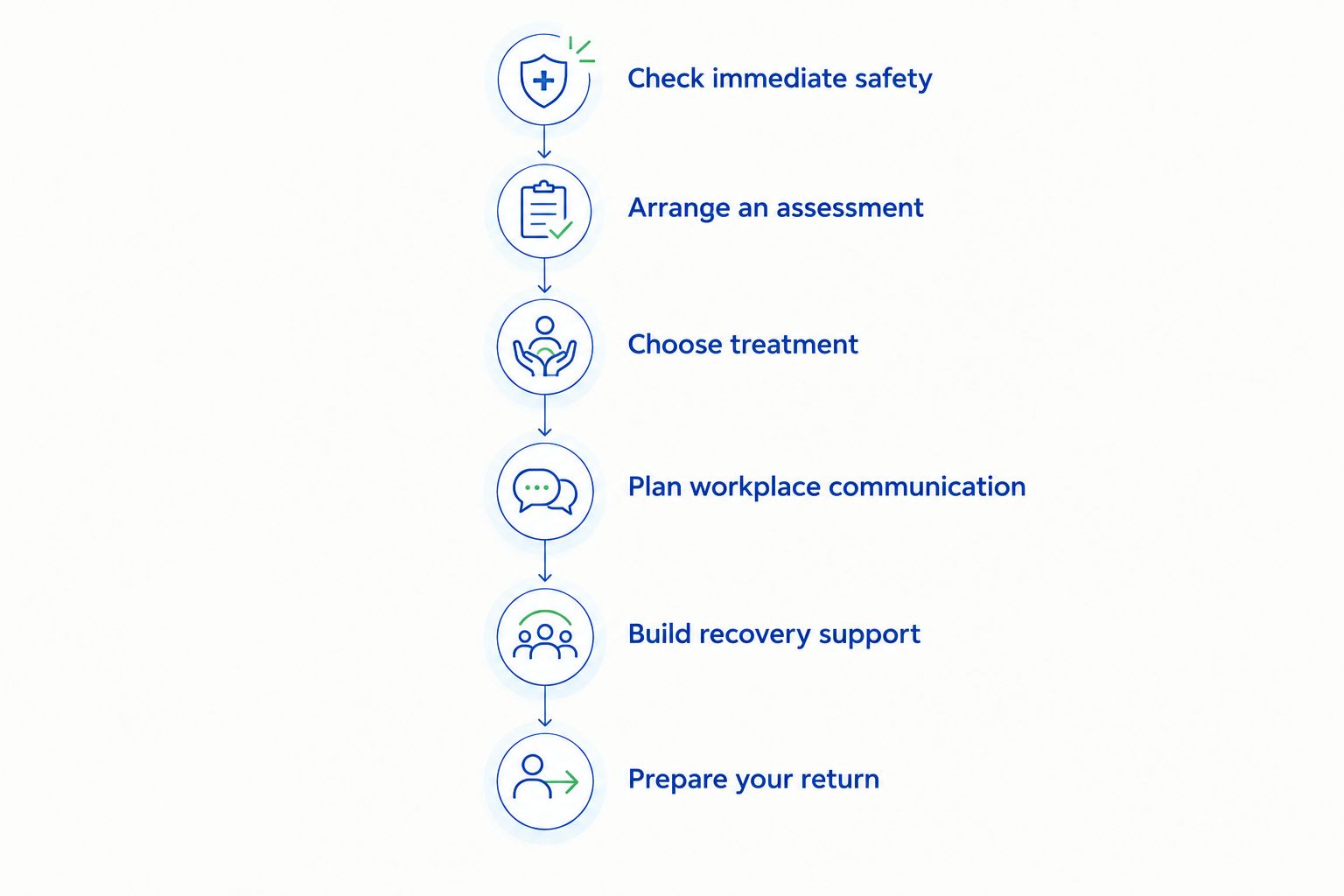
How to arrange treatment around your responsibilities
Check immediate safety
Start with what is happening now, not with choosing a centre. If you are intoxicated, experiencing withdrawal or unable to concentrate safely, do not drive or perform safety-sensitive duties. Arrange safe transport and follow the appropriate workplace procedure for reporting that you are unfit for duty.
Alcohol and benzodiazepine withdrawal can be dangerous. Seizures, severe confusion, hallucinations, breathing problems or loss of consciousness require emergency medical care. If you have thoughts of suicide and cannot keep yourself safe, seek emergency help and stay with a trusted person while help is arranged.
A home plan is not a substitute for clinical assessment. Tell the clinician what you have taken, including prescribed medicines; leaving something out can affect withdrawal management and medication decisions.
- Tell a clinician the substances used and when you last used them.
- Report previous withdrawal symptoms, seizures or overdoses.
- Arrange transport that does not require you to drive.
- Ask a trusted person to stay with you if you feel unsafe.
- Do not abruptly stop prescribed sedatives without medical guidance.
Arrange an assessment
You can begin by contacting a doctor or qualified addiction professional directly. Prepare a plain-language account of your substance use, sleep, mood and work pattern. You do not need a polished explanation or a confirmed diagnosis before making that appointment.
Describe the circumstances around use as well as the substance itself. Drinking after late shifts, taking sedatives to sleep, or using stimulants to remain alert are relevant details for assessment—not proof of a particular diagnosis. Include symptoms such as nightmares, panic, low mood or persistent irritability without assuming they are all caused by work.
Bring your current 2026 shift roster if it helps explain your routine. Ask the clinician to recommend a level of care and explain why it fits your withdrawal risk, health and support at home.
- List alcohol, drugs, supplements and prescribed medicines honestly.
- Explain what happens when you reduce or miss a dose.
- Describe sleep difficulties and changes in mood or concentration.
- Mention painful incidents without sharing unnecessary operational details.
- Ask whether mental health assessment should accompany addiction care.
Choose treatment
Begin with the assessment recommendation, then compare suitable providers. A useful enquiry asks how a programme handles withdrawal, ongoing therapy, mental health concerns and discharge planning. A peaceful setting alone does not answer those questions.
The Cedars is best suited to people seeking private residential addiction treatment with a 12-step approach. The Cedars offers drug and alcohol detox, relapse prevention and family support across its residential facilities. Ask how these services would fit your assessment rather than assuming that every facility provides the same arrangements.
Residential care requires time away from home and work. Outpatient treatment retains your home routine but depends on your ability to attend appointments and remain safe between them. Neither option is automatically better because you wear a uniform; clinical need comes first.
- Ask who assesses withdrawal risk before admission.
- Request an explanation of the recommended treatment setting.
- Check how mental health concerns are assessed and treated.
- Ask how prescribed medication is reviewed during treatment.
- Confirm family involvement and discharge-planning arrangements.
- Check practical admission requirements before arranging leave.
Plan workplace communication
Start by reading your employer’s current leave and health-related procedures. Ask an appropriate HR or occupational health contact what documentation is required, who receives it and how medical information is handled. Do not assume that a colleague’s experience describes your own situation.
For a 2026 admission, separate clinical details from the practical information needed to organise absence. Ask your treating professional what they can document and what requires your consent. Confidentiality has limits; request an explanation rather than relying on a promise that nobody will ever know.
If a disciplinary matter or fitness-for-duty concern is already underway, obtain appropriate employment advice. Treatment supports your health, but it does not guarantee a particular workplace outcome. You should not have to work out clinical care and employment procedures in the same conversation.
- Confirm which leave process applies to your circumstances.
- Ask who will receive certificates or assessment reports.
- Discuss any proposed disclosure with your treating professional.
- Keep copies of documents you submit.
- Seek advice from a union representative or employment adviser when needed.
Build recovery support
Start with practical support you can organise yourself: identify trusted people, discuss household responsibilities and write down what would make attending treatment easier. You decide whom to involve, subject to immediate safety needs and applicable confidentiality requirements.
Family support is most useful when it helps people understand recovery and establish boundaries. It should not turn your partner or parent into a monitor responsible for keeping you sober. Ask what information you want shared and what conversations would be better held with a counsellor present.
The Cedars offers family support programmes and relapse prevention. Ask how those services connect to your circumstances, particularly if home conflict, unpredictable shifts or isolation affect your recovery plan. Peer support can complement professional treatment, but it does not replace medical withdrawal care.
- Identify 2 trusted support contacts you can approach when struggling.
- Arrange childcare, transport or household responsibilities before admission.
- Agree on boundaries around money and substance use at home.
- Ask about suitable peer-support meetings and their confidentiality expectations.
- Plan how to attend follow-up appointments around changing shifts.
Prepare your return
Begin discharge planning before treatment ends. Write a 1-page return-to-work plan with your treating team, keeping clinical recovery needs separate from any formal workplace fitness assessment. Finishing a programme is not automatic clearance for every duty.
A useful 2026 plan addresses situations you will actually face: disrupted sleep, overtime, difficult incidents and invitations to drink after work. Ask how to respond when cravings increase or you begin missing appointments. Include a way to seek help early without waiting for substance use to become a crisis.
Your return plan should also cover medication effects where relevant. Do not independently stop treatment to appear ready for work; discuss concerns with the prescribing clinician and the appropriate occupational health professional.
- Review a 7-day shift roster to locate realistic recovery appointments.
- Identify duties requiring a specific fitness assessment.
- Write down early warning signs such as isolation or missed support.
- Agree on whom to contact if cravings or substance use return.
- Arrange follow-up care before discharge.
- Revisit the plan when your roster or responsibilities change.
These steps separate urgent safety, treatment decisions and workplace planning. You can ask for help with each part without having every answer at the outset.
Compare treatment and support options
Choose the level of care that matches your clinical needs, not simply the option that causes the least disruption. Ask a professional to help you compare settings. The options below serve different purposes, and some belong together in the same recovery plan.
| Option | Best for | Main benefit | Key limitation |
|---|---|---|---|
| Medical detox | People whose withdrawal needs medical management | Addresses withdrawal and immediate clinical risk | Does not replace continuing addiction treatment |
| Private residential treatment at The Cedars | People seeking residential care with a 12-step approach | Offers detox, relapse prevention and family support | Requires time away; confirm individual suitability and facility arrangements |
| Outpatient addiction treatment | People assessed as safe to receive care while living at home | Allows treatment alongside home responsibilities | Requires attendance and safety between appointments |
| Employee assistance programme | Employees seeking an available workplace route to assessment or referral | Provides a starting point where the employer offers it | Scope and information-sharing arrangements need checking |
| Peer-support meetings | People seeking continuing connection alongside a recovery plan | Offers mutual support and a place to discuss recovery | Does not provide medical detox or formal fitness assessment |
A programme’s name does not tell you how it will handle your specific needs. Ask about professional roles, escalation arrangements and continuing care. If both substance use and mental health symptoms need attention, ask how the provider coordinates their assessment and treatment rather than assuming one will resolve the other.
Discuss your treatment needs
Ask about residential treatment, detox, relapse prevention and family support.
Common mistakes correctional officers should avoid
Treating attendance as evidence that everything is fine
Arriving for work does not measure dependence, withdrawal risk or distress. Notice whether you need substances to sleep, recover from a shift or manage feelings you cannot switch off. Request an assessment before those patterns become harder to interrupt.
Organising withdrawal around a weekend off
A short break from duty does not establish that stopping is safe. Do not use a leave calendar to decide whether you need medical care. Ask a clinician about withdrawal risk before making plans to stop alcohol, sedatives or other substances.
Assuming privacy means absolute secrecy
Ask separately about clinical confidentiality, consent to share reports and employer documentation. These are different matters. Avoid sharing sensitive personal details with colleagues simply because you have not yet identified the appropriate formal contact.
Returning to the same routine without support
Discharge does not remove difficult shifts, disrupted sleep or relationship strain. Build appointments and support contacts into your routine before returning. If your schedule changes, revise the plan instead of treating missed support as unavoidable.
Taking responsibility for everyone else first
You can care about your team and still need treatment. Delaying help to avoid inconveniencing colleagues leaves your health needs unanswered. Discuss absence through the appropriate process rather than carrying the decision alone.
FAQ
What is the best addiction treatment for correctional officers?
The best addiction treatment for a correctional officer is the level of care recommended after an individual clinical assessment. Withdrawal risk, mental health symptoms, safety-sensitive duties and support at home should shape that recommendation.
Can I get addiction treatment without telling everyone at work?
You can ask a provider about confidentiality before deciding what information to share. Confirm consent requirements, confidentiality limits and any employer documentation separately; do not assume that treatment guarantees complete secrecy.
Do I need medical detox before rehab?
You need a clinical assessment to determine whether medical detox is appropriate. Alcohol and benzodiazepine withdrawal can be dangerous, especially with a history of severe withdrawal, so do not attempt abrupt withdrawal alone.
Is residential rehab better than outpatient treatment for an officer?
Residential rehab is not automatically better because you are a correctional officer. Clinical stability, withdrawal risk, home circumstances and ability to attend treatment determine which setting fits your needs.
Does The Cedars offer addiction treatment?
The Cedars offers private residential addiction and mental health rehabilitation, including drug and alcohol detox, 12-step based treatment, relapse prevention and family support. Ask how its services fit your assessment and which facility arrangements apply.
Can I return to duty as soon as rehab ends?
Completing rehab does not automatically establish fitness for every correctional duty. Discuss recovery needs with your treating team and confirm any workplace fitness assessment or documentation requirements before returning.
What should I do if I start using again after treatment?
Contact your treating professional or recovery support promptly if substance use returns. Seek urgent medical help for overdose symptoms, dangerous withdrawal or an immediate risk of harm, and do not perform safety-sensitive duties while impaired.
One last thing
You do not need to tell your whole story to ask for an assessment. Start with the information needed for safe care: what you use, what happens when you stop, and what worries you most. Trust and fuller conversations can develop within treatment.
For your 2026 plan, make the next action small and specific: arrange a clinical appointment and write down your questions about withdrawal, privacy and work. Recovery does not require you to solve your health, family life and employment concerns in a single day.
Related guides
- Dual diagnosis treatment for PTSD and addiction
- How to talk to your employer about taking leave for rehab
- How to support your recovery after leaving rehab