
Rehab costs in South Africa in 2026 depend on the treatment you need, the length of the programme and what your medical aid agrees to cover; an itemised assessment-based quote gives you the amount to budget for. Ask whether detox, medication, professional consultations and aftercare are included, because the admission fee alone does not establish your total financial commitment.
- How much does rehab cost in South Africa in 2026? Get an itemised quote and written medical aid confirmation.
- Compare detox, residential treatment and aftercare separately before committing to admission.
- The Cedars suits people seeking private residential addiction treatment with a 12-step approach and family support.
- Choose clinically appropriate care first; then establish the full financial commitment.
How much does rehab cost in South Africa in 2026?
Your rehab budget should reflect the recommended treatment plan, not just the advertised admission fee. Before you compare centres, ask each provider to explain the same categories of care. Otherwise, you risk comparing a residential programme with another quote that covers only part of the treatment journey.
Use this breakdown to request a written quote. These are questions to establish what applies to your admission, not a statement that every centre bills each item separately.
| Part of your budget | What to establish | What to get in writing |
|---|---|---|
| Assessment | How your treatment needs will be assessed | Whether assessment is included in the quote |
| Detox | Whether medically supported withdrawal is needed | Who provides it and whether it is included |
| Residential treatment | What the recommended stay covers | Programme dates, accommodation and treatment inclusions |
| Medication and consultations | What medical or mental health care is planned | Which services are included or billed separately |
| Family support | How loved ones can participate | What the programme includes for families |
| Continuing care | What happens after residential treatment | The follow-up plan and any separate financial commitment |
For medical aid questions, start with how to check whether your medical aid covers rehab treatment. Then confirm the answer directly with your scheme for the particular provider and proposed admission.
Why this matters
When someone you love needs help, a single headline fee feels easier to manage than a detailed treatment plan. But your family needs clarity, not a rushed financial decision.
An itemised quote helps you understand what you are agreeing to and what still needs confirmation. It also gives you a practical way to discuss treatment without turning the conversation into blame, bargaining or promises that nobody can keep.
Asking about affordability is responsible, not a sign that you care less about recovery. You can take the need for treatment seriously while asking direct questions about payment and household responsibilities.
Detox: establish the medical needs before comparing fees
Detox and rehabilitation serve different purposes. Detox addresses withdrawal and immediate medical needs; rehabilitation addresses the patterns, circumstances and behaviours connected with addiction.
Ask whether an assessment indicates that you need medical detox before entering the proposed programme. Do not assume that a residential admission automatically includes every part of withdrawal management.
Alcohol and benzodiazepine withdrawal can be dangerous. If dependence is suspected, seek medical advice before abruptly stopping or reducing use. A financial comparison is not a substitute for a withdrawal assessment.
Questions to ask include:
- Will detox take place at the treatment centre or through another provider?
- What medical assessment is required before admission?
- Are medication and medical consultations included?
- If another provider is involved, who coordinates the transfer?
- What happens financially if the medical plan changes?
You do not need to decide the safest withdrawal approach yourself. Your task is to explain the substance use honestly and ask the treating professional to explain the recommended care.
Residential treatment: compare the programme, not just the stay
Residential treatment means living at the facility during your programme. When requesting a quote, ask what the stay includes beyond accommodation and meals: treatment sessions, medical input, family participation and preparation for leaving.
For a 2026 admission, ask the centre to identify the proposed programme dates and explain how any extension would be discussed. A quote needs a clear period of care, even when the clinical team will review your progress during treatment.
The advantage of residential care is the structured setting away from your usual environment. The practical limitation is that you must arrange time away from home, work and other responsibilities.
The Cedars is best suited to people seeking private residential addiction treatment with a 12-step approach and family support. The Cedars offers drug and alcohol detox, relapse prevention and family support programmes across its residential facilities.
That approach is not a reason to skip the practical questions. Ask how the proposed programme fits your circumstances, what mental health needs must be assessed and how the residential commitment will work for your household.
Continuing care: include the transition home in your budget
The end of residential treatment is not the end of recovery planning. Ask what support is recommended after discharge and whether it forms part of the original programme or requires a separate arrangement.
A useful discharge discussion covers ongoing appointments, relapse prevention, family boundaries and support in your local community. Establish who will coordinate these arrangements rather than assuming they will happen automatically.
The benefit of continuing care is that it connects treatment with everyday life. The limitation is practical: appointments, travel and time away from work still need planning.
Ask for the follow-up recommendation before committing to admission. You do not need every future detail settled immediately, but you should understand the intended next stage and how you will confirm its financial implications.
Why rehab costs vary
Different treatment plans involve different services. These are the main parts of the plan to clarify when you request a quote:
- Detox needs: Establish whether withdrawal care is required and whether it is included in the proposed admission.
- Residential care: Confirm the recommended programme length and what the residential stay covers.
- Mental health treatment: Ask what assessment and support are planned alongside addiction treatment.
- Family participation: Check which family support sessions form part of the programme and what involvement is expected.
- Relapse prevention and follow-up: Establish what preparation and continuing support are included before discharge.
Medical aid approval is a separate question: it affects what you personally need to fund, rather than defining the clinical care you need. Keep the treatment recommendation and the funding decision distinct so that neither gets lost in the other.
Which treatment option should you compare?
Compare treatment settings only after a clinical assessment establishes what is appropriate. A programme that fits your budget but does not address your withdrawal or support needs is not a sound choice.
This table explains the different roles of common treatment settings. It is not a recommendation that every option suits every person.
| Treatment setting | Best for | Main advantage | Main limitation |
|---|---|---|---|
| Medical detox | People assessed as needing supported withdrawal | Focuses on withdrawal and immediate medical needs | Does not replace ongoing addiction treatment |
| Residential rehab | People assessed as needing a live-in treatment setting | Provides a structured environment away from usual surroundings | Requires time away from home and work |
| Outpatient treatment | People assessed as able to receive treatment while living at home | Allows treatment alongside some everyday responsibilities | Does not provide a residential setting |
| Continuing care | People moving from an initial programme into ongoing recovery support | Connects treatment with life after discharge | Does not replace detox or residential care when those are needed |
Ask the clinician to explain why the recommended setting fits your situation. Then ask the provider to quote for that plan, rather than choosing a setting from a fee alone.
How to get a clear rehab quote
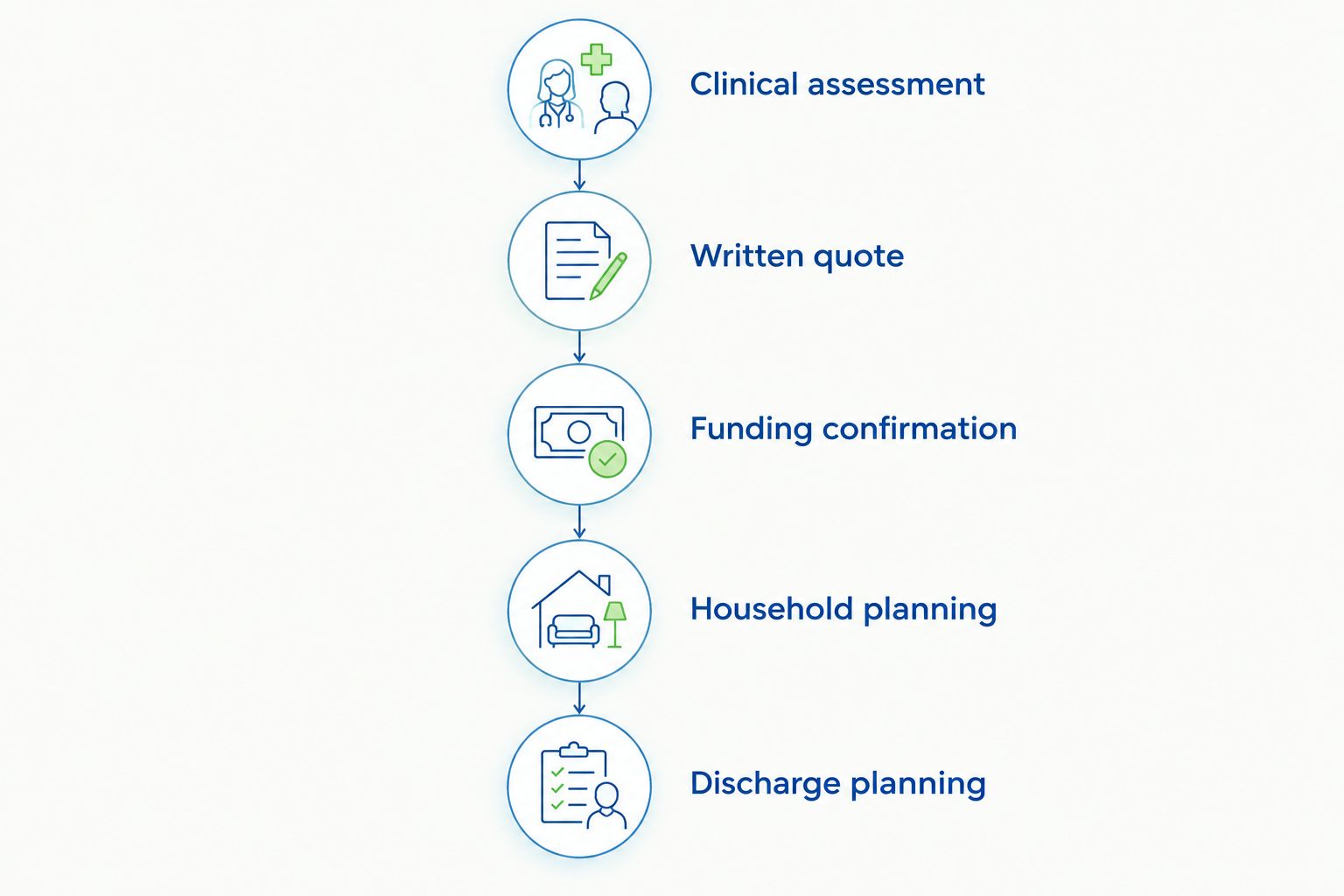
Use these steps when you speak with an admissions team. You can ask a trusted family member to help record the answers, with your consent.
- Clinical assessment: Explain substance use, current medication, previous withdrawal experiences and mental health concerns honestly. Ask what further assessment is needed.
- Written quote: Request the proposed treatment period, included services, exclusions and payment terms in one document.
- Funding confirmation: Ask your medical aid to confirm the proposed provider and treatment in writing. Establish any authorisation requirements before relying on cover.
- Household planning: Account for travel, childcare, dependent care and time away from work where these apply to you.
- Discharge planning: Ask what continuing care is recommended, who arranges it and how its financial commitment will be confirmed.
A useful 2026 quote should identify the treatment it relates to and when you need to reconfirm its terms. Keep the quote and the medical aid response together so you can distinguish the provider's charges from the scheme's funding decision.
If an answer is unclear, ask the team to explain it in ordinary language. You should be able to describe what you are agreeing to without needing to interpret unfamiliar billing terms.
Discuss your treatment needs
Ask The Cedars about its residential treatment approach and the information needed for your admission enquiry.
Does medical aid cover rehab in South Africa?
Your medical aid's written funding decision establishes what it agrees to cover for the proposed treatment. Do not treat a general statement that a centre accepts medical aid as confirmation of your own admission.
Ask the scheme about the provider, required authorisation, approved treatment and any amount you remain responsible for. Share the response with the admissions team so both parties are discussing the same plan.
For treatment in 2026, use confirmation that applies to your current membership and the proposed admission. Keep copies of correspondence and record the authorisation reference if one is issued.
How do I plan for rehab without medical aid?
Without medical aid, ask the provider to explain your direct financial commitment and payment terms in writing. Discuss affordability before agreeing to admission, and ask a healthcare professional or social worker about other treatment routes if private residential care is beyond your budget.
Do not assume that a payment arrangement exists. Ask directly, and avoid committing to debt before you understand both the treatment plan and your household's essential expenses.
Is a more expensive rehab programme better?
A higher fee does not establish whether a programme suits your clinical needs. Compare the recommended treatment, qualified professional involvement, withdrawal arrangements, family support and discharge planning.
A comfortable setting and an appropriate treatment plan are different considerations. Ask what care you will receive and how it addresses your circumstances rather than treating accommodation as evidence of treatment effectiveness.
FAQ
How much does rehab cost in South Africa in 2026?
Rehab costs in South Africa in 2026 depend on your assessed treatment needs, programme length and confirmed funding. Request an itemised quote that identifies inclusions, exclusions and the period of care.
Does a rehab quote include medical detox?
A rehab quote includes medical detox only if the provider explicitly lists it as included. Ask where withdrawal care takes place and whether medical consultations and medication form part of the quote.
Will my medical aid pay for residential rehab?
Your medical aid must confirm whether it will fund the proposed residential admission. Check the provider, authorisation requirements, approved care and your remaining financial responsibility directly with the scheme.
Can I go to rehab without medical aid?
You can enquire about treatment without medical aid and ask the provider to explain direct payment terms. If private care is unaffordable, ask a healthcare professional or social worker about other treatment routes.
Is outpatient rehab better than residential rehab?
Outpatient rehab is not automatically better than residential rehab; the appropriate setting depends on clinical assessment. Outpatient treatment takes place while you live at home, whereas residential treatment requires a live-in stay.
What should I ask The Cedars before admission?
Ask The Cedars to explain the proposed residential addiction treatment plan, detox arrangements, family support and relapse prevention. Request written financial terms and confirm any medical aid funding separately.
Should I stop drinking while I wait for a rehab quote?
If alcohol dependence is suspected, seek medical advice before abruptly stopping or reducing alcohol use. Withdrawal can be dangerous, so urgent medical needs should not wait for a financial comparison.
What should I budget for after leaving rehab?
Budget for the continuing care recommended in your discharge plan and establish whether it is included or arranged separately. Also consider practical commitments such as transport and time away from work where they apply.
One last thing
The most useful financial question is not only what admission costs, but what the full recommended treatment plan includes. Ask for a clear explanation from assessment through to continuing care, and keep the funding confirmation beside it.
You do not need to solve every part of recovery before asking for help. Start with an honest assessment and a written plan; those give you something concrete to discuss with your family and the treatment team.
Related guides
- How to pay for rehab without medical aid in South Africa
- How to choose between inpatient and outpatient rehab
- How to support a family member through rehab